Showing posts with label John Roberts. Show all posts

Thursday, May 26, 2011

Supreme Court upholds Arizona law that requires employers to check the immigration status of job applicants.

Announced, just now, on the SCOTUSblog live-blog of the Court. Here's how SCOTUSblog described the issue in the case, which is called Chamber of Commerce v. Whiting:
Whether an Arizona statute that imposes sanctions on employers who hire unauthorized aliens is invalid under a federal statute that expressly “preempt[s] any State or local law imposing civil or criminal sanctions (other than through licensing and similar laws) upon those who employ, or recruit or refer for a fee for employment, unauthorized aliens”; whether the Arizona statute, which requires all employers to participate in a federal electronic employment verification system, is preempted by a federal law that specifically makes that system voluntary; whether the Arizona statute is impliedly preempted because it undermines the “comprehensive scheme” that Congress created to regulate the employment of aliens.
According to the live-blog, the decision was 5-3 (with Kagan recused). Breyer, Ginsburg, and Sotomayor are the dissenters.
The Chief Justice's opinion explains that the licensing provision falls squarely within a savings clause in federal immigration law and that the Arizona statute does not otherwise conflict with federal law.
Here's the PDF of the opinion.

Sunday, May 22, 2011

"What the academy is doing, as far as I can tell... is largely of no use or interest to people who actually practice law."

Said Chief Justice John Roberts, in a quote that sprang to mind when I read this from Gordon Smith (via Instapundit):
[Some old lawprof once said:] "To become a great law professor, one must write a casebook, a treatise, and a Restatement ... Seavey never wrote a treatise."

... It is impossible to imagine anyone giving Scott's advice to a young professor today. The sort of doctrinal synthesis that lies at the heart of casebooks, treatises, and Restatements is not highly valued among today's law professors, even though it has real-world value.

What is the measure of a great law professor today? The highest achievement of a law professor today is creating a new concept or theory that is used widely by other academics in the field....
Lawprofs injecting other lawprofs with theories. It sounds unsanitary, but it's a closed system, so what could go wrong? It's not as if a law professor is going to break out and grasp massive power in the actual real world. Imagine a lawprof as President! It's absurd!

Aw, come on. Seriously. Barack Obama wasn't a law professor law professor. Did he ever try to create a new concept or theory for other lawprofs to use in the sickly circulatory system of academia? Absolutely not. He was always organizing and operating in the political world.

Wednesday, March 2, 2011

The Westboro Baptist Church wins in the Supreme Court in the case about protesting at a soldier's funeral.

"The First Amendment shields Westboro from tort liability for its picketing in this case."

Chief Justice Roberts writes the opinion, with only Justice Alito dissenting. Justice Breyer has a concurring opinion. From the Roberts opinion:
The picketing was conducted under police supervision some 1,000 feet from the church, out of the sight of those at the church. The protest was not unruly; there was no shouting, profanity, or violence....

Given that Westboro’s speech was at a public place on a matter of public concern, that speech is entitled to “special protection” under the First Amendment. Such speech cannot be restricted simply because it is upsetting or arouses contempt. “If there is a bedrock principle underly- ing the First Amendment, it is that the government may not prohibit the expression of an idea simply because society finds the idea itself offensive or disagreeable.” Texas v. Johnson, 491 U. S. 397, 414 (1989). Indeed, “the point of all speech protection . . . is to shield just those choices of content that in someone’s eyes are misguided, or even hurtful.” Hurley v. Irish-American Gay, Lesbian and Bisexual Group of Boston, Inc., 515 U. S. 557, 574 (1995)....

Speech is powerful. It can stir people to action, move them to tears of both joy and sorrow, and—as it did here— inflict great pain. On the facts before us, we cannot react to that pain by punishing the speaker. As a Nation we have chosen a different course—to protect even hurtful speech on public issues to ensure that we do not stifle public debate. That choice requires that we shield West- boro from tort liability for its picketing in this case.
Clearly, this is the right outcome.

AND: Alito, the lone dissenter, stresses the value of the tort called "intentional infliction of emotional distress":
Respondents’ outrageous conduct caused petitioner great injury, and the Court now compounds that injury by depriving petitioner of a judgment that acknowledges the wrong he suffered.

In order to have a society in which public issues can be openly and vigorously debated, it is not necessary to allow the brutalization of innocent victims like petitioner.
Breyer's short concurrence makes the point that the decision is limited to in-person picketing about matters of "public concern." In adding that the Court "does not examine in depth the effect of television broadcasting" and "internet postings," I get the sense that he's looking ahead to cases about bullying. 

Tuesday, March 1, 2011

Chief Justice Roberts teaches a language lesson: "The noun 'crab' refers variously to a crustacean and a type of apple, while the related adjective 'crabbed' can refer to handwriting that is 'difficult to read'..."

"... 'corny' can mean 'using familiar and stereotyped formulas believed to appeal to the unsophisticated,' which has little to do with 'corn,' ('the seeds of any of the cereal grasses used for food'); and while 'crank' is “a part of an axis bent at right angles,' 'cranky' can mean 'given to fretful fussiness."

And the point is, a corporation may be a "person" within the meaning of the Freedom of Information statute, but that doesn't mean it's gets in on the "personal" privacy referred to elsewhere in the statute.
[I]n ordinary usage, a noun and its adjective form may have meanings as disparate as any two unrelated words. ...

"Person" is a defined term in the statute; “personal” is not. When a statute does not define a term, we typically “give the phrase its ordinary meaning.”... “Personal” ordinarily refers to individuals. We do not usually speak of personal characteristics, personal effects, personal correspondence, personal influence, or personal tragedy as referring to corporations or other artificial entities. This is not to say that corporations do not have correspondence, influence, or tragedies of their own, only that we do not use the word “personal” to describe them.

Certainly, if the chief executive officer of a corporation approached the chief financial officer and said, "I have something personal to tell you," we would not assume the CEO was about to discuss company business. Responding to a request for information, an individual might say, "that’s personal." A company spokesman, when asked for information about the company, would not.
Crisply explained!

IN THE COMMENTS: rhhardin said:
While he's got the FCC's attention, mention that the "fucking" in "fucking brilliant" is not an adjective.
Ha! He's referring to this FCC opinion:
The complainants allege that the licensees named in their respective complaints aired the “Golden Globe Awards” program, during which the performer Bono uttered the phrase “this is really, really, fucking brilliant,” or “this is fucking great.”...

The word “fucking” may be crude and offensive, but, in the context presented here, did not describe sexual or excretory organs or activities. Rather, the performer used the word “fucking” as an adjective or expletive to emphasize an exclamation. Indeed, in similar circumstances, we have found that offensive language used as an insult rather than as a description of sexual or excretory activity or organs is not within the scope of the Commission’s prohibition of indecent program content.
"Fucking" can be an adjective, as in "You're a fucking crank," "Watch out for the fucking crab," or "I can't believe you're serving fucking corn again," but in the Bono boast, it's a fucking adverb.

Tuesday, February 22, 2011

A professor is forced to resign after making a racist remark: Is he more likely right-wing or left-wing?

"A political science professor at Murray State University has resigned after telling an African American student that she didn't show up early to class because slaves were always late."

I see that the first commenter there says: "Another asshole, undoubtedly a Republican/TeaPartier."

My guess is exactly the opposite. What would possess a professor to say something like that? From my long experience with  professors, I think it is the left-wing professors who: 1. Feel confident in their own goodness on racial issues, 2. Analyze events in terms of race, 3. Think up "critical theory"-type explanations that explore ideas about racial difference, 4. Imagine that it's clever to express these ideas out loud, and 5. Are capable of making the mistake of thinking that the students will know that they are good people who do racial critique that is supposed to be understood as an attack on white people.

A "Republican/TeaPartier" is much more likely to be strongly committed to color-blindness. Ironically, that's something that, in academic circles, can quite easily get you called a racist. (Try asking a lefty lawprof about Chief Justice Roberts's statement that "The way to stop discrimination on the basis of race is to stop discriminating on the basis of race.")

Anyway, the professor in this incident is named Mark Wattier. The school is Murray State University. I haven't checked into what his actual political propensities are or what he really had in mind when he said whatever he said that is being reported the way you see it in the linked article. My motivation to write this post was the commenter's reflexive assumption that Wattier displayed right-wing ideology. That is absurd.

***

I noticed that story because John McWhorter and Glenn Loury are talking about it on Bloggingheads. Their discussion centers on whether the student is "lowering" herself by requesting an apology.

Tuesday, February 8, 2011

Professor Tribe would like you to know how nonpartisan the Supreme Court Justices are ... I mean, will be, when they decide the individual mandate question the way he would like.

The NYT has an op-ed by lawprof Larry Tribe that purports to demonstrate how obvious it supposedly is that the Supreme Court will find the health care law constitutional.
The justices aren’t likely to be misled by the reasoning that prompted two of the four federal courts that have ruled on this legislation to invalidate it on the theory that Congress is entitled to regulate only economic “activity,” not “inactivity,” like the decision not to purchase insurance. This distinction is illusory. Individuals who don’t purchase insurance they can afford have made a choice to take a free ride on the health care system. They know that if they need emergency-room care that they can’t pay for, the public will pick up the tab. This conscious choice carries serious economic consequences for the national health care market, which makes it a proper subject for federal regulation.
Of course, the argument Tribe likes was presented, considered, and rejected in the 2 federal court cases. It's a perfectly comprehensible argument, but that doesn't make its success in the Supreme Court a sure thing. Acting as if it does, Tribe says "it’s distressing that many assume its fate will be decided by a partisan, closely divided Supreme Court." Oh, you terrible people who fail to bow to the obviousness of one side of a constitutional argument! You compound your sins by falling prey to the upsetting belief that the Supreme Court Justices are politically partisan!
To imagine Justice Scalia would abandon that fundamental understanding of the Constitution’s necessary and proper clause because he was appointed by a Republican president is to insult both his intellect and his integrity.
That's not sarcasm. Read the whole thing. You'll see, it's not intentional sarcasm. It might be an attempt to sweet-talk Scalia into using the health-care litigation to score some political neutrality points, but it's not sarcasm. It's more: Ah! What a fine Justice, full of integrity and intellect, I will say Justice Scalia is if he decides this case my way!
Justice Anthony Kennedy, whom many unfairly caricature as the “swing vote,” deserves better as well. 
Oh! People are sooooo unfair to Justice Kennedy. I, Larry Tribe, will protect him from the scurrilous "swing vote" remarks people make.... when he decides this case my way!
Yes, his opinion in the 5-4 decision invalidating the federal ban on possession of guns near schools is frequently cited by opponents of the health care law. 
I hope they do a better job of pointing at the Lopez case than that NYT link does. Here's the right link, in case anyone cares.
But that decision in 1995 drew a bright line between commercial choices, all of which Congress has presumptive power to regulate, and conduct like gun possession that is not in itself “commercial” or “economic,” however likely it might be to set off a cascade of economic effects. 
Drew a bright line, eh? But the line, if you can call it a line, isn't about "commercial choices." That's Tribe's phrase — as he assures us the line is bright! — and what the Court said was "commercial activity" — which is why the argument about the distinction between activity and inactivity has been so important in the health care litigation. Tribe declares lines to be bright precisely at the point when he is shedding darkness. (If you think you can't shed darkness, I agree. I'm just riffing on the linguistic oddity of the lawyer's expression "bright line." Aren't easy-to-see lines usually dark — like black ink on white paper?)
The decision about how to pay for health care is a quintessentially commercial choice in itself, not merely a decision that might have economic consequences.
"Quintessentially" is such a strong word that perhaps you will not notice that it's next to the phrase that is not "economic activity."
Only a crude prediction that justices will vote based on politics rather than principle would lead anybody to imagine that Chief Justice John Roberts or Justice Samuel Alito would agree with the judges in Florida and Virginia who have ruled against the health care law.
Oh, come on. Tribe's rhetorical move has become comical at this point. It reminds me of an old-fashioned mother exerting moral pressure on a child by telling him how sure she is that he is such a good little boy that he could never do whatever it is she doesn't want him to do. Put more directly, it's an assertion of authority: I'm telling you what's right and if you don't do it, you'll be wrong. Could the Justices possibly yield to pressure like that? It's crude to think that they would, isn't it? It's an insult both their intellect and their integrity.

And yet, Larry Tribe does think it, right? That's what's behind his rhetoric. I believe. Crudely.

UPDATE: I have 2 more posts about this op-ed, one dealing with Tribe's disapproval of people who fail to take responsibility and one dealing with the meaning of "choice."

Wednesday, January 5, 2011

"I do solemnly swear that I will support and defend the Constitution of the United States..."

"... against all enemies, foreign and domestic; that I will bear true faith and allegiance to the same; that I take this obligation freely, without any mental reservation or purpose of evasion; and that I will well and faithfully discharge the duties of the office on which I am about to enter. So help me God."

That's the wording of the oath of office taken by members of Congress, used yesterday as Chief Justice John Roberts "presided over a closed-door ceremony in the offices of the soon-to-be House speaker, John A. Boehner of Ohio, to swear in his staff a day before Republicans are scheduled to take control of the chamber."

I'm linking to the NYT, where the first comment is "did he cry?" Boehner, famously, cries easily, and I think the oath actually is the sort of thing that would move him to tears. Read it. Seriously. Does it reach you in a deep place that gives rise to tears? If not, why not?

How many members of Congress take that oath with mental reservation and purpose of evasion and don't even feel a twinge of conscience when they say those words? How many members of Congress take that oath and it's just words — written more than a hundred years ago — and they don't even have a spark of awareness of what they are promising to do, so the purpose of evasion doesn't even flicker across a synapse?

IN THE COMMENTS: The Crack Emcee says:
And, after all that, you're surprised how I talk about marriage?
Strangely, the news that Russ Feingold will teach a course at Marquette Law School got me looking back at a post I wrote in 2005 about a lecture he gave at Wisconsin Law School, and I see that the lecture focused on the congressional oath and I brought up the issue of the marital oath:
I would never have said this out loud, but I couldn't help thinking how interesting it was that Feingold shaped his whole lecture around the sanctity of the oath, when just a few days ago he announced that he was getting a divorce, his second. Was I the only one who thought how strange it was to hear a man piously invoke a passionate fidelity to an oath when he had -- so conspicuously -- gone back on the marriage oath twice?\

But I like Senator Feingold. I do think he's a good man. I don't presume to know what happens to people in their marriages, and I am divorced myself. Nevertheless, he could have discussed his devotion to the Constitution from some perspective other than the fact that he'd sworn an oath. Taking an oath to the Constitution, after all, is not the strongest reason to support it.

Wednesday, November 10, 2010

Bush on Harriet Miers, John Roberts, and Samuel Alito.

Jan Crawford finds the stuff about Supreme Court nominations in Bush's book, "Decision Points":
"While I know Harriet would have made a fine justice, I didn't think enough about how the selection would be perceived by others," Mr. Bush writes. "I put my friend in an impossible situation. If I had to do it over again, I would not have thrown Harriet to the wolves of Washington."...

--After he tapped Roberts for chief justice when William Rehnquist died, he only considered women candidates to replace O'Connor. "I didn't like the idea of the Supreme Court having only one woman."
But Roberts was originally picked for the O'Connor position.  The idea of appointing a woman, then, didn't matter all that much.
--There were "frustrating roadblocks" for most of the women candidates. When several senators said they were impressed by Miers, he concluded "she would make an outstanding justice." Miers was "shocked" when he asked if she was interested.

--No one in the White House ever suggested conservatives would revolt over her nomination. Bush suggests the opposition was elitist because Miers didn't go to an Ivy League school and "is not glib."
In addition to Miers, Bush says he considered Patricia Owen, but he thought Miers would be easier to confirm. After all the trouble with Miers, he switched to Alito, who, he writes, was "ill at ease" with Bush at first. Bush relaxed him by talking about baseball.

Bush says wanted to avoid appointing another Souter — Souter, who disappointed Bush's father, by "evolv[ing] into a different kind of judge."
--Roberts was not the unanimous choice. Vice President Cheney and Attorney General Alberto Gonzales backed Judge Mike Luttig. Miers supported Alito. Chief of Staff Andy Card and adviser Karl Rove favored Roberts. (Which means J. Harvie Wilkinson and Edith Brown Clement, the other two contenders early on, didn't have prominent backers.)

--Brett Kavanaugh, now a federal appeals court judge, told Bush Luttig, Alito and Roberts would all be solid justices. He suggested Bush ask a "tiebreaker question" of which man would be the most effective leader. To Bush, that was Roberts.
It seems that Roberts has a special appeal to Bush, who liked his "gentle soul" and "quick smile."

Monday, October 4, 2010

It's the first Monday in October, time for people like Barry Friedman and Dahlia Lithwick to tell us "the court has taken the law for a sharp turn to the ideological right..."

"... while at the same time masterfully concealing it." And, annoyingly enough — to them, anyway — ordinary Americans still think the Supreme Court is too liberal.
How to explain the justices shoving the law rightward, while everyone thinks it is dead center or too far left? 
Their metaphor is magic — the article is accompanied by a photoshop of the Chief Justice in magician garb about to pull something out of a hat — and that question fails to acknowledge the difference between absolute and relative position. Obviously you can push — or shove as the exaggerated language of anguished liberals will have it — something to the right and have it still be on the left if the thing started out way the hell to the left. And obviously liberals know this: Tell Friedman/Lithwick that Anthony Kennedy is in the legal/political center because he's at the center of the current array of Supreme Court Justices. It will take them much less than a second to decide to inform you of the distinction between absolute and relative position.

Like TV's "Masked Magician," Friedman and Lithwick want to reveal the secrets behind what they'd like you to think are magic tricks the Court uses to conceal its terrible right-wingitude.

First, they say, there's "stacking the deck": "picking cases with facts so extreme that only one outcome seems possible." One of only 2 examples they give is Gonzales v. Carhart, in which the Supreme Court, in 2005, upheld the federal law banning so-called partial-birth abortion. Friedman and Litwick say:
The law bans late-term abortions in which the fetus is partially delivered before its brains are sucked out and skull collapsed. If you find it hard even to read that, you've caught the point: That's deck-stacking.
But the Court didn't choose that case out of a big pool of abortion cases in order to get something with "gruesome facts" that would keep us from "notic[ing] the major inroads the case makes on women's rights more generally." Congress passed the Partial-Birth Abortion Ban Act in 2003, right after the Supreme Court had stricken down Nebraska's partial-birth abortion law in 2000, in Stenberg v. Carhart. The Court in Stenberg showed legislatures what would be needed to pass a law against these abortions that would avoid the same constitutional flaw and Congress responded with a statute that we knew would have to go through judicial scrutiny and end up in the Supreme Court.

That it came to the Supreme Court in 2005 has nothing to do with the Court "stacking the deck"! Friedman and Lithwick just don't like what the case said about abortion rights, but the truth is that Gonzales v. Carhart was a moderate decision that avoided both extremes and, because of that, produced a separate opinion by Justices Thomas, joined by Justice Scalia (rejecting abortion rights altogether and questioning Congress's use of the Commerce Clause to regulate abortion), as well as a dissenting opinion consisting of the 4 Justices who, with the now-retired Justice O'Connor, had formed the majority in Stenberg.

The second "trick" Friedman and Lithwick identify is "misdirection":
While we are watching the term's "big" cases, it works its magic on the ones we aren't paying attention to, which often matter more. In this enterprise, the court is aided and abetted by the media.
Speaking of tricks, calling this a trick is itself a trick! It lets Friedman and Lithwick discount all the big cases that came out liberal and cherry pick any and every case that came out conservative. Hey! Look what the Court did in here! They proceed to tell you about their least-favorite recent cases.
Iqbal, Twombley, Garrett, Gross, Rapanos, Rent-a-Center. Maybe you haven't heard of most of those. But these are the cases that, read together, are making it harder and harder for everyday litigants to walk into a courthouse and hold unscrupulous employers, manufacturers of defective products, or polluters to account.
And you could pull out an equivalent list of little cases that make it easier. So what?

Friedman and Lithwick have 3 more tricks to reveal/do, so if you're up for their whole show, click through and read.

Sunday, June 27, 2010

Tom Goldstein predicts the outcomes (and the authors) of the final 4 Supreme Court cases of this Term.

To be announced tomorrow morning:

1. Bilski v. Kappos:
The only Justice who has not issued a majority opinion from [the November] sitting is Justice Stevens, which makes him the very likely author. Justice Stevens tends to take a narrow view of patent rights...

I ultimately predict that the Bilski majority opinion will be authored by Justice Stevens and that the decision will be very significant in its narrowing of the scope of method patents.
2. Free Enterprise Fund v. Public Company Accounting Oversight Board:
[N]either the Chief Justice nor Justice Kennedy has authored an opinion from [the December] sitting... [but] Chief is ... unlikely to leave himself without an opinion in a sitting.

If I’m right, that means that the PCAOB’s structure is likely to be invalidated as unconstitutional. At oral argument the Chief Justice asked no questions of counsel to the plaintiffs and was hostile to the defense of the statute....
3. McDonald v. City of Chicago:
[T]he only Justice not to write from [the February] sitting is Justice Alito....

I predict that Justice Alito will write the Court’s opinion in McDonald recognizing that the Second Amendment is incorporated [in the 14th Amendment and thus applicable to state and local government]....
4. Christian Legal Society v. Martinez:
Neither Justice Stevens nor Justice Ginsburg authored an opinion from [the April] sitting....

Though it is very difficult to tell, I think that the most likely outcome in these circumstances is that Justice Ginsburg will issue a majority opinion in favor of Hastings Law School on the relatively narrow basis that the plaintiffs stipulated that the school had a neutral “all comers” policy that did not discriminate against this group but instead provided that all groups must accept all students
We shall see. It's a big Supreme Court day tomorrow. The Court's Term ends, with the retirement of Justice Stevens, and the hearings on the Kagan nomination begin.

Monday, May 17, 2010

"Very bad news for constitutional federalism."

Says Ilya Somin about today's decision in Comstock...

The big problem is not just that the Court ruled that Congress had the power to detain “sexually dangerous” federal prisoners who have already completed their sentences. By itself, this is a relatively minor policy (except, of course, for the people detained). The really dangerous element of the majority opinion is that it adopts the highly deferential “rational basis” test for assessing assertions of power under the Necessary and Proper Clause, holding that “in determining whether the Necessary and Proper Clause grants Congress the legislative authority to enact a particular federal statute, we look to see whether the statute constitutes a means that is rationally related to the implementation of a constitutionally enumerated power.”
Though "the statute involved here is somewhat peculiar,"  so that it might be distinguished in future cases, Eugene Volokh says that the Chief Justice's joining the majority suggests that the Court has lost its taste for striking down federal laws on the ground that they exceed Congress's enumerated powers.
To be sure, the facts of this case are unusual, because the law here applies only to people who had already been convicted of federal crimes. But the majority’s rationale seems quite broad; it concludes that federal power challenges should be upheld so long as they are “rationally related to the implementation of a constitutionally enumerated power” — that’s the famously extremely deferential “rational basis” test....
But, "the case has little or no import for the constitutional challenges to the individual health insurance mandate," says Randy Barnett:
Comstock involved whether ample connection existed between the law incarcerating sexual predators after their federal criminal sentence had been completed and an enumerated power....

With the challenges to the individual mandate, however, Congress is explicitly asserting that the individual mandate is “necessary and proper” to execute its power under the Commerce Clause. Moreover, the argument for “necessity” is reasonably straight-forward: it is necessary to compel all uninsured persons into the insurance pool to pay for the increased costs being imposed on insurance companies by the Act. Under the Court’s normal deferential approach, finding “necessity” won’t be hard.
The problem with the mandate is whether it is a “proper” means to achieve a constitutional end. ...
In Comstock, nothing about the incarceration of sexually dangerous persons was alleged to be an “improper” means of pursuing an enumerated end. The issue was whether or not the statute was enacted pursuant to an enumerated power....

Wednesday, May 12, 2010

Was the Wall Street Journal trying to make Elena Kagan look gay?

"A spokeswoman for the Wall Street Journal said today its cover art was not intended as innuendo about Supreme Court nominee Elena Kagan's sexual orientation after the paper's front-page use of an image of Kagan playing softball provoked a mixture of irritation and amusement from gay and lesbian advocates."

Ha ha. This takes me back to 2005, when John Roberts was nominated and I wrote that the New York Times used photographs (and other material) to try to create the impression that John Roberts is gay:
Just look at the series of photographs they chose: young John in plaid pants, young John with his boys' school pals, young John in a wrestling suit with his fellow wrestlers, John with footballers, and -- the final pic -- John smiling in an all-male wedding photograph. The article also says Roberts married his wife when both were in their forties and that that their children were adopted.
There was a huge discussion on the internet at the time, much of it focused on the question whether plaid pants suggest gayness.


Whatever it means for a man, here's Gawker laying out "The Case that Kagan Is a Lesbian":
The haircut...
She's never been married...
She's opposed to "Don't Ask, Don't Tell"...
She played softball...
She wears plaid: Okay, since we're digging out the circumstantial evidence, there is a picture of Kagan from 1977 where she is wearing a plaid, flannel shirt. Sorry, but, like softball, flannel=lesbian.
The mayor of Gaytown has endorsed her...
She's never denied the rumor...
Obama digs lesbian judges...
The gay establishment is suspiciously quiet...
CBS News reported it...
So, do newspapers use photographs and other signals to create the impression that a public figure is gay? I certainly think so. I think it matters mainly because of the way it creates the impression that the newspaper is not journalistically...  straight.

Tuesday, April 13, 2010

"A big debate on the Constitution, a serious debate, actually, in the Senate this year would be good for Republicans..."

And therefore Republicans will and should oppose any Supreme Court nominee Obama comes up with — even "a very respectable choice" like Elena Kagan — says Bill Kristol.

Watch/read the diavlog. It's very funny, because Juan Williams tries to push Kristol back: How is it that a conservative President gets to "nominate very conservative people to the court like the chief justice," and the conservatives expect Democratic Senators to vote for him because he's very highly qualified, and "then when a liberal president" gets his turn they get to put up opposition and won't vote for the nominee simply based merely on her very high qualifications? That sounds like a great argument, but the parry is pathetically easy:
Who voted against Justice Roberts and Justice Alito? A senator from Illinois named Barack Obama. Also a Senator from Delaware named Joe Biden. I don't think Barack Obama and Joe Biden can very well say about these two extremely well qualified nominees they voted against that Republicans in the Senate and conservatives in the country aren't entitled to say, "We respect Elena Kagan," or, "We respect Diane Wood..." [but...]
You can't say let's stop noticing how political it is now, when I've got the political power.

And, of course, conservatives are always up — or should always be up — for a debate about how their approach to constitutional interpretation is properly and neutrally judicial and it's only the the liberal's approach that is political. That's not quite true, but the general public is immensely receptive, and the liberals know it. That's why, when their nominee comes before the Senate Judiciary Committee, regardless of the reason why she was picked — e.g., her empathy with the poor and the unfortunate — she is not going to open up and defend liberal constitutional jurisprudence. She is going to do her best imitation of John Roberts.

And that's why Bill Kristol is crushingly right: "A big debate on the Constitution, a serious debate" will benefit Republicans.

Friday, March 26, 2010

Linda Greenhouse peers into the psyches of the Supreme Court Justices to predict what they'll say about the constitutionality of the health care bill.

She predicts the decisional path in the brains of the judges will be determined by deep instincts about the states and the federal government:
The architects of the Rehnquist federalism revolution....
Go to the link for some detail on what Greenhouse likes to call the "federalism revolution."
.... were Chief Justice William H. Rehnquist and his fellow Arizonan, Justice Sandra Day O’Connor (Chief Justice Rehnquist was actually from Milwaukee, but he decided during his Army service in North Africa that he liked the air of the desert rather than the cold and damp of the Great Lakes.) They were Westerners to whom the notion of states’ rights came naturally.

But Chief Justice John G. Roberts Jr. is not William Rehnquist, and Justice Samuel A. Alito Jr. is not Sandra Day O’Connor. John Roberts has made his career inside the Beltway ever since coming to Washington to clerk for Rehnquist. As for Sam Alito, I don’t believe that apart from a brief part-time gig as an adjunct law professor, this former federal prosecutor, Justice Department lawyer and federal judge has cashed a paycheck in his adult life that wasn’t issued by the federal government. Nothing in their backgrounds or in their jurisprudence so far indicates that they are about to sign up with either the Sagebrush Rebellion or the Tea Party.

Chief Justice Roberts appears particularly in tune with the exercise of national power. 
Here, Greenhouse notes 2 dissenting opinions —Massachusetts v. Environmental Protection Agency, where Roberts would have saved the EPA from the state's lawsuit to force it to deal with global warming, and Gonzales v. Oregon, where Roberts would have let the United States attorney general keep doctors from prescribing the suicide drugs that were authorized by Oregon law.

Finally, Greenhouse aptly observes that even some of the Justices who favor the states in federalism decisions lose their nerve when they are confronted with "issues that people really care about." Chief Justice Rehnquist balked when he got to the Family and Medical Leave Act (in Nevada Department of Human Resources v. Hibbs) — and that case was only about whether an employee of a state could get back pay when the act was violated, not the more momentous question of whether the act was constitutional or could bind the state.

So now we have a monumental new law. Can we really imagine the Supreme Court thwarting it?
John Roberts is an acutely image-conscious chief justice, as watchful and protective of the Supreme Court’s image as he is of his own. I find it almost impossible to believe that this careful student of history would place his court in the same position as the court that has been rewarded with history’s negative judgment for thwarting the early New Deal.
But the Supreme Court got cold feet about standing up to the will of the democratic branches of government right after Franklin Roosevelt won a big landslide election in 1936. The health care reform law followed an election that wasn't about health care reform at all. The main thing people were thinking about when they voted for Obama in 2008 was the dramatic economic crisis. There were also the 2 wars and amorphous hopes for a post-racial America.

The 2008 election cannot be read as a mandate for health care reform, especially not for the aspect of it that is challenged in the current lawsuits: the  individual mandate to buy health insurance. That could not possibly have been foremost in the voters' minds. First, during the campaign, Obama spoke emphatically against it. And second, even after a year of talk about the reform, people don't really understand what the individual mandate is going to be.

There isn't a big majority of Americans who are counting on being compelled to buy insurance. There isn't even a majority — even a thin majority — of Americans who favor the health care reform as a whole, and this is even before they need to confront something that is probably going to shock and distress a lot of people who haven't studied the text of the law and have simply trusted that the government is about to give them the good things they need.

Greenhouse tries to patch this hole in her argument:
Midweek polls showed the public already rallying around the new health care law. That trend is likely to accelerate as people realize that the law’s benefits belie the scare stories — just around that time that the state challenges are likely to reach the Supreme Court. It won’t require a summa cum laude in history from Harvard to be able to tell history’s wrong side from its right.
So Chief Justice Roberts and the others are going to want to surf the wave of history... that wave that we're still watching for.

Thursday, December 3, 2009

"Now, if they put a noisy hot dog stand that keeps you up at night, doesn't that violate the statute?"

"Well, you can have quiet hot dog stands during the daytime."

Justices Breyer and Scalia concern themselves with hot dogs (transcript PDF) in a case about whether public access to newly added beach is a "taking" of the property of homeowners who previously had private beach extending all the way to the water:
“You didn’t lose one inch,” Justice Stephen G. Breyer told the lawyer for the owners, D. Kent Safriet. “All you lost was the right to touch the water. But the court here says you in effect have that right because you can walk right over it and get to the water.”

The new strip of land is as wide as 75 feet in places, and the public has access to it.

“If somebody wanted to put up a hot dog stand on this new land,” Chief Justice John G. Roberts Jr. asked, “would you have the right to tell them they can’t?”

“Absolutely not,” Mr. Safriet answered.

Justice Breyer said the relevant law did protect the owners’ right to enjoy their land in peace, meaning they could at a minimum ban “a noisy hot dog stand that keeps you up at night.”

Justice Antonin Scalia found the middle ground, as it were. “You can have quiet hot dog stands during the daytime,” he said.

Justice Sonia Sotomayor added that even before the beach project, “a hot dog stand could have sat in the water.”

Wednesday, October 21, 2009

"The effect of the rule below will be to grant drunk drivers 'one free swerve' before they can be legally pulled over by police."

"It will be difficult for an officer to explain to the family of a motorist killed by that swerve that the police had a tip that the driver of the other car was drunk, but that they were powerless to pull him over, even for a quick check."

Chief Justice John Roberts, talking tough about drunk driving, as he dissents from a denial of certiorari, in a case where the state court said it violates the Fourth Amendment to pull over a driver based solely on an anonymous tip. (The police responding to the call did not see the driver do anything wrong.)

Some state courts have said this is not a search-and-seizure violation and some have said it is. How important do you think it is that this interpretation of federal constitutional law now varies from state to state? Should the U.S. Supreme Court become involved when a state has given what might be an overly generous meaning to a constitutional right? Or can we tolerate this diversity of interpretation?

Roberts displays empathy for potential victims of drunk drivers, but what about empathy for the decent driver who might be the target of some fellow citizen who decides he wants to make trouble for you? There's that ex-boyfriend/asshole neighbor/right-wing blogger having 2 glasses of wine with dinner and then heading out to his car for a super-careful 3-mile drive home. Let's call the cops! Is the world out of whack if the state of Virginia thinks the right to be free of unreasonable searches and seizures requires a bit more than an anonymous tip?

Tuesday, September 8, 2009

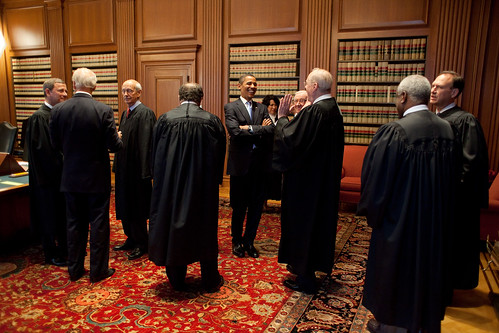
Let's analyze this picture of Obama and the Justices (and Biden).

Keep in mind that this is the shot the White House chose to put up on its Flickr page. (There's also this pic of Obama shaking hands with his appointee Sonia Sotamayor — with Scalia looking thoroughly delighted.)


(Enlarge.)

That's Biden, on the left, with his back to the camera, talking to Breyer and Roberts. The charming Roberts looks charmed by the gasbag VP, while Breyer — though more liberal than Roberts — looks like he's sleeping on his feet.

The short hulk by himself with his back to the camera is Scalia. Also alone, lurking in the background, is the newest Justice, Sonia Sotomayor. Or is Ruth Bader Ginsburg back there too (in the ladies section?) out of camera range?

Brooding over on the extreme right are Justice Thomas and Alito.

In the center, there's the President. As Stevens looks on, Obama laughs at Justice Kennedy's vain effort to enlist the Prez in a game of pattycake. Oh! Pattycake! Such fun!

IN THE COMMENTS: Freeman Hunt says:
Imagine holding a party. Your spouse takes pictures. When the guests leave, you say, "I'll email a group picture to you all."

The guests check their email accounts the next morning to find a picture wherein all of them have their backs to the camera or are by some other means obscured. Except you. You stand, fully visible, smiling broadly, center frame.

He he he.

Wednesday, June 3, 2009

Let's watch C-SPAN clips of Senator Obama fretting about the dysempathy of those terrible judges, Roberts and Alito.


Via Andrew Malcolm, who says:

[Obama expresses] admiration for and no reason to doubt the fine character of either man.

But, ultimately, Obama explains on Sept. 22, 2005, a nominee's character alone is insufficient to earn his support because both men, he alleges without detailing the merits of specific cases, too often side with powerful interests over others, with large companies against individuals, with prosecutors over defense attorneys.

He says he's seeking a judge who wants to "even" the playing field and that in a private meeting Roberts agreed. But Obama states that Roberts' words are unconvincing and contradicted by his decisions. "Ultimately," Obama says, "we need [to] give more weight to his deeds than his reassuring words."
Give more weight to his deeds than his reassuring words? The funny thing is: if the American people had done that, Obama would not now be in the position to appoint Supreme Court Justices.

Tuesday, May 19, 2009

Jeffrey Toobin has at Chief Justice John Roberts.

In the New Yorker.

1. Things Roberts did to Deputy Solicitor General Neal K. Katyal during the oral argument in the voting rights case: a. "pounced," b. "removed his glasses and stared down at," and c. "was relentless in challenging.”

2. The tone of Roberts's questions aimed at a lawyer arguing in favor of a city's affirmative action policy: "belligerent."

3. What Roberts is like compared to Scalia: "extreme" and more "effervescent."

4. Why Roberts's style is inconsistent with the self-image as an "umpire" that he promoted at his confirmation hearings: "In every major case since he became the nation’s seventeenth Chief Justice, Roberts has sided with the prosecution over the defendant, the state over the condemned, the executive branch over the legislative, and the corporate defendant over the individual plaintiff." And "Roberts has served the interests, and reflected the values, of the contemporary Republican Party."

5. I skimmed the rest of the article.

IN THE COMMENTS: Juris Dentist said:
On the Althouse blog:

1. We went to the laundromat!

2. We took a drive.

3. We took a walk.

4. Boo hoo, why does Jeffrey Toobin get to write articles that should be written be me!!!

5. I skimmed the rest.

Thursday, April 30, 2009

"Congress can impose this disparate treatment forever because of the history in the South?"

Chief Justice Roberts in argument in the Voting Rights Act case, which Dahlia Lithwick summarizes — with unusually labored breeziness — here.
[Justice Scalia] insists that the judgment of Congress is not to be trusted because when it came to reauthorizing the Voting Rights Act, "they get elected under this system. Why should they take it away?" Oh. My. God. You mean legislators are self-interested!?! That must mean the court is free to substitute its judgment for that of Congress.
This is a too-cheap laugh for Lithwick. Obviously, this is not a typical case for deferring to Congress. The challenged law structures the election of members of Congress, and it applies to some states and not others.
Debo Adegbile is in the case representing the NAACP Legal Defense Fund. When he reminds the court that "Congress is permitted to use so much of its power as is necessary" to remedy racial discrimination, the Chief Justice clobbers him with: "Is it your position that today Southerners are more likely to discriminate than Northerners?" When Adegbile replies that the covered states tend to be repeat offenders in this area, Roberts comes back with, "So your answer is yes?"

Scalia asks Adegbile what the vote was when Congress reauthorized Section 5 in 2006.

Answer: 390-33 in the House, 98-0 in the Senate. Scalia retorts that "the Israeli Supreme Court, the Sanhedrin, used to have a rule that if the death penalty was pronounced unanimously, it was invalid, because there must be something wrong there." (And before you liberals start crowing that Scalia is citing foreign law, let it be noted that he is citing religious law, which is totally cool and different than foreign law.) Today Scalia seems to have fashioned a new constitutional principle: The courts should always defer to Congress unless Congress is unanimous, in which case Congress is a sack of self-interested liars. Fascinating.
Well, think about it. They're all there — from all the states — and they all got elected under the existing system, a system that is not uniform among the states. Doesn't that mean something?