Showing posts with label law and emotion. Show all posts

Tuesday, May 4, 2010

"Harvard Law students are not in the 'pursuit of truth.' They’re not scientists. They’re not researchers."

"They’re law students and legal academics. I presume that everyone there is manifestly unqualified to evaluate the scientific evidence one way or the other. It’s rebuttable. If they show me their scientific creds, I’ll listen. Until then, STFU."

So says a commenter over at Volokh, provoking are great response from Volokh:
Now if these comments just complained about people who write definitive-sounding op-eds or blog posts about subjects they know nothing about, I wouldn’t be responding to it here. But of course the author of the e-mail wasn’t writing an op-ed aimed at persuading the public. She was continuing a conversation with a friend. The recommendation is that non-scientists who don’t know much about the subject shouldn’t even discuss it....

[W]hat a narrow, stultifying notion of education that is. Read quietly, on your own, with no discussion with others who are interested in the subject, until you become knowledgeable enough. Only then should you feel authorized to discuss it. Only then will we be “sympathetic” should you be publicly pilloried for your e-mail to a friend that raises the question — because only then could we say that “actual science is being foreclosed” by the condemnation of you.
The law school classroom experience requires students to discuss complicated and sensitive subjects in front of other students. How on earth are we going to be able to do that if the students think there's a terrible risk in saying the wrong thing — or the right thing the wrong way?
The way most people actually educate themselves effectively, it seems to me, is very different. They get interested in a subject. They talk to friends about it. They read some more. They talk some more about their readings, perhaps especially with people who are also learning about the matter. Their friends might help correct their errors. Enlightenment might emerge in a conversation when it didn’t emerge in mere reading.
Yes. Exactly. Human culture emerges as people interact with each other. Life would be very different if it was all about reading and studying. In fact, this is why we value diversity in the classroom, so that different kinds of individuals will converse and react. We will get to a better understanding of things that way.

Now, part of that really is seeing and feeling what makes other people angry. This conversation that is so valuable can't be bland and emotionless. Emotion is a part of reasoning and learning. But what does the group do to itself? What should the law school classroom (or any classroom) be like? There is an ideal level of interaction that includes ease and care in the expression of ideas and the response to what other people are saying. I want students to debate and even argue, to get excited and even angry, but not to the point where the exchange breaks down.

Back to Volokh:
That’s supposed to be one of the joys of intellectual life. It’s supposed to be one of the advantages of life in a university, where you can find classmates who — like you — have intellectual interests beyond your narrow field of study.
My law school, the University of Wisconsin, prides itself on interdisciplinary study. We encourage students (and faculty) to import other fields of study into working within law. We like the cross-fertilization and don't see the academic disciplines walled off from each other (with the walls staunchly guarded by the experts). Do you think law should be aridly academic? Do you think cases should be argued and decided by people who are intensely specialized in the study of legal texts? If you think you do, I don't think you'd keep thinking that if we had a way to run the experiment and see the results.

Back to Volokh:
Some of the people who learn about the subject may end up working on it professionally. People with Ph.D.s in physiology and membrane biophysics might write prominent books on anthropology and geography. Computer programmers who get interested in law, and who spend years talking to their friends about policy questions unrelated to their formal educations, might become lawyers. 
Volokh himself is that computer programmer. Jared Diamond is the biophysicist.

I think the lesson here is that we should want to experience our full humanity and to understand and respect and help each other as full human beings. This is an idea that completely harmonizes with the rejection of racism.

Monday, May 3, 2010

Is Judge Alvin K. Hellerstein too empathetic about the 9/11 lawsuits?

The NYT channels criticisms of a federal judge who has involved himself in judging the fairness and adequacy of settlements in non-class action lawsuits. (In a class action, the judge is required to determine that a setttlement "is fair, reasonable, and adequate.")

The NYT article portrays the 76-year-old as having lost his bearings:
The struggle over control of the settlement has underscored two different, but not necessarily contradictory views of the judge: the compassionate jurist driven by a sense of social responsibility and with a wealth of experience with victims’ suffering, and the aggressive judge unwilling to cede ground on cases he has shepherded for years...
“This is history for him,” said Arthur Miller, a professor at New York University School of Law who specializes in federal procedure. “This is an awesome responsibility. He wants to be the person who brought peace to this entire situation. He would not be human if he didn’t feel a personal interest in this.”...

Donald A. Migliori, a lawyer for survivors in airline-related cases whose settlement amounts were reduced, said that such intervention was unusual in a non-class-action suit. “It’s a very frustrating thing for lawyers,” he said. “He’s guided by a concept of fairness that’s not in the law.”...

... John Feal, who works as an advocate for the 9/11 workers through his FealGood Foundation, counters that Judge Hellerstein himself has emerged as a ground zero hero.

“The judge is now like Elvis in the 9/11 community,” he said. “For years these guys have been neglected, and now there’s someone who cares.”

Friday, April 30, 2010

Harvard 3L Stephanie Grace writes "I absolutely do not rule out the possibility that African-Americans are, on average, genetically predisposed to be less intelligent" — and is publicly reamed.

... at her law school, on the internet, and in the press. Grace's statement came in email sent to 2 friends, who'd had a private conversation about affirmative action. She felt a need to extend her remarks. And at some point the email got out on the internet, and all hell broke loose:
“Here at Harvard Law School, we are committed to preventing degradation of any individual or group, including race-based insensitivity or hostility,’’ [Martha Minow, dean of Harvard Law School] wrote in a message to Harvard’s law school community.

Minow said she had met with leaders of Harvard’s Black Law Students Association on Wednesday to discuss the hurt caused by Grace’s e-mail....

... Minow called the incident “sad and unfortunate’’ but said she was heartened by the student’s apology. She added: “We seek to encourage freedom of expression, but freedom of speech should be accompanied by responsibility.’’
(Via TaxProf, who collects a bunch of other links on the story, including links that will get you to the full text of the email.)

Grace has apologized. Of course, she's sorry now. "I am heartbroken and devastated by the harm that has ensued. I would give anything to take it back." Note the passive voice: "the harm that ensued." A  new way to say I'm sorry you were offended. She also says "I understand why my words expressing even a doubt [that African-Americans are genetically inferior] were and are offensive." She's learned something: This is a subject where you can't play with ideas and speculate. People get very angry, and the speaker had better be ready to deal with it.

Did Dean Minow handle this the right way? One question is: Why does the dean even get involved with something one student said in private email? If the answer is because the Black Law Students Association came to her and demanded a response, then maybe the question should be why did the  Black Law Students Association go to the dean for help? Why didn't the students all just argue and debate and express themselves to each other? These are Harvard students. Law students. Why not dig in and have it out and show your stuff? Why go to the nearest, biggest authority figure? Stephanie hurt me!

Here's the full text of Minow's message. (By the way, Martha Minow's father was FCC chairman Newton Minow, the man who called television "a vast wasteland.")
This sad and unfortunate incident prompts both reflection and reassertion of important community principles and ideals. We seek to encourage freedom of expression, but freedom of speech should be accompanied by responsibility. This is a community dedicated to intellectual pursuit and social justice....
Law school is a community with shared ideals. One of the ideals could be: When a student makes a point that contains what you think is an outrageous statement, unless she's been actively insulting to you, you should engage her in debate and not not expose her to a public trashing. And don't bring the dean into the fray as your champion. More from Minow:
As news of the email emerged yesterday, I met with leaders of our Black Law Students Association to discuss how to address the hurt that this has brought to this community. For BLSA, repercussions of the email have been compounded by false reports that BLSA made the email public and pressed the student’s future employer to rescind a job offer. 
I was going to say that "the hurt" to Grace and her reputation was much greater than the hurt to those students who only read the email. It's not as if she shouted ugly words in their face. But now I see that the BLSA students had reason to worry that they were the ones who would look bad because they were believed to have overreacted and taken some nasty revenge. Minow may have been activated by the need to clear their reputation.
A troubling event and its reverberations can offer an opportunity to increase awareness, and to foster dialogue and understanding. 
Minow tries to be even-handed and control the fallout. She frames it as a teaching moment. But what has everyone learned?

Friday, March 26, 2010

"When we have a terrorist attack, the Democrats always ask, 'What did we do to provoke it? Why do they hate us?'"

"Have you heard, any of them, ask the same for something they've imposed on us?  Have you heard the Democrats once ask, 'Why are they mad at us?  We need to understand their rage!'  We have to understand the rage of people who killed 3,000 Americans in terrorist incidents.  We're told, 'We have to understand the people in this country, minorities and whoever else, unhappy with whatever.  We gotta understand their rage. We have to expect it. We have to allow for it.'  Well, how come the anger that we feel, the Democrats aren't interested in understanding?  Why do they not ask, 'Why are they so mad?'" 

***

The Democrats immediately shifted into the theory that anger over the bill is simply not allowed. They merged that anger with actual violence, and they took whatever reports and threats of violence they could find and, in turn, merged them with the anger over the bill.

***

Can we identify neutral principles about anger and violence? How much free expression of anger do we accept in our opponents? When will we listen to it as part of a valuable debate? When do we stigmatize it as part of a system of violence? If the answer to the last question is whenever it serves our political interests to do so, then we are making propaganda.

Linda Greenhouse peers into the psyches of the Supreme Court Justices to predict what they'll say about the constitutionality of the health care bill.

She predicts the decisional path in the brains of the judges will be determined by deep instincts about the states and the federal government:
The architects of the Rehnquist federalism revolution....
Go to the link for some detail on what Greenhouse likes to call the "federalism revolution."
.... were Chief Justice William H. Rehnquist and his fellow Arizonan, Justice Sandra Day O’Connor (Chief Justice Rehnquist was actually from Milwaukee, but he decided during his Army service in North Africa that he liked the air of the desert rather than the cold and damp of the Great Lakes.) They were Westerners to whom the notion of states’ rights came naturally.

But Chief Justice John G. Roberts Jr. is not William Rehnquist, and Justice Samuel A. Alito Jr. is not Sandra Day O’Connor. John Roberts has made his career inside the Beltway ever since coming to Washington to clerk for Rehnquist. As for Sam Alito, I don’t believe that apart from a brief part-time gig as an adjunct law professor, this former federal prosecutor, Justice Department lawyer and federal judge has cashed a paycheck in his adult life that wasn’t issued by the federal government. Nothing in their backgrounds or in their jurisprudence so far indicates that they are about to sign up with either the Sagebrush Rebellion or the Tea Party.

Chief Justice Roberts appears particularly in tune with the exercise of national power. 
Here, Greenhouse notes 2 dissenting opinions —Massachusetts v. Environmental Protection Agency, where Roberts would have saved the EPA from the state's lawsuit to force it to deal with global warming, and Gonzales v. Oregon, where Roberts would have let the United States attorney general keep doctors from prescribing the suicide drugs that were authorized by Oregon law.

Finally, Greenhouse aptly observes that even some of the Justices who favor the states in federalism decisions lose their nerve when they are confronted with "issues that people really care about." Chief Justice Rehnquist balked when he got to the Family and Medical Leave Act (in Nevada Department of Human Resources v. Hibbs) — and that case was only about whether an employee of a state could get back pay when the act was violated, not the more momentous question of whether the act was constitutional or could bind the state.

So now we have a monumental new law. Can we really imagine the Supreme Court thwarting it?
John Roberts is an acutely image-conscious chief justice, as watchful and protective of the Supreme Court’s image as he is of his own. I find it almost impossible to believe that this careful student of history would place his court in the same position as the court that has been rewarded with history’s negative judgment for thwarting the early New Deal.
But the Supreme Court got cold feet about standing up to the will of the democratic branches of government right after Franklin Roosevelt won a big landslide election in 1936. The health care reform law followed an election that wasn't about health care reform at all. The main thing people were thinking about when they voted for Obama in 2008 was the dramatic economic crisis. There were also the 2 wars and amorphous hopes for a post-racial America.

The 2008 election cannot be read as a mandate for health care reform, especially not for the aspect of it that is challenged in the current lawsuits: the  individual mandate to buy health insurance. That could not possibly have been foremost in the voters' minds. First, during the campaign, Obama spoke emphatically against it. And second, even after a year of talk about the reform, people don't really understand what the individual mandate is going to be.

There isn't a big majority of Americans who are counting on being compelled to buy insurance. There isn't even a majority — even a thin majority — of Americans who favor the health care reform as a whole, and this is even before they need to confront something that is probably going to shock and distress a lot of people who haven't studied the text of the law and have simply trusted that the government is about to give them the good things they need.

Greenhouse tries to patch this hole in her argument:
Midweek polls showed the public already rallying around the new health care law. That trend is likely to accelerate as people realize that the law’s benefits belie the scare stories — just around that time that the state challenges are likely to reach the Supreme Court. It won’t require a summa cum laude in history from Harvard to be able to tell history’s wrong side from its right.
So Chief Justice Roberts and the others are going to want to surf the wave of history... that wave that we're still watching for.

Thursday, November 5, 2009

"For me, it's always been taking the facts of the case and applying them to the law."

Said former Wisconsin Supreme Court Justice Louis Butler, testifying before the Senate Judiciary Committee yesterday, in a hearing on his nomination to the federal district court here in the Western District of Wisconsin. He is, in what has become typical confirmation hearing ritual, asserting his faithfulness to the law and attempting to quell charges of judicial activism.

But isn't that quote interesting? In the established liturgy, judges aver that they apply the law to the facts. For example, Sonia Sotomayor said: "The job of a judge is to apply the law... The judge applies the law to the facts before that judge."

Butler, however, said, "For me, it's always been taking the facts of the case and applying them to the law." He said that he would apply the facts to the law. Now, I don't for one minute believe that he meant to flip the ritual phrase around. I think if he were confronted with the point I'm making here, he would immediately switch the words back to the liturgical form used by Sotomayor and countless others:  "The judge applies the law to the facts before that judge."

Think what it would mean to apply the facts to the law. You begin with the factual context of the case. That is the part you know. Then, you must find the law through the use of the facts. Imagine a judge who really believed that the facts determine the law. Read this important interchange from the Sotormayor hearings:
KYL: Let me ask you about what the president said -- and I talked about it in my opening statement -- whether you agree with him. He used two different analogies. He talked once about the 25 miles -- the first 25 miles of a 26-mile marathon. And then he also said, in 95% of the cases, the law will give you the answer, and the last 5 percent legal process will not lead you to the rule of decision. The critical ingredient in those cases is supplied by what is in the judge's heart. Do you agree with him that the law only takes you the first 25 miles of the marathon and that that last mile has to be decided by what's in the judge's heart?

SOTOMAYOR: No, sir. That's -- I don't -- I wouldn't approach the issue of judging in the way the president does. He has to explain what he meant by judging. I can only explain what I think judges should do, which is judges can't rely on what's in their heart. They don't determine the law. Congress makes the laws. The job of a judge is to apply the law. And so it's not the heart that compels conclusions in cases. It's the law. The judge applies the law to the facts before that judge.

KYL: ... [H]ave you ever been in a situation where a lawyer said I don't have any legal argument to me, Judge, please go with your heart on this or your gut?

SOTOMAYOR: Well, I've actually had lawyers say something very similar to that. (LAUGHTER) I've had lawyers where questions have been raised about the legal basis of their argument. I thought one lawyer who put up his hands and said, but it's just not right. (LAUGHTER) But it's just not right is not what judges consider. What judges consider is what the law says.....

KYL: ... Have you always been able to have a legal basis for the decisions that you have rendered and not have to rely upon some extra-legal concept, such as empathy or some other concept other than a legal interpretation or precedent?

SOTOMAYOR: Exactly, sir. We apply law to facts. We don't apply feelings to facts.
Wouldn't a judge applying the facts to the law do what President Obama said he thinks a good judge will do?
I will seek someone who understands that justice isn't about some abstract legal theory or footnote in a case book. It is also about how our laws affect the daily realities of people's lives — whether they can make a living and care for their families; whether they feel safe in their homes and welcome in their own nation.
I.e., apply the facts to the law.

Tuesday, July 28, 2009

Senator Grassley: Sotomayor "doesn't have a clear role of what the Supreme Court is."

Doesn't have a clear role of what the Supreme Court is?

He can't talk right, but he has a vote, and he's voting against Sonia Sotomayor.
Grassley said his vote in part is based on second thoughts he has had about Souter, confirmed in 1990.

"I can say my vote for him is probably the only vote for 11 or 12 Supreme Court justices that has come back to haunt me from time to time," Grassley said. "I think Judge Sotomayor's very lukewarm answer that she gave me left me with the same pit in my stomach I had as a result of my vote for Souter."
Pit in my stomach? Oh, good lord, he really can't talk right. From Common Errors in English:
Just as you can love someone from the bottom of your heart, you can also experience a sensation of dread in the pit (bottom) of your stomach. I don’t know whether people who mangle this common expression into “pit in my stomach” envision an ulcer, an irritating peach pit they’ve swallowed or are thinking of the pyloric sphincter; but they’ve got it wrong.
So, Sotomayor either does or does not make judicial decisions emanating from empathy and Wise Latina experience, and Grassley feels his decisions in his stomach and when they feel like the part of a fruit that he shouldn't have eaten — or when he's haunted — he votes no.

Does anybody have a clear role about anything anymore?

Wednesday, June 3, 2009

Let's watch C-SPAN clips of Senator Obama fretting about the dysempathy of those terrible judges, Roberts and Alito.


Via Andrew Malcolm, who says:

[Obama expresses] admiration for and no reason to doubt the fine character of either man.

But, ultimately, Obama explains on Sept. 22, 2005, a nominee's character alone is insufficient to earn his support because both men, he alleges without detailing the merits of specific cases, too often side with powerful interests over others, with large companies against individuals, with prosecutors over defense attorneys.

He says he's seeking a judge who wants to "even" the playing field and that in a private meeting Roberts agreed. But Obama states that Roberts' words are unconvincing and contradicted by his decisions. "Ultimately," Obama says, "we need [to] give more weight to his deeds than his reassuring words."
Give more weight to his deeds than his reassuring words? The funny thing is: if the American people had done that, Obama would not now be in the position to appoint Supreme Court Justices.

Wednesday, May 27, 2009

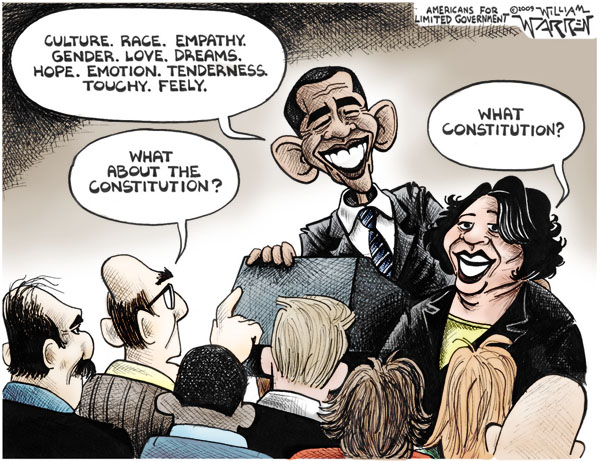
The Sotomayor-is-not-a-real-judge meme.

Let this William Warren cartoon represent what I'm calling a meme because I'm seeing it everywhere:


When a white man gets onto the Supreme Court, it's because of his legal credentials, because he got no points for diversity, but when a woman or a member of a minority group makes it onto the Court, she (or he) will be forever marginalized as an embodiment of the quality or qualities that clinched the appointment, even though excellent legal credentials were required for her to make it into the pool of finalists. Don't you see how unfair this marginalization is?

The fact that Sonia Sotomayor is female and Hispanic and that she got the nomination because of that does not nullify or degrade the legal credentials that she also has. It is wrong and unfair to say that it does.

Now, it's a separate question whether being female and Hispanic is supposed to play a part in constitutional interpretation. Both Obama and Sotomayor have made statements that suggest they believe something that many lawprofs say all the time: That a judge's background experiences and understandings play a role in answering hard questions of interpretation.

If you don't think that is true, think deeply about why you disagree. What do you know about the how human mind works that makes you think that our reasoning is abstracted from our real-world context? Don't tell me that you just feel sure that's what judges ought to do. The question is what human beings do, not what you wish they could do and would do.

And frankly, I think that if judges could reason about legal texts abstracted from the real world, they would make all sorts of intolerable, ridiculous decisions that would lead us soon enough to replace them with more practical judges. If your wish came true, it would only be temporary.

It's also a separate question whether Presidents should make Supreme Court appointments based purely on legal credentials. Is there some idea that all possible nominees could be ranked and the President ought to choose #1? Assuming some absolute rank order is possible — and I don't think it is — would you want to limit him that way? Why? What if it meant that the next 100 judges would be white males from upper middle class backgrounds? I think that would be intolerable.

Tuesday, May 5, 2009

"Deciphering Obama’s Supreme Court 'empathy' remark..."

"... Does the next justice have to be a woman?... The sex offender case that may trip up a frontrunner ... Ann to Obama: Appoint a strong liberal!... Is Obama trying to wriggle out of closing Gitmo?... Emily announces Double X, a women’s site that’s for men, too."

It's the new Bloggingheads, with me and Slate's Emily Bazelon.

Monday, May 4, 2009

Would you have picked David Souter? Would Obama?

"He wore the same gray suit year after year. He worked long hours, including weekends, and ate lunch at his desk.... He collected old books and revered precedents in the law. He would not watch television or use a computer. He avoided Washington parties. Instead, in the evenings, he jogged several miles near his small apartment. His summers were spent hiking in the White Mountains of New Hampshire."

Some group of 9 individuals will say what the law is for us all. What sort of individuals do you want? Assume fine intellectual credentials and solid relevant experience. Aside from that, what sort of individual characteristics make you want to give a man or woman this immense responsibility?

Here's what Obama said after David Souter revealed his intention to leave the Supreme Court:
Justice Souter has shown what it means to be a fair-minded and independent judge. He came to the bench with no particular ideology. He never sought to promote a political agenda.

He approached judging as he approaches life, with a feverish work ethic and a good sense of humor, with integrity, equanimity and compassion -- the hallmark of not just being a good judge, but of being a good person.
Feverish... that is the out-of-place word that tells us something about Obama. Souter sounds utterly cool — if anything, too cold to trust with the grand decisions of life and liberty submitted to the Court.

The key thing Obama has told us about what he wants in a Supreme Court Justice is empathy:
I view that quality of empathy, of understanding and identifying with people's hopes and struggles as an essential ingredient for arriving as just decisions and outcomes. I will seek somebody who is dedicated to the rule of law, who honors our constitutional traditions, who respects the integrity of the judicial process and the appropriate limits of the judicial role. I will seek somebody who shares my respect for constitutional values on which this nation was founded, and who brings a thoughtful understanding of how to apply them in our time.
Obama — like many lawprofs — believes (or purports to believe) that emotion and engagement with real life is integral to constitutional interpretation. This is different (or certainly purports to be different) from deciding cases according to one's sympathies. But even understood that way, Obama's favorite qualification would obviously have excluded the bookish, reclusive Souter.

That word "empathy" stoked the Sunday talk shows:
“What does that mean? Usually that’s a code word for an activist judge,” Sen. Orrin Hatch (R-Utah) said on ABC’s “This Week.”...

“I may have empathy for, for the little guy in a fight with a big corporation, but the law may not be on his side. So I think that’s a concern,” former Republican Party Chairman Ed Gillespie said on NBC’s “Meet the Press.”

“What I hear in President Obama’s statement is that he wants the justices of the court to try to understand the real world we live in and the impact of some of these decisions. Apply the law, but do it in a sensible fashion,” Sen. Dick Durbin (D-Ill.) said on “Fox News Sunday.”...

Obama’s comments Friday about judges needing to identify “with people’s hopes and struggles” and the reaction to those remarks seemed to cast the early debate in a way that is likely to favor Democrats — especially at a time of economic distress, when Wall Street and big corporations are widely regarded by many as a greater threat than the rulings of federal judges.

In fact, the anti-establishment attitude that powered Obama’s campaign remains strong enough that there is serious discussion of putting a nonjudge, or even a nonlawyer, on the court, which presently consists entirely of former federal appeals court judges.

“I would like to see more people from outside the judicial monastery, somebody who has had some real-life experience, not just as a judge,” Sen. Pat Leahy (D-Vt.), the chairman of the Judiciary Committee, said on ABC.
And who was more monk-like than David Souter?

It's funny. For years, I've heard conservatives cry "No more Souters!" But now, I'm hearing the Democrats say that too. All due respect will be paid to the retiring Justice, but he isn't what they want.

And frankly, he isn't what they should want. The Court needs a forthright liberal. And Obama is perfectly entitled to pick such an individual. Of course, this person will — as Obama said — be dedicated to the rule of law, honor constitutional tradition, and respect the integrity of the judicial process and the appropriate limits of the judicial role. But he or she will do all of this in the liberal mode. I hope to see a fine Justice who will show us how this is done.

Monday, March 23, 2009

"It’s complex decisions, the ones that involve lots of information, that benefit the most from unconscious emotional processing."

"The conscious brain can only handle a very limited amount of information at one time — seven digits, plus or minus two. Unconsciously, however, you can process tons of information. It’s these complex decisions — like choosing a car, an apartment, or a leather couch — that often require the rational brain to turn off to some degree."

Jonah Lehrer on how we decide.

Could he do a Bloggingheads with Justice Scalia?

***

And here's the Bush/Obama part:
So if our gut is best at weighty decisions, a leader ought to think, “Should we go to war? Yeah, I’m feeling pretty good about this”?

Well, here’s the big caveat, and this is maybe the main distinction between Obama and Bush. There’s been extensive research over the last few decades about the danger of certainty, about believing you’re right. What that causes the brain to do is ignore all the evidence that suggests you’re wrong. We clearly tend to filter the world to conform to our ideology, to our preconceived notions. So if I had to identify one flaw of the Bush administration, it’s not that simply Bush trusted his gut instincts or that he was a “decider.” It was that he and his entire administration fell victim to the certainty trap. And I think you saw that very clearly with the Iraq war and WMDs. They believed they knew that Saddam Hussein had them. And so they ignored lots of relevant evidence and dissenting voices telling them that there were no WMDs. It wasn’t simply his gut instincts that led him astray, it was the fact that he didn’t seek out those dissident voices. And that’s a very natural human flaw, one of the frailties of the human brain. It’s also why liberals watch MSNBC and conservatives watch Fox News. It’s nice to have one’s beliefs reinforced. But it’s dangerous when leading a country.

Monday, November 10, 2008

How unfair is it to use Enya to make jurors want to put a murderer to death?

The Supreme Court declines to hear 2 cases about "victim impact" evidence in death sentencing, and 3 Justices protest:
In the cases denied review on Monday, the evidence was composed of a 20-minute videotape in one case, and a 14-minute videotape in the other. In each case, the... 20-minute presentation included dozens of still photographs and video clips depicting the victim’s life, set to the music of recording star Enya, with a voice narration by the victim’s mother. The 14-minute display included 118 photographs of the murdered couple, with a narration by their children....

Justice Stevens described the videos as “a far cry from the written victim impact evidence at issue” in the Court’s two prior rulings on such evidence. “As these cases demonstrate, when victim impact evidence is enhanced with music, photographs, or video footage, the risk of unfair prejudice quickly becomes overwhelming."
Is it unfair to stoke emotions with Enya?
While the video tributes at issue in these cases contained moving portrayals of the lives of the victims, their primary, if not sole, effect was to rouse jurors’ sympathy for the victims and increase jurors’ antipathy for the capital defendants.”
The test, under the existing Supreme Court case law -- from Payne v. Tennessee -- is whether the evidence "is so unduly prejudicial that it renders the trial fundamentally unfair." What sort of music/video presentation would cause you to take leave of your senses?