For example, Thomas is shown standing on two pizza boxes, a reference to Thomas's statement in the 2005 case National Cable & Telecomm. Association v. Brand X Internet Services, "One can pick up a pizza rather than having it delivered, and one can own a dog without buying a leash. By contrast, the [Federal Communications] Commission reasonably concluded, a consumer cannot purchase Internet service without also purchasing a connection to the Internet."More details here,
Likewise, Thomas is holding an American flag which has on the reverse side the text of the 1954 federal law that added the words "under God" to the Pledge of Allegiance. The law was at issue in the 2004 case Elk Grove Unified School District v. Newdow, in which Thomas wrote a concurrence asserting the unusual view that the First Amendment's Establishment Clause does not protect an individual right or apply against state laws.
Showing posts with label Clarence Thomas. Show all posts
Showing posts with label Clarence Thomas. Show all posts
Monday, July 11, 2011
The "meticulous iconography" of the Clarence Thomas bobblehead doll.
Supreme Court bobblehead dolls are a Green Bag (law journal) tradition, and each one depicts a Justice along with various items that reflect things from decision he or she has authored:


Monday, June 27, 2011
In the violent video games case, Scalia notes the irony of Alito's strenuous effort to describe the "astounding" violence.
From the majority opinion in the just-decided case of Brown, Governor of California v. Entertainment Merchants Association:
Alito, by the way, does not dissent. (Remember he was the lone dissenter in the Phelps case, showing the most empathy for sensitive people brutalized by ugly expression.) He thinks that "the experience of playing a video game may be quite different from the experience of reading a book, listening to a radio broadcast, or viewing a movie," and he'd prefer to put off the more difficult free speech questions and "hold only that the particular law at issue here fails to provide the clear notice that the Constitution requires." That would leave room for legislatures to craft better laws designed to protect minors.
ADDED: The 2 dissenting opinions come from Justices Thomas and Breyer. Thomas relies on originalism: "the founding generation" didn't think First Amendment free speech included a right "to speak to minors (or a right of minors to access speech) without going through the minors’ parents or guardians." I haven't had the chance to read the entire opinion, but I can see that it contains some detailed discussion about the history of ideas about children. I'll leave that for another post.
Justice Breyer's dissenting opinion reject the facial challenge to the law. He says the "case is ultimately less about censorship than it is about education."
JUSTICE ALITO has done considerable independent research to identify, see post, at 14–15, nn. 13–18, video games in which “the violence is astounding,” post, at 14. “Victims are dismembered, decapitated, disemboweled, set on fire, and chopped into little pieces. . . . Blood gushes, splatters, and pools.” Ibid. JUSTICE ALITO recounts all these disgusting video games in order to disgust us—but disgust is not a valid basis for restricting expression. And the same is true of JUSTICE ALITO’s description, post, at 14–15, of those video games he has discovered that have a racial or ethnic motive for their violence—“‘ethnic cleansing’ [of] . . . African Americans, Latinos, or Jews.” To what end does he relate this? Does it somehow increase the “aggressiveness” that California wishes to suppress? Who knows? But it does arouse the reader’s ire, and the reader’s desire to put an end to this horrible message. Thus, ironically, JUSTICE ALITO’s argument highlights the precise danger posed by the California Act: that the ideas expressed by speech—whether it be violence, or gore, or racism—and not its objective effects, may be the real reason for governmental proscription.The Court strikes down a California law that prohibits the sale or rental of "violent video games" to minors. The statute defined violent games in a way that "mimics the New York statute regulating obscenity-for-minors that we upheld in Ginsberg v. New York." But sex and violence are different: "obscenity is not protected expression" under the First and Fourteenth Amendments. California was trying "to create a wholly new category of content-based regulation that is permissible only for speech directed at children." "That is unprecedented and mistaken," the Court says today.
California’s argument would fare better if there were a longstanding tradition in this country of specially restricting children’s access to depictions of violence, but there is none. Certainly the books we give children to read—or read to them when they are younger—contain no shortage of gore. Grimm’s Fairy Tales, for example, are grim indeed. As her just deserts for trying to poison Snow White, the wicked queen is made to dance in red hot slippers “till she fell dead on the floor, a sad example of envy and jealousy.” The Complete Brothers Grimm Fairy Tales 198 (2006 ed.). Cinderella’s evil stepsisters have their eyes pecked out by doves. Id., at 95. And Hansel and Gretel (children!) kill their captor by baking her in an oven. Id., at 54.I was reading that out loud here at Meadhouse, and somebody said: "The Supreme Court needs spoiler alerts!"
High-school reading lists are full of similar fare. Homer’s Odysseus blinds Polyphemus the Cyclops by grinding out his eye with a heated stake. The Odyssey of Homer, Book IX, p. 125 (S. Butcher & A. Lang transls. 1909) (“Even so did we seize the fiery-pointed brand and whirled it round in his eye, and the blood flowed about the heated bar. And the breath of the flame singed his eyelids and brows all about, as the ball of the eye burnt away, and the roots thereof crackled in the flame”). In the Inferno, Dante and Virgil watch corrupt politicians struggle to stay submerged beneath a lake of boiling pitch, lest they be skewered by devils above the surface. Canto XXI, pp. 187–189 (A. Mandelbaum transl. Bantam Classic ed. 1982). And Golding’s Lord of the Flies recounts how a schoolboy called Piggy is savagely murdered by other children while marooned on an island. W. Golding, Lord of the Flies 208–209 (1997 ed.).That Homer passage still grosses people out. Even after all the horrible movies and video games they've witnessed.
Alito, by the way, does not dissent. (Remember he was the lone dissenter in the Phelps case, showing the most empathy for sensitive people brutalized by ugly expression.) He thinks that "the experience of playing a video game may be quite different from the experience of reading a book, listening to a radio broadcast, or viewing a movie," and he'd prefer to put off the more difficult free speech questions and "hold only that the particular law at issue here fails to provide the clear notice that the Constitution requires." That would leave room for legislatures to craft better laws designed to protect minors.
ADDED: The 2 dissenting opinions come from Justices Thomas and Breyer. Thomas relies on originalism: "the founding generation" didn't think First Amendment free speech included a right "to speak to minors (or a right of minors to access speech) without going through the minors’ parents or guardians." I haven't had the chance to read the entire opinion, but I can see that it contains some detailed discussion about the history of ideas about children. I'll leave that for another post.
Justice Breyer's dissenting opinion reject the facial challenge to the law. He says the "case is ultimately less about censorship than it is about education."
Our Constitution cannot succeed in securing the liberties it seeks to protect unless we can raise future generations committed cooperatively to making our system of government work.... Sometimes, children need to learn by making choices for themselves. Other times, choices are made for children—by their parents, by their teachers, and by the people acting democratically through their governments.
Sunday, June 19, 2011
The NYT goes after Clarence Thomas over "an unusual, and ethically sensitive, friendship."
It's a long article, and you have to comb through it to try to grasp what we're supposed to think Justice Thomas did wrong. I'd just like to highlight the historical preservation that is at the center of the insinuations. You have to get to the 3rd screen of this 4-screen-long article to read:
But Clarence Thomas is the man that liberals would love to discredit. Here, the idea is that although the judicial code of conduct does not apply to Supreme Court justices, the justices do purport to follow it, and:
And all in the context of preserving a site in the Gullah/Geechee Cultural Heritage Corridor designated by Congress!
The Times notes: "The justices are not bound by the federal judiciary’s conduct code, because it is enforced by a committee of judges who rank below the justices." Right. Of course, that's the way it has to be. Imagine a committee of judges unleashed to have at Clarence Thomas!
The constitutional check on a Supreme Court Justice is impeachment. Picture Congress going after Thomas for playing some background role in preserving a valuable black history site.
ADDED: Instapundit says:
At first glance the Pin Point Heritage Museum, scheduled to open this fall, would seem an unlikely catalyst for an ethical quandary. That Pin Point’s history is worthy of preservation is not in dispute.Imagine a liberal justice raised under such circumstances. Imagine this historical preservation project without any connection to conservative politics. What article would appear in the New York Times?
Part of the Gullah/Geechee Cultural Heritage Corridor designated by Congress, it is representative of tight-knit Southern coastal settlements that trace their roots to freed slaves and were often based around fishing. In Pin Point, the Varn crab and oyster cannery, founded in the 1920s, was a primary source of jobs until it closed in 1985....
Justice Thomas, 62, was born and raised near the cannery overlooking the Moon River, where it was not uncommon for babies to rock in bassinets made of crab baskets while their mothers shucked oysters.
But Clarence Thomas is the man that liberals would love to discredit. Here, the idea is that although the judicial code of conduct does not apply to Supreme Court justices, the justices do purport to follow it, and:
The code says judges “should not personally participate” in raising money for charitable endeavors, out of concern that donors might feel pressured to give or entitled to favorable treatment from the judge.Here's the actual text of the code:
A judge should not solicit funds for any educational, religious, charitable, fraternal, or civic organization, or use or permit the use of the prestige of the judicial office for that purpose, but the judge may be listed as an officer, director, or trustee of such an organization. A judge should not personally participate in membership solicitation if the solicitation might reasonably be perceived as coercive or is essentially a fund-raising mechanism.Note how the "personally participate" language relates to "membership solicitation" and there's nothing in the article about that. At most, the article has Thomas saying "I’ve got a friend I’m going to put you in touch with" to the owner of the cannery. So "a judge should not solicit funds..." — let's use the actual text. How is that soliciting funds? You can see the interest in sliding over to the "personally participate" language that relates to "membership solicitation." Pretty sleazy.
And all in the context of preserving a site in the Gullah/Geechee Cultural Heritage Corridor designated by Congress!
The Times notes: "The justices are not bound by the federal judiciary’s conduct code, because it is enforced by a committee of judges who rank below the justices." Right. Of course, that's the way it has to be. Imagine a committee of judges unleashed to have at Clarence Thomas!
The constitutional check on a Supreme Court Justice is impeachment. Picture Congress going after Thomas for playing some background role in preserving a valuable black history site.
ADDED: Instapundit says:
But of course, the New York Times piece isn’t really about ethics. It’s battlespace preparation for the Supreme Court’s healthcare vote. The problem for the Times is that Thomas doesn’t care what the New York Times thinks. Which means this is more about preparing a narrative of failure for ObamaCare — It was struck down by evil corrupt conservative judges. I think they’re going to be kept quite busy constructing failure narratives over the next couple of years.
Saturday, May 21, 2011
"Justice Anthony M. Kennedy... said he aspired to Ernest Hemingway’s stripped-down language..."
Talk about falling short of your aspirations! Of all the Justices on the Court today, I find that Justice Kennedy writes in the least straightforward style. Ah, well. At least he means well. Or is he conning us with this Hemingway talk?
The linked article — by Adam Liptak, in the NYT — links to this set of long recorded interviews with Supreme Court Justices about how they write and how they want lawyers to write.
ADDED: Both Nabokov and Agatha Christie are discussed in the Wikipedia article "Unreliable Narrator":
The linked article — by Adam Liptak, in the NYT — links to this set of long recorded interviews with Supreme Court Justices about how they write and how they want lawyers to write.
Justice Ginsburg said she had learned much from a course Nabokov taught at Cornell on European literature.Ginsburg and Nabokov. Thomas and Christie. What do you think of Liptak's juxtaposition? It's a literary device. Would you put it at the Nabokov level? The Christie level? Somewhere lower?
“He was a man in love with the sound of words,” she said of her former professor. “He changed the way I read, the way I write.”
Justice Thomas, on the other hand, cited only a single author, and then only by way of contrast. “It’s not a mystery novel,” he said of a good brief. “People can’t think, ‘I’m Agatha Christie,’ or something like that.”
ADDED: Both Nabokov and Agatha Christie are discussed in the Wikipedia article "Unreliable Narrator":
A controversial example of an unreliable narrator occurs in Agatha Christie's novel The Murder of Roger Ackroyd, where the narrator hides essential truths in the text (mainly through evasion, omission, and obfuscation) without ever overtly lying. Many readers at the time felt that the plot twist at the climax of the novel was nevertheless unfair....Now, you want your judges and lawyers to be reliable narrators when they tell you about the facts of the case and interpret and apply the law. Thomas said don't be like Agatha Christie. You need to tell it straight. But Ginsburg said she learned from Nabokov, learned to love the sound of the words. Liptak — I think — intended to make Ginsburg look good and Thomas bad, but it didn't quite work out that way.
Humbert Humbert, the main character and narrator of Vladimir Nabokov's Lolita, often tells the story in such a way as to justify his pedophilic fixation on young girls, in particular his sexual relationship with his 12-year-old stepdaughter....
Wednesday, May 18, 2011
What Thurgood Marshall said to Clarence Thomas.
"I had to do in my time what I had to do. You have to do in your time what you have to do."
And, on society's cynics:
And, on society's cynics:
"What monument is built for all that negativity? You are negative sometimes in order to make something better. You criticize it in a way to improve it. There are things wrong in this country that have to be improved, but you don't just keep nagging and nagging and nagging. But at some point it's got to stop. At some point too much is too much."IN THE COMMENTS: Eric Muller said:
If I were Clarence Thomas, this is what I would tell myself Thurgood Marshall really believed about me too.
Friday, February 25, 2011
100 lawprofs ask Congress to impose an ethics code on the Supreme Court.
Oddly, the name Koch appears 10 times in this Washington Post article. It appears that some lawprof brains are aboil with worries about the nefarious Koch brothers. Kochophobia rages on, and these furious minds seem to imagine themselves overcoming the evil that is Antonin Scalia and Clarence Thomas — as if their "ethics" plan — assuming it could be put in place — couldn't possibly backfire and oust their favorite liberal/swing justice.
So... retired Justices Souter, Stevens, and O'Connor might step up to decide who to disqualify in — let's say — the case about the constitutionality of the individual mandate. Maybe you think that skews a tad liberal, a tad too anti-Scalia-and-Thomas. Well, first, that's not a bug, it's a feature. And, second, whoever is setting up the "independent body" could always balance it with those "other experts." You know where to get them, don't you? Elite law schools! Begin with the names of those 100 professors who signed that letter to Congress.
It's all so delightfully inbred — isn't it? — in the feverish fantasy life of the Scalia- and Thomas-haters of legal academia.
The professors said in their letter to the committees that their goal is not to second-guess the activities of any individual judge but to create "mandatory and enforceable rules to protect the integrity of the Supreme Court." An influential British judge declared in the 17th century that "no man may be a judge in his own case," the letter said, but "inexplicably we still allow Supreme Court justices to be the sole judge of themselves on recusal issues."And what man will be the judge of whether these law professors are truthfully reporting their motives?
Under the ethics code that the lawyers consider their model, approved and regularly updated by the nation's chief appellate judges under the chairmanship of the chief justice, lesser judges are prohibited from accepting travel reimbursements from outside groups if they "give the appearance of influencing the judge" or "otherwise give the appearance of impropriety."And who will be the judge of which meetings and events are overtly political? If they're sponsored by the Kochs, they're political. So far, we know that. Thanks a lot. I love the irony. It's obvious that this proposal is overtly political!
Nan Aron, director of the liberal group Alliance for Justice, said that if these rules were extended to the Supreme Court, none of the justices could attend "overtly political meetings or events" like those sponsored by the Kochs.
At present, said Ellen Yaroshefsky, director of the Jacob Burns Ethics Center at the Benjamin Cardozo School of Law, "we have standard-less standards" at the court that she struggles to explain to students.Oh, wonderful! An independent body of retired justices or other experts. Yes, wouldn't it be great to have an independent body of retired justices or other experts decide which Supreme Court Justices got to participate in particular cases?
She said it would be straightforward for the court to appoint an independent body of retired justices or other experts to adjudicate recusal and ethics controversies.
So... retired Justices Souter, Stevens, and O'Connor might step up to decide who to disqualify in — let's say — the case about the constitutionality of the individual mandate. Maybe you think that skews a tad liberal, a tad too anti-Scalia-and-Thomas. Well, first, that's not a bug, it's a feature. And, second, whoever is setting up the "independent body" could always balance it with those "other experts." You know where to get them, don't you? Elite law schools! Begin with the names of those 100 professors who signed that letter to Congress.
It's all so delightfully inbred — isn't it? — in the feverish fantasy life of the Scalia- and Thomas-haters of legal academia.
Monday, February 7, 2011
"Where are the liberal civil rights leaders in response to the openly racist comments and calls for violence against America's black Supreme Court Justice?"
"These same men -- all men, I believe, as per usual with the black civil rights groups -- got all in a multi-week, if not many month, tizzy with their allegation that what obviously was a 'say it don't spray it' situation at a Tea Party rally was a spit attack on a black Member of Congress, but they evidently do not care when persons at an event affiliated with one of the nation's most established liberal groups, Common Cause, publicly say they want Clarence Thomas physically attacked and put into slavery."
Says Amy Ridenour, via Instapundit, who uses the word "hypocrisy." It's something beyond hypocrisy, though, I think.
Says Amy Ridenour, via Instapundit, who uses the word "hypocrisy." It's something beyond hypocrisy, though, I think.
Friday, January 21, 2011
"Indeed, there is an internal logic to Santorum's remarks that represents the exact opposite of racism."
Concedes Joe Klein, who supports abortion rights.
ADDED: James Taranto:
ADDED: James Taranto:
Klein ... misses the point.... What makes it racially invidious is not the underlying argument or the rhetorical inelegance with which Santorum makes it. It is the implication that because Obama is "a black man," he is obliged to agree with Santorum.
The notion that the range of acceptable opinion is narrower for a black person than for a white person (or for a woman than a man, or a homosexual than a heterosexual) is a pernicious form of bigotry. It is usually heard from left-wing multiculturalists, as when they attack Clarence Thomas for being black and taking the position that racial preferences are unconstitutional....
Friday, October 22, 2010
"Lillian McEwen breaks her 19-year silence about Justice Clarence Thomas."
The Washington Post has the scoop, including what may be the key sentence: "She has written a memoir, which she is now shopping to publishers."
UPDATE: McEwan in a interview reveals that she had an intimate relationship with Thomas. She says he liked pornography, especially depictions of large breasts. What is the point of revealing something so incredibly banal? Does it corroborate Anita Hill's testimony in any significant way? The issue, in the confirmation hearing, was whether Thomas engaged in sexual harassment in the workplace. McEwan is talking about his private life. First, that's really creepy. Imagine if a man revealed private, sexual things about a woman. McEwan even admits that she's speaking now because she is politically opposed to Clarence Thomas. She doesn't like the way he's deciding the cases.
Since McEwan never says that Thomas talked about pornography in the office, the supposed corroboration is virtually nil. It's true that if we know a man is interested in pornography, it makes it more likely that he talked about that interest somewhere, more likely than if we didn't know whether the man liked pornography. But huge numbers of men are interested in pornography, and only a small subset of them who pester women by talking about it graphically in the office environment. So it just doesn't matter enough to bring it up.
McEwan also talks about the way Thomas thought about women, but it comes across as sheer speculation. She somehow knows he thought about whether women he met in the office would make good sexual partners. Again, this is perfectly banal. It says little about how he might attempt to initiate a relationship with a coworker. Doesn't nearly every single adult look around at other people and think about whether they are attractive and might make a good sexual partner?
This is just sad and embarrassing.
UPDATE: McEwan in a interview reveals that she had an intimate relationship with Thomas. She says he liked pornography, especially depictions of large breasts. What is the point of revealing something so incredibly banal? Does it corroborate Anita Hill's testimony in any significant way? The issue, in the confirmation hearing, was whether Thomas engaged in sexual harassment in the workplace. McEwan is talking about his private life. First, that's really creepy. Imagine if a man revealed private, sexual things about a woman. McEwan even admits that she's speaking now because she is politically opposed to Clarence Thomas. She doesn't like the way he's deciding the cases.
Since McEwan never says that Thomas talked about pornography in the office, the supposed corroboration is virtually nil. It's true that if we know a man is interested in pornography, it makes it more likely that he talked about that interest somewhere, more likely than if we didn't know whether the man liked pornography. But huge numbers of men are interested in pornography, and only a small subset of them who pester women by talking about it graphically in the office environment. So it just doesn't matter enough to bring it up.
McEwan also talks about the way Thomas thought about women, but it comes across as sheer speculation. She somehow knows he thought about whether women he met in the office would make good sexual partners. Again, this is perfectly banal. It says little about how he might attempt to initiate a relationship with a coworker. Doesn't nearly every single adult look around at other people and think about whether they are attractive and might make a good sexual partner?
This is just sad and embarrassing.
Wednesday, October 20, 2010
Slate and Stupid: William Saletan's cocky ignorance of the First Amendment.
I'm turning William Saletan's headline back on him.
Saletan proceeds, on this scanty evidence, to insist that the real problem with O'Donnell is that she is too confident when she speaks. Supposedly, that makes her "impervious" to new information and arguments, and that would be bad. Yeah, it would be bad. But this is a political debate! It's not the time to make a show of uncertainty and doubt. It's a time to state clear positions so voters can make a choice. I'm sure if O'Donnell had seemed uncertain about what to think, Saletan would have attacked her for her weakness. Instead, he's left criticizing her for "imperviousness." That's really lame. It reminds me of the way people of the left were always calling George Bush "incurious." It might make some sense if an ever-searching, ever-questioning intelligence was demanded of every candidate, across the political spectrum, but it is not.
My working theory is that it's Saletan who is impervious — and incurious. But I will continue, as ever, to search and question (and be, as ever, completely ill-suited to run for political office).
________________________
* The 14th Amendment — the Supreme Court has held — incorporates the Establishment Clause and makes it applicable to state and local government. There is, by the way, an impressive argument that the incorporation of the Establishment Clause was a mistake. Justice Thomas makes that argument here. I would not be surprised if O'Donnell would, as Senator, enthusiastically vote to confirm more federal judges who think like Clarence Thomas. And that's certainly something Delaware voters should take into account.
.... The key exchange begins just after the 17-minute mark. Here's my transcription:Perhaps she emphasized "First" because the discussion had been about what local school boards could do, and restrictions on them would need to come out of the 14th Amendment.* Now, Coons does properly restrict his assertion to the federal government at that point, but:Coons: The First Amendment establishes the separation, the fact that the federal government shall not establish any religion, and decisional law by the Supreme Court over many, many decades—... In expressing her disbelief, she clearly emphasizes the word first. She seems incredulous not just at Coons' position against government-established religion, but that he bases it on the First Amendment. It's the citation that surprises her.
O'Donnell: The First Amendment does?
A minute later, O'Donnell brings the discussion back to this question:"Government shall make no establishment of religion" is a blatant misstatement of the Establishment Clause of the First Amendment. ("Congress shall make no law respecting an establishment of religion...") Now, I'm not trying to skewer Coons for saying that. Coons is doing well enough for speaking purposes. This isn't scholarly writing. But he's open to questioning, and O'Donnell might have pursued the point. Maybe she grinned because she knew he'd said something wrong.O'Donnell: Let me just clarify: You're telling me that the separation of church and state is found in the First Amendment?Again, you need the audio, and in this case full-screen video, to get her meaning. As she says, "That's in the First Amendment," she stares at Coons with a look of contemptuous amusement. (You can see her expression more clearly in this video, about 7 minutes in.) Then she grins knowingly at somebody in the audience. She thinks Coons has just embarrassed himself.
Coons: Government shall make no establishment of religion.
O'Donnell: That's in the First Amendment.
Saletan proceeds, on this scanty evidence, to insist that the real problem with O'Donnell is that she is too confident when she speaks. Supposedly, that makes her "impervious" to new information and arguments, and that would be bad. Yeah, it would be bad. But this is a political debate! It's not the time to make a show of uncertainty and doubt. It's a time to state clear positions so voters can make a choice. I'm sure if O'Donnell had seemed uncertain about what to think, Saletan would have attacked her for her weakness. Instead, he's left criticizing her for "imperviousness." That's really lame. It reminds me of the way people of the left were always calling George Bush "incurious." It might make some sense if an ever-searching, ever-questioning intelligence was demanded of every candidate, across the political spectrum, but it is not.
My working theory is that it's Saletan who is impervious — and incurious. But I will continue, as ever, to search and question (and be, as ever, completely ill-suited to run for political office).
________________________
* The 14th Amendment — the Supreme Court has held — incorporates the Establishment Clause and makes it applicable to state and local government. There is, by the way, an impressive argument that the incorporation of the Establishment Clause was a mistake. Justice Thomas makes that argument here. I would not be surprised if O'Donnell would, as Senator, enthusiastically vote to confirm more federal judges who think like Clarence Thomas. And that's certainly something Delaware voters should take into account.
Tuesday, October 19, 2010
"Good morning, Anita Hill, it's Ginny Thomas."
"I just wanted to reach across the airwaves and the years and ask you to consider something. I would love you to consider an apology sometime and some full explanation of why you did what you did with my husband. So give it some thought and certainly pray about this and come to understand why you did what you did. Okay have a good day."
Now, how could that kind of reaching out possibly work?
Now, how could that kind of reaching out possibly work?
Monday, August 16, 2010
"The true measure of affirmative action's staying power is that its absence now is virtually inconceivable."
Writes Harvard lawprof Randall Kennedy:
Liberalism has made racial homogeneity uncool and unacceptable. Even many conservatives are made uncomfortable by lily-white gatherings -- hence the enhanced value to the right of Clarence Thomas, Shelby Steele, Condoleezza Rice, Linda Chavez, and any well-spoken Negro or Latino who consorts with the Tea Party crowd. That conservatives practice affirmative action even as they condemn it is a tribute to liberalism's handiwork.
Monday, May 17, 2010
The Supreme Court's new federalism decision.
United States v. Comstock, today's Supreme Court case upholding the federal civil-commitment statute, deals only with the question whether Congress has an enumerated power to make a law that authorizes the continued detention of sexual dangerous or mentally ill persons after they have completed serving their federal prison sentences. That is, the case is not about whether there is an individual right to be free of this deprivation of liberty — only whether the federal government can do it.
On this federalism question, the Court relies on the Necessary and Proper Clause of the Constitution. The persons who are detained have, in every case, been convicted of federal crimes. If there was federal power to create those crimes and to impose criminal punishment for them, then why wouldn't it follow that the federal government could do something more to those individuals? Justice Breyer writes for the majority: "the same enumerated power that justifies the creation of a federal criminal statute... justifies civil commitment...."
Justice Thomas dissents (joined by Justice Scalia):
On this federalism question, the Court relies on the Necessary and Proper Clause of the Constitution. The persons who are detained have, in every case, been convicted of federal crimes. If there was federal power to create those crimes and to impose criminal punishment for them, then why wouldn't it follow that the federal government could do something more to those individuals? Justice Breyer writes for the majority: "the same enumerated power that justifies the creation of a federal criminal statute... justifies civil commitment...."
[T]he statute is a “necessary and proper” means of exercising the federal authority that permits Congress to create federal criminal laws, to punish their violation, to imprison violators, to provide appropriately for those imprisoned, and to maintain the security of those who are not imprisoned but who may be affected by the federal imprisonment of others. The Constitution consequently authorizes Congress to enact the statute.Justice Kennedy writes separately to note that federalism concerns have been adequately tended to: "this is a discrete and narrow exercise of authority over a small class of persons already subject to the federal power." Ditto Alito: "This is not a case in which it is merely possible for a court to think of a rational basis on which Congress might have perceived an attenuated link between the powers underlying the federal criminal statutes and the challenged civil commitment provision. Here, there is a substantial link to Congress’ constitutional powers."
Justice Thomas dissents (joined by Justice Scalia):
Absent congressional action that is in accordance with, or necessary and proper to, an enumerated power, the duty to protect citizens from violent crime, including acts of sexual violence, belongs solely to the States....
Not long ago, this Court described the Necessary and Proper Clause as “the last, best hope of those who defend ultra vires congressional action.” ... Regrettably, today’s opinion breathes new life into that Clause, and... comes perilously close to transforming the Necessary and Proper Clause into a basis for the federal police power that “we always have rejected"... In so doing, the Court endorses the precise abuse of power Article I is designed to prevent—the use of a limited grant of authority as a “pretext . . . for the accomplishment of objects not intrusted to the government.”
Constitutionally, death is different... youth is different.
(Also posted at Instapundit.)
WITHOUT MURDER, it's cruel and unusual punishment to sentence a juvenile to life in prison without parole, writes Justice Kennedy for a 6-3 Court. Dissenting, Justice Thomas criticizes the majority for imposing "an exacting constraint on democratic sentencing choices based on ... such an untestable philosophical conclusion": "that a 17-year-old who pulls the trigger on a firearm can demonstrate sufficient depravity and irredeemability to be denied reentry into society, but... a 17-year-old who rapes an 8- year-old and leaves her for dead does not."
WITHOUT MURDER, it's cruel and unusual punishment to sentence a juvenile to life in prison without parole, writes Justice Kennedy for a 6-3 Court. Dissenting, Justice Thomas criticizes the majority for imposing "an exacting constraint on democratic sentencing choices based on ... such an untestable philosophical conclusion": "that a 17-year-old who pulls the trigger on a firearm can demonstrate sufficient depravity and irredeemability to be denied reentry into society, but... a 17-year-old who rapes an 8- year-old and leaves her for dead does not."
Monday, May 3, 2010
"Racist Harvard Law Email: The Cat Fight That Turned Into a National Scandal."
Oh, no!
We cannot absolutely rule out the the possibility that women are, on average, genetically predisposed to be....
Ha. How horribly, embarrassingly messy for everyone at Harvard who took the bait. They got sucked into the vortex. They got played.
AND: David Lat has some details. And some opinion:
If you're trying to remember the "Seinfeld" reference for "cat fight," it's "The Summer of George":
We cannot absolutely rule out the the possibility that women are, on average, genetically predisposed to be....
Ha. How horribly, embarrassingly messy for everyone at Harvard who took the bait. They got sucked into the vortex. They got played.
AND: David Lat has some details. And some opinion:
Heck, this episode probably won’t even stop Steph from landing a Supreme Court clerkship. If I were in her shoes, I’d focus my efforts on Justice Clarence Thomas. Of all the members of the Court, he’d probably be most open to hiring the victim of what some conservatives might call, to paraphrase CT himself, the “high-tech lynching [of conservative females] who in any way deign to think for themselves, to do for themselves, to have different ideas.”He also has an update from the woman whom some accused of leaking the email. She writes:
There was no fight over a guy (this isn’t Mean Girls). I certainly didn’t yell that I would ruin Stephanie’s life.
Moreover, I didn’t forward the e-mail to BLSA, anyone in BLSA, or ATL....
I know that you would prefer anything related to two girls to be a catfight... but that just isn’t how it happened.
***
If you're trying to remember the "Seinfeld" reference for "cat fight," it's "The Summer of George":
Jerry: Did you tell Peterman about this?
Elaine: Well, I tried, but he thought it was some sort of cat fight.
Kramer: Cat fight?
Elaine: Ok, why? Why do guys do this? What is so appealing to men about a cat fight?
Kramer: Yeye cat fight!
Tuesday, September 8, 2009
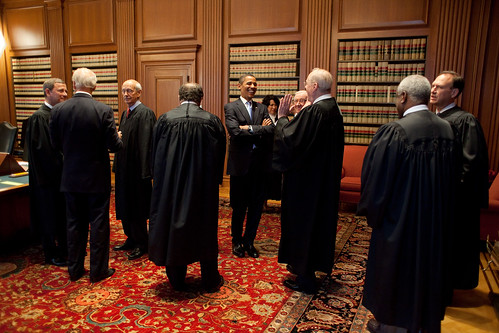
Let's analyze this picture of Obama and the Justices (and Biden).
Keep in mind that this is the shot the White House chose to put up on its Flickr page. (There's also this pic of Obama shaking hands with his appointee Sonia Sotamayor — with Scalia looking thoroughly delighted.)

(Enlarge.)
That's Biden, on the left, with his back to the camera, talking to Breyer and Roberts. The charming Roberts looks charmed by the gasbag VP, while Breyer — though more liberal than Roberts — looks like he's sleeping on his feet.
The short hulk by himself with his back to the camera is Scalia. Also alone, lurking in the background, is the newest Justice, Sonia Sotomayor. Or is Ruth Bader Ginsburg back there too (in the ladies section?) out of camera range?
Brooding over on the extreme right are Justice Thomas and Alito.
In the center, there's the President. As Stevens looks on, Obama laughs at Justice Kennedy's vain effort to enlist the Prez in a game of pattycake. Oh! Pattycake! Such fun!
IN THE COMMENTS: Freeman Hunt says:
(Enlarge.)
That's Biden, on the left, with his back to the camera, talking to Breyer and Roberts. The charming Roberts looks charmed by the gasbag VP, while Breyer — though more liberal than Roberts — looks like he's sleeping on his feet.
The short hulk by himself with his back to the camera is Scalia. Also alone, lurking in the background, is the newest Justice, Sonia Sotomayor. Or is Ruth Bader Ginsburg back there too (in the ladies section?) out of camera range?
Brooding over on the extreme right are Justice Thomas and Alito.
In the center, there's the President. As Stevens looks on, Obama laughs at Justice Kennedy's vain effort to enlist the Prez in a game of pattycake. Oh! Pattycake! Such fun!
IN THE COMMENTS: Freeman Hunt says:
Imagine holding a party. Your spouse takes pictures. When the guests leave, you say, "I'll email a group picture to you all."
The guests check their email accounts the next morning to find a picture wherein all of them have their backs to the camera or are by some other means obscured. Except you. You stand, fully visible, smiling broadly, center frame.
He he he.
Friday, August 14, 2009
"We have been in dozens of Wal-Mart parking lots throughout the country, actually it’s one of our favorite things to do..."
"... if we’re not having to plug in and we’ve got enough electricity and all that. But you can get a little shopping in, see part of real America. It’s fun!"
Clarence Thomas's wife talks about traveling around America in an RV with her husband, whom most people don't recognize. They drive a 40-foot Prevost bus, customized by Marathon Coaches, which looks damned glamorous.
Clarence Thomas's wife talks about traveling around America in an RV with her husband, whom most people don't recognize. They drive a 40-foot Prevost bus, customized by Marathon Coaches, which looks damned glamorous.
Wednesday, May 6, 2009
Arlen Specter tells us about Bob Dole's penis — and other things.
From the Deborah Solomon interview:
Specter also accidentally says he wants Norm Coleman to win. Oops!
You and Bob Dole share a hometown, Russell, Kan. What do they put in the water there?Okay, enough cock talk. Unless this counts;
Debaters’ tonic. Russell is famous for its high-school debate championship teams.
Did you know Dole in your Kansas days?
No. When I moved to Russell in the eighth grade, he was much older, but in the intervening years I’ve pretty much caught up to him.
I assume this was before he was appearing on television in Viagra commercials.
From reliable sources, he did not need Viagra then.
Many women can never forgive you for your aggressive questioning of Anita Hill during the Clarence Thomas confirmation hearings. Do you regret your behavior?This doesn't count:
No. When a serious charge is made like sexual harassment, the subject is entitled to question the accuser and find out the facts, and that’s what I did.
You’re 79 and you’ve endured two bouts of Hodgkin’s disease. Why would you want to run for re-election?Vanity...
Don’t forget my brain tumors or my bypass surgery or the incorrect diagnosis of A.L.S. on the list of my maladies. But I’m full of vim, vigor and vitality....
Specter also accidentally says he wants Norm Coleman to win. Oops!
“In the swirl of moving from one caucus to another, I have to get used to my new teammates,” he said. “I’m ordinarily pretty correct in what I say. I’ve made a career of being precise. I conclusively misspoke.”And when he finds more Democratic members, may he tell us what he knows about their members too.
Asked who he’s backing now in elections, Specter said, “I’m looking for more Democratic members. Nothing personal.”
Monday, May 4, 2009
There will be math.
Yesterday, I said that, contrary to Arlen Specter's assertion, black people are not underrepresented on the Supreme Court. I noted the presence of Clarence Thomas, the fact that 1 is 11.1111 percent of 9, 2 is 22.2222 percent of 9, and that African-Americans make up 13.4% of the U.S. population.
In the comments, JackOfClubs defended Spector:
In the comments, JackOfClubs defended Spector:
Technically, he's right since 11.11...% is less than 13.4%. To get an accurate representation, we would need 0.134 * 9 = 1.206 black people on the Court. This could be achieved if the next candidate were 13/64 = .203125 black, i.e. if 13 of his or her great-great-great-great grandparents were black and the other 51 were some other race. This approximation would be precise to the 2nd decimal place which is really all we can expect given that the original statistic of 13.4% is probably rounded. A slightly more precise approximation could be achieved by looking for someone 53/256 = .2070312 black, but that would just be silly.More math satire, from Mike S:
The views of Blacks (13% of the population) are only under-represented on the court if they are on the LOSING end of an 8-1 or 9-0 decision. If they are on the losing end of 7-2, 6-3, or 5-4 decisions, or on the winning side of any decision, they are over-represented.
The views of whites (60% of the population), on the other hand, are under-represented if they are on the LOSING end of ANY decision.
Therefore, to be fair, all supreme court cases should be decided by a nationwide poll of white people.
Tuesday, April 28, 2009
The Supreme Court decides the "fleeting expletives" case.
SCOTUSblog reports:
Splitting 5-4, the Supreme Court upheld the government’s power under existing law to ban the use on radio and TV of even a single four-letter word that is considered indecent — but left open the question of whether the ban might violate the First Amendment, at least in some situations. The Court, in an opinion by Justice Antonin Scalia, said the Federal Communications Commission’s switch in policy to ban even a fleeting use of such a word was “entirely rational” under the law that governs federal administrative powers....Glitteratae... female glitterati? Cher was involved. And Nicole Ritchie.
His written opinion, in a case dealing with uses of those four-letter words during performance awards broadcasts involving celebrities, took a swipe at “foul-mouthed glitteratae from Hollywood.”
Basically, the ruling simply means that the FCC provided a sufficient explanation of why it switched from a more relaxed policy on “dirty words” to a near-total ban on “fleeting expletives.”So the constitutional free-speech question remains.
... Justice Clarence Thomas, in a separate concurring opinion, said he would be open to reconsidering two of the Court’s major precedents that allow the government the constitutional authority to treat broadcasting differently from the rest of the press for First Amendment purposes. Those two precedents — Red Lion Broadcasting v. FCC in 1969 and FCC v. Pacifica Foundation in 1978 — brought a “deep intrusion into the First Amendment rights of broadcasters”....Bring it on.
Subscribe to:
Posts (Atom)