Showing posts with label Ginsburg. Show all posts

Saturday, July 2, 2011

Prof. Chemerinsky says Justice Ginsburg "has in her power the ability to prevent a real shift in the balance of power on the court."

"On the other hand, there's the personal. How do you decide to leave the United States Supreme Court?"

Wow! How much of this kind of moral pressure is being applied to the venerable Justice?
Democrats and liberals have a nightmare vision of the Supreme Court's future: President Barack Obama is defeated for re-election next year and Justice Ruth Bader Ginsburg, at 78 the oldest justice, soon finds her health will not allow her to continue on the bench.

The new Republican president appoints Ginsburg's successor, cementing conservative domination of the court, and soon the justices roll back decisions in favor of abortion rights and affirmative action.
Abortion and affirmative action. Abortion and affirmative action. That's the fixed point in constitutional law for a lot of people: it must work out in favor of abortion and affirmative action.
[S]ome on the left say ... Ginsburg needs to put self-interest aside and act for the good of the issues they believe in, Harvard law professor Randall Kennedy wrote recently. Kennedy said 72-year-old Justice Stephen Breyer should leave, too....
Get out, you selfish oldies — say some on the left — Obama needs to appoint some liberal ideologues before its too late!
David Garrow, a Cambridge University historian who follows the court, said Ginsburg's situation points to an institutional problem for the court, "the arguably narcissistic attitude that longer is better."
Narcissist!
Justices sometimes look at electoral projections when considering retirement, he said, adding that Ginsburg probably still could decide to retire next summer if Obama's electoral prospects seem shaky.
The rest of the article is a history lesson about how waiting too long doesn't work. Earl Warren, LBJ, Richard Nixon, Warren Burger and all that. The message is clear. The liberal media want Ruth Bader Ginsburg out now.

I know that sounds mean, but it's not me saying it. I'm just paraphrasing for clarity.

Monday, June 20, 2011

The Wal-Mart case was decided unanimously, but it was 5-4 in a very important way.

Permit me to explain what is a bit complicated. Under Federal Rule of Civil Procedure 23, which governs class action, there is a set of preliminary requirements in subsection (a) and then a list of 3 types of class actions in subsection (b). The class must meet all the requirements in (a) and then fit one of the categories in (b).  The Scalia opinion (joined by the Chief Justice and Kennedy, Thomas, and Alito) and the Ginsburg opinion (joined by Breyer, Sotomayor, and Kagan)  agree that the district court erred in putting the class into the second category in subsection (b), but only the Scalia majority also thought a preliminary requirement in 23(a) was not met. Since all class actions — in any of the (b) categories — must meet the requirements in (a), the Scalia opinion has a much more restrictive effect on class actions.

Let's focus on that disagreement. The proposed class included all current and former female employees of Wal-Mart, well over a million women. Rule 23(a) requires that all the members of the class share a common question of law or fact. Wal-Mart had a policy of decentralizing employment decisions to the store level, and the plaintiffs, attempting to satisfy 23(a), said that Wal-Mart has "a strong and uniform 'corporate culture' [that] permits bias against women to infect, perhaps subconsciously, the discretionary decisionmaking of each one of Wal-Mart’s thousands of managers — thereby making every woman at the company the victim of one common discriminatory practice."

Is this policy of decentralizing decisionmaking a common question? Scalia called it "a policy against having uniform employment practices." There have been cases in which an "undisciplined system of subjective decisionmaking" has been held to violate Title VII (the federal statutory law about employment discrimination). But in the case of Wal-Mart, once the decisionmaking was decentralized to the store level, there would be differences from store to store in how that decisionmaking would be done. Even assuming there was an undisciplined system of subjective decisionmaking in every store, each  store would might have its own undisciplined system of subjective decisionmaking. To meet the Rule 23(a) requirement of a common question, Scalia wrote, there would need to be a "specific employment practice" that was applied to all the members of the class, not simply a policy that created the conditions for thousands of stores to devise specific employment practices. 

Ginsburg thought that Wal-Mart's delegation of discretion, "uncontrolled by formal standards, has long been known to have the potential to produce disparate effects."
Managers, like all humankind, may be prey to biases of which they are unaware. The risk of discrimination is heightened when those managers are predominantly of one sex, and are steeped in a corporate culture that perpetuates gender stereotypes."...
Ginsburg tried to portray Scalia as importing a requirement that the common questions predominate over the individual questions. (That actually is a requirement in one of the subsection (b) categories.) But that's not what Scalia did. Scalia said that the decentralization move simply wasn't a question in the case and that the actual questions are specific to the store level and not to the entire class the plaintiffs attempted to define.

ADDED: After reading the case and trying to explain it as clearly as I could, I've been reading some of the press accounts, and... I can't say I'm surprised, but what politicized drivel!

"The Supreme Court on Monday blocked a massive sex discrimination lawsuit against Wal-Mart on behalf of women who work there."

WaPo reports:
The court ruled unanimously that the lawsuit against Wal-Mart Stores Inc. cannot proceed as a class action, reversing a decision by the 9th U.S. Circuit Court of Appeals in San Francisco. The lawsuit could have involved up to 1.6 million women, with Wal-Mart facing potentially billions of dollars in damages....

The justices divided 5-4 on another aspect of the ruling that could make it much harder to mount similar class-action discrimination lawsuits against large employers.

Justice Antonin Scalia’s opinion for the court’s conservative majority said there needs to be common elements tying together “literally millions of employment decisions at once.”

But Scalia said that in the lawsuit against the nation’s largest private employer, “That is entirely absent here.”

Justice Ruth Bader Ginsburg, writing for the court’s four liberal justices, said there was more than enough uniting the claims. “Wal-Mart’s delegation of discretion over pay and promotions is a policy uniform throughout all stores,” Ginsburg said.
I hope the GOP candidates for President are smart and articulate enough to use this case in their argument against electing the Democratic President to a second term.

ADDED: After the oral argument, back in March, I wrote:
I think plaintiffs are trying to say that if headquarters can see a pattern of women doing poorly under the decentralized discretion system, then keeping that system in place is a discriminatory policy. That absence of centralized control is the common issue that makes it an appropriate class action (rather than lot of individual cases that ought to be brought separately if at all).

So... the thing that makes a million individuals the same is that they... are different. They should have been made the same.... or more alike... by a sex-discrimination-conscious policy. I think it's possible to get your head around that idea, but nearly impossible to picture workable legal doctrine governing the real-world affairs of human beings... including the judges who would apply it.
ALSO: I'm reading Justice Scalia's assessment of the "social framework" analysis that the plaintiffs offered to prove that Wal-Mart had "a general policy of discrimination" (which was supposed to be the common question supporting the class action form of litigation):
[Dr. William] Bielby testified that Wal-Mart has a “strong corporate culture,” that makes it “ ‘vulnerable’ ” to “gender bias.” Id., at 152. He could not, however, “determine with any specificity how regularly stereotypes play a meaningful role in employment decisions at Wal-Mart. At his deposition … Dr. Bielby conceded that he could not calculate whether 0.5 percent or 95 percent of the employment decisions at Wal-Mart might be determined by stereotyped thinking.” 222 F. R. D. 189, 192 (ND Cal. 2004)....“[W]hether 0.5 percent or 95 percent of the employment decisions at Wal-Mart might be determined by stereotyped thinking” is the essential question on which respondents’ theory of commonality depends. If Bielby admittedly has no answer to that question, we can safely disregard what he has to say.
AND: I've written a new post to help you understand the way in which this was not a unanimous decision.

Saturday, May 21, 2011

"Justice Anthony M. Kennedy... said he aspired to Ernest Hemingway’s stripped-down language..."

Talk about falling short of your aspirations! Of all the Justices on the Court today, I find that Justice Kennedy writes in the least straightforward style. Ah, well. At least he means well. Or is he conning us with this Hemingway talk?

The linked article — by Adam Liptak, in the NYT — links to this set of long recorded interviews with Supreme Court Justices about how they write and how they want lawyers to write.
Justice Ginsburg said she had learned much from a course Nabokov taught at Cornell on European literature.

“He was a man in love with the sound of words,” she said of her former professor. “He changed the way I read, the way I write.”

Justice Thomas, on the other hand, cited only a single author, and then only by way of contrast. “It’s not a mystery novel,” he said of a good brief. “People can’t think, ‘I’m Agatha Christie,’ or something like that.”
Ginsburg and Nabokov. Thomas and Christie. What do you think of Liptak's juxtaposition? It's a literary device. Would you put it at the Nabokov level? The Christie level? Somewhere lower?

ADDED: Both Nabokov and Agatha Christie are discussed in the Wikipedia article "Unreliable Narrator":
A controversial example of an unreliable narrator occurs in Agatha Christie's novel The Murder of Roger Ackroyd, where the narrator hides essential truths in the text (mainly through evasion, omission, and obfuscation) without ever overtly lying. Many readers at the time felt that the plot twist at the climax of the novel was nevertheless unfair....

Humbert Humbert, the main character and narrator of Vladimir Nabokov's Lolita, often tells the story in such a way as to justify his pedophilic fixation on young girls, in particular his sexual relationship with his 12-year-old stepdaughter....
Now, you want your judges and lawyers to be reliable narrators when they tell you about the facts of the case and interpret and apply the law. Thomas said don't be like Agatha Christie. You need to tell it straight. But Ginsburg said she learned from Nabokov, learned to love the sound of the words. Liptak — I think — intended to make Ginsburg look good and Thomas bad, but it didn't quite work out that way.

Sunday, October 31, 2010

"Her womb was a barren desert in which my seed could find no purchase."

April finally comes up with the quote that my quote from Larry Tribe reminded her of. I was riffing on "Neither Steve Breyer nor Ruth Ginsberg has much of a purchase on Tony Kennedy's mind." The quote that had found purchase in April's brain was from from "Raising Arizona."

What if the odd and arch use of the word "purchase" gained purchase in Larry Tribe's brain because he'd watched "Raising Arizona." Suddenly "the idea of the image Tribe had of Kennedy's brain" is funny in a whole new way. "Justice Kennedy's brain/womb was a barren desert in which Breyer/Ginsburg's seed could find no purchase." Tribe thought Elena Kagan would be much better at.... what?

But it's not such an odd image. We speak of fertilizing minds and seminal ideas and gestating thoughts and mindfucks.

Sunday, June 27, 2010

Tom Goldstein predicts the outcomes (and the authors) of the final 4 Supreme Court cases of this Term.

To be announced tomorrow morning:

1. Bilski v. Kappos:
The only Justice who has not issued a majority opinion from [the November] sitting is Justice Stevens, which makes him the very likely author. Justice Stevens tends to take a narrow view of patent rights...

I ultimately predict that the Bilski majority opinion will be authored by Justice Stevens and that the decision will be very significant in its narrowing of the scope of method patents.
2. Free Enterprise Fund v. Public Company Accounting Oversight Board:
[N]either the Chief Justice nor Justice Kennedy has authored an opinion from [the December] sitting... [but] Chief is ... unlikely to leave himself without an opinion in a sitting.

If I’m right, that means that the PCAOB’s structure is likely to be invalidated as unconstitutional. At oral argument the Chief Justice asked no questions of counsel to the plaintiffs and was hostile to the defense of the statute....
3. McDonald v. City of Chicago:
[T]he only Justice not to write from [the February] sitting is Justice Alito....

I predict that Justice Alito will write the Court’s opinion in McDonald recognizing that the Second Amendment is incorporated [in the 14th Amendment and thus applicable to state and local government]....
4. Christian Legal Society v. Martinez:
Neither Justice Stevens nor Justice Ginsburg authored an opinion from [the April] sitting....

Though it is very difficult to tell, I think that the most likely outcome in these circumstances is that Justice Ginsburg will issue a majority opinion in favor of Hastings Law School on the relatively narrow basis that the plaintiffs stipulated that the school had a neutral “all comers” policy that did not discriminate against this group but instead provided that all groups must accept all students
We shall see. It's a big Supreme Court day tomorrow. The Court's Term ends, with the retirement of Justice Stevens, and the hearings on the Kagan nomination begin.

Wednesday, October 14, 2009

"Have you ever conducted a capital case in which the defendant takes the stand with a Hitler moustache and says he's glad for what he's done and he will do it again?"

Justice Antonin Scalia, at oral argument, yesterday.

"What would you have done? It makes sense logically to say he has the worst defendant he has ever seen. He's murdered lots of people in cold blood. He gets up on the stand and says, 'I'm going to kill a lot more.' He sounds totally bonkers."

Said Justice Stephen Breyer.

Is it possible to be constitutionally ineffective when you've got such a bad client?

Justice Ruth Bader Ginsburg tried to help: ""What's remarkable about it is at no point did counsel say, 'Give him a life sentence.' He said that either one would be acceptable: either death or life would be acceptable."

So did Justice Sonia Sotomayor, remarking on the lawyer's strategy of using the crimes themselves as evidence of mental illness": "At some point you can have a strategy and execute it so poorly, so incompetently, that you're providing ineffective assistance of counsel."

Saturday, September 19, 2009

"On Sunday, President Barack Obama will execute what might be called a Modified Full Ginsburg..."

"... appearing on five Sunday morning talk shows to make a pitch for health reform. It’s a move few politicians have attempted. Even fewer have been able to stick the landing. The Full Ginsburg, of course, was named for Monica Lewinsky’s lawyer William Ginsburg, who first did the five-fecta of Sunday talk on Feb. 1, 1999."

Of course. Wow. Some people need to get out of Washington more. Does Politico writer Eamon Javers really think that that we all remember the name William Ginsburg and his overexposure on Sunday shows 10 years ago? Or is this just another inane use of the verbal filler "of course"?

When I saw "Full Ginsburg," I thought of Ruth Bader Ginsburg...


... and "The Full Monty"....


... and I wasn't sure what to think.

A naked, yet prim President?

Anyway, yeah, too much Obama on TV. At some point, everyone's going to figure out that he actually is pretty tedious and that he's pushing some routine old political ideas.

That's good. We should get used to him. Very very used to him and tired of him.

And when that happens, it won't be racism. It will be racial progress. He's only a man. A politician. Calm down everyone. Think about whether we really want what he's selling. I bet we don't.

Tuesday, September 8, 2009

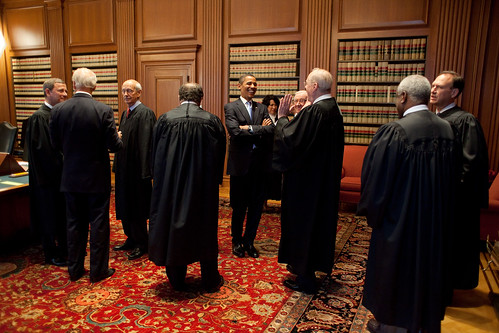
Let's analyze this picture of Obama and the Justices (and Biden).

Keep in mind that this is the shot the White House chose to put up on its Flickr page. (There's also this pic of Obama shaking hands with his appointee Sonia Sotamayor — with Scalia looking thoroughly delighted.)


(Enlarge.)

That's Biden, on the left, with his back to the camera, talking to Breyer and Roberts. The charming Roberts looks charmed by the gasbag VP, while Breyer — though more liberal than Roberts — looks like he's sleeping on his feet.

The short hulk by himself with his back to the camera is Scalia. Also alone, lurking in the background, is the newest Justice, Sonia Sotomayor. Or is Ruth Bader Ginsburg back there too (in the ladies section?) out of camera range?

Brooding over on the extreme right are Justice Thomas and Alito.

In the center, there's the President. As Stevens looks on, Obama laughs at Justice Kennedy's vain effort to enlist the Prez in a game of pattycake. Oh! Pattycake! Such fun!

IN THE COMMENTS: Freeman Hunt says:
Imagine holding a party. Your spouse takes pictures. When the guests leave, you say, "I'll email a group picture to you all."

The guests check their email accounts the next morning to find a picture wherein all of them have their backs to the camera or are by some other means obscured. Except you. You stand, fully visible, smiling broadly, center frame.

He he he.

Monday, June 1, 2009

Mental retardation as a mitigating factor ≠ mental retardation constitutionally barring execution.

These are 2 different issues, the unanimous Supreme Court said today. And Justice Ginsburg, the author of the opinion, schools the Sixth Circuit in the law of issue preclusion:
[M]ental retardation for purposes of Atkins, and mental retardation as one mitigator to be weighed against aggravators, are discrete issues. Most grave among the Sixth Circuit’s misunderstandings, issue preclusion is a plea available to prevailing parties. The doctrine bars relitigation of determinations necessary to the ultimate outcome of a prior proceeding. The Ohio courts’ recognition of Bies’ mental state as a mitigating factor was hardly essential to the death sentence he received. On the contrary, the retardation evidence cut against the final judgment. Issue preclusion, in short, does not transform final judgment losers, in civil or criminal proceedings, into partially prevailing parties.
Ouch.

Friday, May 1, 2009

Monday, April 13, 2009

Should Congress scrutinize the aging Supreme Court Justices and lean on them to retire?

Paul D. Carrington thinks so:
What can we do about justices who cling to power that they are no longer completely fit to exercise? District and court of appeals judges are subject to Circuit Judicial Councils, which look into citizens’ grievances against their conduct (though not their specific rulings).

Councils may then investigate and conduct hearings in confidence, and then perhaps order that at least temporarily no further cases be assigned to the judge whose conduct is in question. A council may censure a judge either privately or by a public pronouncement, or request his retirement. If a judge rejects a council’s advice, it could issue a statement to be considered by the House of Representatives that might initiate an impeachment proceeding.

Congress could establish a very similar process to apply to the justices....

This is not to suggest that any of our current Supreme Court justices should be addressed by such a discipline committee. But the mere existence of such a process would serve to remind our mortal justices that they have a right to serve during good behavior, not for life.
I don't think this is such a great idea. We all can see what the Supreme Court Justices are doing. There's no need for a special council with the work of scrutinizing them. It would either be too political — pressuring Justices based on how much various politicians like or want to appear to like the outcomes they've voted for — or it would be suspected of being that.

All that is needed is more frank discussion of age and its effects on the Justices, who don't get enough real-life feedback. Take this article — "Ginsburg Gives No Hint Of Giving Up the Bench," by Robert Barnes — published yesterday in the Washington Post:
The symposium on Justice Ruth Bader Ginsburg's life on and before the Supreme Court had all the trappings of a grand finale: laudatory tributes, scholarly evaluations of her jurisprudence, a running theme about her love of opera and her unfulfilled desire to be a great diva.

Conspicuously missing was any mention of an exit from the stage.

If anything, Ginsburg's appearance at Ohio State University's Moritz College of Law -- and at a host of other events since the 76-year-old justice had surgery in February to remove a cancerous pancreatic tumor -- seemed intended to send a contrary message....

In a video tribute shown at Friday's day-long symposium, Chief Justice John G. Roberts Jr. offered "my warm congratulations on the occasion of your reaching the midpoint of your tenure."
The midpoint. Get it? Oh, isn't that cute? Nothing but warm support and encouragement for staying on as long as her heart desires it.

But I bet we can't stop talking like that. It would be mean. And it's wrong to discriminate based on age. Blah blah blah blah. Ugh! Maybe I should endorse Carrington's proposal!

Tuesday, February 24, 2009

Obama's address to Congress... the live-blog.

Watch the don't-call-it-the-State-of-the-Union with me.

8:00: How come there are already 43 comments? The thing hasn't started yet! I suppose you guys are really excited about this. Nancy Pelosi has her olive-green sweatshirt on. I've chosen CBS... Katie Couric is obviously reading from a script.

8:04: Ruth Bader Ginsburg! Among the living! Closeups. Cheers.

8:05: Michelle Obama. Sleeveless! Purple!

8:06: Hillary! Looking radiant. Rahm! He's hot.

8:11: It's O! Red striped tie. Super-short hair. He's kissing all the ladies. The CBS commentary is soooo lame. This is true bipartisanship... except to the extent that it isn't....

8:15: Oops! O spoke over Nancy. Is Chief Justice Roberts there in the audience laughing?

8:20: We have terrible economic problems, but we're going to solve them. To do that, we need to understand how we got here. Then he lists various reforms — like health care — that I think he'd be listing even if there were no economic crisis. I can't see the connection between his economic wish list and the crisis at hand.

8:25: The text of the speech. Great, now like Nancy Pelosi, I can read along. It would be cool if Nancy had her laptop up there and was live-blogging.

8:31: Damn those executives with their jets and fancy drapes! No drapes for you!

8:33: Screw Wall Street but I love small business. Just be small and I will love you.

8:34: "Slowly, but surely, confidence will return, and our economy will recover." There's no lilt of hope in that. Whatever happened to all the hope? This is leaden and lecture-y.

8:37: Which member of Congress is most obviously up past his bedtime? I'm going to say Charles Rangel.

8:40: "It will be the goal of this administration to ensure that every child has access to a complete and competitive education – from the day they are born to the day they begin a career." So... no child left behind?

8:51: Orrin Hatch's name is invoked. We see him reading the speech and grimacing at his own name. He is not a prideful man.

8:59: Obama supports the troops.

9:03: Now, he's in the generic inspiration, listing-of-the-heroes part. Some businessman handed out money because "I didn't feel right getting the money myself." See, rich folk? Cough it up.

9:08: "Some day years from now our children can tell their children that this was the time" — oh, he's doing "this was the time" again — "when we performed, in the words that are carved into this very chamber, 'something worthy to be remembered.'" That was a goofy crescendo. I mean, paraphrase it: In the future, we'll look back and say that we remember doing something.

9:09: "And God Bless the United States of America." He almost forgot to say it.

9:22: Waiting for Bobby Jindal.

9:24: "Happy Mardi Gras!" Bobby's all enthusiastic about Barack Obama, the first African-American President!

9:26: Bobby learned a can-do attitude from his immigrant dad. His emphatic hand gestures are not quite in the camera frame. But I think his style is pretty good, though it sounds super-rehearsed. Somebody taught him every inflection I think. And that eye contact. It's a bit unnerving!

9:29: Jindal is nicely upbeat and confidence-inspiring. Don't monitor volcanoes! Monitor the eruption of spending!

9:35: The GOP wants to win back our trust.

9:37: Bobby: plastic and peppy. But maybe we'll get used to him.

Friday, August 29, 2008

Live-blogging the McCain VP announcement. UPDATE: "MCCAIN PICKS SARAH PALIN."

8:26: I don't know what it says about me, but I got up this morning and didn't think about the McCain VP announcement on my own. It wasn't until I turned on the TV news that the subject occurred to me. On the day Obama announced his pick, it was the second or third thought in my head after waking. This could mean that in my heart of hearts, I really have decided on Obama. It could simply mean that I'm more interested in Obama.

My blogging over the months clearly shows much greater interest in him, and that could be for any number of reasons. Some people might say, I'm just monitoring him, looking for things to attack, but an easier explanation is that he is just more interesting. He's new and different. His ongoing battle with Hillary Clinton made him more interesting. And she obviously also made his VP selection far more interesting.

On TV, on Fox, they are saying what they know is that Romney, Huckabee, and Pawlenty are out. [CORRECTED TEXT: I'd written "is up" for some strange reason.] Ah so, it's going to be a woman. I'm hearing this for the first time at 8:37 Central Time. I will reveal that, instantly, a chill ran through my body when I heard that, and I have broken a sob or two as I write this.

8:37: The Fox reporters are talking a lot about Sarah Palin. Exciting. To continue my theme of why I've been less interested in the McCain VP announcement, it might be that I'm just drained from watching way too much Democratic convention TV or that the Obama announcement was more interesting because it was first. But it might very well be that the Obama campaign had a great idea with its text-message announcement and, in particular, having us go to bed at night knowing or almost knowing that it would come in the middle of the night. That made me think of it immediately on awakening because the thought was: Quick, look at the web, get the answer now. I thought the text-message approach was annoying and dorky, but I should probably concede that Obama got inside my head.

8:52: There's talk about a jet leaving Fairbanks, Alaska late last night, and a woman in her 40s getting on board. Now, here's Charles Krauthammer saying that McCain should pick someone "as bland as possible." He refers to Palin as "a rookie out of Alaska" and says it might make sense to do something like this if he was seriously trailing in the polls and needed "a hail Mary." Krauthammer's idea of bland: Pawlenty would have been best. Second best: Romney. Or even Fred Thompson.

8:52: I haven't heard any talk from these Fox guys about the importance of jazzing up the Hillary devotees. I wasn't a Hillary devotee, as you know, but I am in the demographic group that locked onto her emotionally. Can you understand how we feel about women? I remember when Bill Clinton announced his first Supreme Court nominee. Most or all of the talk had been about males. Bill dragged out the selection process, and finally the announcement came: Ruth Bader Ginsburg. I remember a conversation with my neighbor that day when I got home from work:
Neighbor: So what do you think of Clinton's Supreme Court pick?

Me: I'm so glad he picked a woman.

Neighbor: Really. You care about that?

Me: Yeah!

Neighbor: I mean, we already have a woman on the Court. It's not a first. At some point, it's not special to pick a woman. When will you not care about it anymore?

Me: When there are 5 women on the Court -- in proportion to the population. 5, not 4, because women are more than 50% of the population.
That was 15 years ago, and I was more radical then. But the feeling remains. It means something. I was resistant to Hillary (because I think she betrayed women by attacking women to support Bill), but I know the feeling of women my age wanting to see women get through to the top.

9:13: I was just checking Wikipedia to make sure I had the right year for the Ginsburg appointment. Scanning the article, I see that when she went to college (at Cornell), one of her professors was Vladimir Nabokov. Random new fact of the day.

9:21: I've switched to CNN, and at the bottom of the screen I see the words: "Sources point to Palin as McCain's running mate; CNN has not confirmed."

9:33: Here's the WaPo article: "Speculation Mounts on McCain's Running Mate Pick: Alaska Governor Palin Said to Be on McCain's Short List for Vice President":
Three senior Republican sources said they had been told Palin was McCain's choice. But those accounts came amidst conflicting reports about whether Palin had arrived here on a chartered plane last night or was still in Alaska.

Republicans have never nominated a woman for their ticket, and Palin's scant experience would make her a surprise choice. She was elected governor two years ago, and before that was mayor of Wasilla (pop. 6,715).
Yikes. I Google for a list of the states in order of population and see that Alaska is the 4th smallest state by that measure. [AND: I was about to add that we think of Alaska as really big, but it's tiny by population. Only Wyoming, Vermont, and North Dakota are smaller. Biden's state -- I mean Delaware -- is bigger.]

CNN CONFIRMS!!!!

9:37: "MCCAIN PICKS SARAH PALIN." On the screen. Tears! Chills!!!!

9:42: On CNN now, Senator Kay Bailey Hutchison, who keeps talking about how little we know about Palin, but is guessing that "she'll hold her own." There's some talk about how "we'll all be eating mooseburgers."

9:42: A key puzzle about Palin has to do with abortion. They're discussing this on CNN now. Palin is a woman and may excite the Hillary supporters. But if Hillary's supporters were big on the abortion issue, they shouldn't like Palin, who vividly embodies pro-life. But you know, even people who believe abortion should be legal (like me) can have immense respect for individuals like Palin who live their own lives according to pro-life values, who make their choice to continue their pregnancies. And those who care about the rights of the disabled -- like many liberals -- should have great respect for a woman who did not discard the fetus she knew would be born with a serious disability, as was the case with Palin.

9:47: Oh, good lord, Hutchison is mispronouncing "Palin." She's overtly unenthusiastic!

9:53: The best attack of Palin is, of course, that she is inexperienced. It's a little hard for Obama people to say that, though, because their guy is inexperienced. Does that mean the best attack is silenced? No, it will transmogrify into an effort to catch her saying something that sounds inexperienced. I haven't heard her enough to have any idea whether she has the nerve and the mental capacity to sound right all the time. She's never been exposed like this before. So many people will be salivating at the chance to make her look bad.

10:16: Let's think about Palin in a debate with Joe Biden. How will that work? In the comments, Henry says:
[P]eople with almost not debating chops routinely "win" political debates.

Often these debates are "won" entirely on facial hair and body language. Palin could "win" a debate with Biden just by not looking like a warmed-over stiff.

Even if the debates were real debates, the fact that Palin is inexperienced politically has no bearing on her debating skills.

We know she'd cream Biden in 1 on 1 basketball. The debates have about the same relationship to political experience as that.
I was just reading that in the comments, and now, I notice it's the topic on CNN too. I flip over to Fox for a second, and there's a smiling Palin, in a light green t-shirt and eating a vanilla ice cream cone. Voice over: "People love her."

10:21: More from the comments. This is from Peter V. Bella:
Man, the leftist whackos and nutroots are going to come out of the woodwork like cockroaches. Pallin wears fur, she hunts and eats moose burgers, she is a life long member of the NRA, and the worst, the absolute worst crime -- her husband is a fisherman who works in the oil fields in the off-season. Yep, a regular working stiff. The kind of guy they hate and are jealous of. Not a lawyer or a fuzzy headed policy wonk; not a professor of basket weaving or Mayan Mysticism, not someone who lives off the teat of government grants; but a real, solid, hard core, working man. A guy who gets his hands dirty every day. The average Joe American.

What makes her even more odious is she actually worked with her husband on the fishing boats. She really, actually worked for a living. The Gospel chorus is lining up to rage and rant; “my God, how can he pick someone like that? Working people, why, they, they, they, know too much about real life!”

PETA, the anti-gun nuts, ELF, KOS, MYDD, Huffingglue and probably a host of others will be gnashing their teeth, pounding their drums, shaking their chubby little fists and green tamborines, and going into full, foaming at the mouth, rabid attack mode. They are going to have heartastrokes over this.
10:35: On CNN, they're reading messages off their website, including the statement that McCain "is trying to out-minority Barack Obama." Earth to nameless CNN website commenter: Women are not a minority.

10:38: I'm going back to my first post about Sarah Palin, which was only last June. Excerpt:
Alaska! With Hawaii represented by Barack Obama, it would be cool to give the other latecomer state some respect at this time. It's always troubled me that Hawaii's been so far off and disconnected from the rest of the United States, and it's good that there's another disconnected state to keep it company. (You know when I was a kid in the 1950s, I heard discussion of Alaska becoming a state, and when someone said "I hear Hawaii is coming in too," I thought the islands were somehow floating over and would connect to the west coast.) Alaska's important too: oil-related. We're going to be talking about gas prices, and having the governor of Alaska will resonate.
10:39: We're over 200 comments, so switch the commenting to the new Palin post, here. And I'll carry on there too.

Monday, December 10, 2007

"It is better to receive than to give... at least when the subject is guns."

Justice Ginsburg, concurring, characterizes today's opinion in Watson v. United States:
For reasons well stated by Justice Scalia in his dissenting opinion in Smith, 508 U. S., at 241, I would read the word “use” in §924(c)(1) to mean use as a weapon, not use in a bartering transaction. Accordingly, I would overrule Smith, and thereby render our precedent both coherent and consistent with normal usage. Cf. Henslee v. Union Planters Nat. Bank & Trust Co., 335 U. S. 595, 600 (1949) (Frankfurter, J., dissenting) (“Wisdom too often never comes, and so one ought not to reject it merely because it comes late.”).
Everyone else on the Court accepted the distinction between giving and getting. Justice Souter finds "the appeal to symmetry underwhelming":
The problem... is not with the sturdiness of Smith but with the limited malleability of the language Smith construed, and policy-driven symmetry cannot turn “receipt-in-trade” into “use.” Whatever the tension between the prior result and the outcome here, law depends on respect for language and would be served better by statutory amendment (if Congress sees asymmetry) than by racking statutory language to cover a policy it fails to reach.

Monday, June 4, 2007

Four new Supreme Court opinions.

Howard Bashman has the links. I'll update soon with more detail.

UPDATE #1: Erickson v. Pardus is a per curiam opinion that rejects the too-strict pleading requirements the Sixth Tenth Circuit imposed on a pro se prisoner who alleged that depriving him of his hepatitis medication constituted cruel and unusual punishment. "Federal Rule of Civil Procedure 8(a)(2) requires only 'a short and plain statement of the claim showing that the pleader is entitled to relief.' Specific facts are not necessary; the statement need only '"give the defendant fair notice of what the . . . claim is and the grounds upon which it rests."'"

UPDATE #2: Sole v. Wyner is a unanimous opinion, written by Justice Ginsburg, about what it means to be a "prevailing party" -- entitled to attorneys' fees -- in a §1983 civil rights case. The Court decided that winning a preliminary injunction is not enough if you go on to lose the case on the merits. The plaintiff, by the way, was fighting for the right to protest the war with a giant peace sign composed of naked people.

UPDATE #3: Uttecht v. Brown is a 5-4 opinion written by Justice Kennedy, with a dissenting opinion written by Justice Stevens and joined by Souter, Ginsburg, and Breyer and a dissenting opinion written by Justice Breyer and joined by Souter. This case concerns the degree of deference that is owed to a trial judge's decisions about when a juror should be excused based on an inability to follow instructions about the application of the death penalty. An excerpt from Stevens's opinion:
Today, the Court has fundamentally redefined — or maybe just misunderstood — the meaning of “substantially impaired,” and, in doing so, has gotten it horribly backwards. It appears to be under the impression that trial courts should be encouraging the inclusion of jurors who will impose the death penalty rather than only ensuring the exclusion of those who say that, in all circumstances, they cannot....

Judge Kozinski’s opinion for the Court of Appeals in this case is solidly grounded on the entire line of our cases recognizing the basic distinction dramatically illustrated by Justice Powell’s opinion in Darden and by Justice Rehnquist’s statement in Lockhart. He surely was entitled to assume that the law had not changed so dramatically in the years following his service as a law clerk to Chief Justice Burger that a majority of the present Court would not even mention that basic distinction, and would uphold the disqualification of a juror whose only failing was to harbor some slight reservation in imposing the most severe of sanctions.
I don't remember ever seeing the fact that a judge was a Supreme Court clerk used to bolster his opinion. Apparently, you're "entitled to assume" some things. I think that whole paragraph, the last paragraph of the Stevens dissent, is just screaming look at all the conservatives who agree with me. I've got Burger and Rehnquist and Powell... and Kozinski, who practically counts as a Supreme Court justice.

UPDATE #4: Safeco Insurance v. Burr is a case about the Fair Credit Reporting Act that I'm going to leave for someone else to untangle. My reticence and my use of the word "untangle" is based on this:
Souter, J., delivered the opinion of the Court, in which Roberts, C. J., and Kennedy and Breyer, JJ., joined, in which Scalia, J., joined as to all but footnotes 11 and 15, in which Thomas and Alito, JJ., joined as to all but Part III–A, and in which Stevens and Ginsburg, JJ., joined as to Parts I, II, III–A, and IV–B. Stevens, J., filed an opinion concurring in part and concurring in the judgment, in which Ginsburg, J., joined. Thomas, J., filed an opinion concurring in part, in which Alito, J., joined.
On the bright side: No one dissented.

"The White House is developing a short list of possible Supreme Court nominees..."

Writes Jan Crawford Greenburg:
The White House is not expecting a retirement, but it wants to be ready if a surprise announcement occurs, sources said.

It's widely considered that the most likely candidates for retirement are liberal Justices John Paul Stevens and Ruth Bader Ginsburg, although both have said emphatically that they do not plan to step down....

[A]dvisers are focusing on possible nominees who are believed to be solid judicial conservatives and would galvanize the base at a time when Bush desperately needs its support....

Leading Senate Democrats are already warning against solidly conservative nominees, and that could make confirmation difficult in the Democratic-controlled Senate.

Still, some of Bush's political advisers believe he would be better off tapping a strong conservative who would rally the base -- especially a nominee with a compelling life story who would be difficult for moderate Senate Democrats to oppose.
So there don't seem to be retirements in the offing this year, and I hope there are none. If there are, however, it will be an exciting political spectacle that I assume will be primarily about the 2008 election. As Greenburg indicates, the obvious strategic move for Bush is to defy what will be the Democrats' demand that he pick a centrist, and the key is to do it with a nominee that will make the Democrats look terrible opposing her (or him). Of course, we've already gone through this routine with Roberts and Alito, but that was: 1. before the Democrats got the majority in the Senate, 2. when the previous election was a positive one for Bush, 3. not on the eve of an election, 4. (assuming one of the liberal justices retires) not as likely to upset the balance on the Court, 5. not after 2 consecutive conservative appointments.