That quote has long been on my list of best quotes about federalism in the history of the Supreme Court, so I was pleased to see it quoted in a Supreme Court case that came out today, Bond v. United States. It's a quote within a quote, and now it's a quote within a quote within a quote.
One thing I like about it, aside from the sound principle — that the constitutional structures of government were devised to protect the people — is that Justice O'Connor, in New York v. United States, was quoting a Justice Blackmun opinion that was a dissent from an opinion she wrote one year earlier. In that earlier case, Coleman v. Thompson, Blackmun had chided her for relying on federalism as if it existed for the sake of the states rather than for the people. It seemed as though Justice O'Connor felt a need to get on the right side of that principle.
In today's case, Bond, the Blackmun/O'Connor idea about federalism was used to explain why a criminal defendant had standing to challenge the constitutionality of the federal crime she was charged with (the Chemical Weapons Convention Implementation Act of 1998). (Carol Anne Bond had put caustic chemicals on a doorknob, door handle, and mailbox likely to be touched by a woman who had gotten pregnant via Bond's husband.)
Bond made a federalism-based constitutional challenge, and the Court of Appeals said that she lacked standing because she wasn't asserting her own legal rights or interests — as required by standing doctrine. In this view, only the states have standing to raise the issue that Congress has exceeded its enumerated powers and made a crime in an area that is reserved to the states under the 10th Amendment.
Intuitively, you should sense that the Court of Appeals was wrong. Here's this woman, charged with a crime that is — if she's right about the scope of Congress's power — a nullity. She's supposed to endure conviction and punishment on the theory that only the state is allowed to say that Congress overstepped its power? That's crazy.
Do you see how eloquently the old Blackmun/O'Connor quote explained why it's crazy?
Because the limitations of federalism exist to protect citizens from the excesses of power, when Bond argues that there is a federalism limit on congressional power, she is asserting her own legal interests.
Showing posts with label Anthony Kennedy. Show all posts
Showing posts with label Anthony Kennedy. Show all posts
Thursday, June 16, 2011

Monday, May 23, 2011
"Today the Court affirms what is perhaps the most radical injunction issued by a court in our Nation’s history..."
"... an order requiring California to release the staggering number of 46,000 convicted criminals."
Writes Justice Scalia, dissenting today in Brown v. Plata:
Writes Justice Scalia, dissenting today in Brown v. Plata:
... My general concerns associated with judges’ running social institutions are magnified when they run prison systems, and doubly magnified when they force prison officials to release convicted criminals....The majority opinion in this 5-4 case is written by Justice Kennedy:
This case arises from serious constitutional violations in California’s prison system. The violations have persisted for years. They remain uncorrected....The central dispute was about the requirements of the Prison Litigation Reform Act of 1995 (PLRA), which was designed to reduce the role of federal courts in supervising state prisons.
After years of litigation, it became apparent that a remedy for the constitutional violations would not be effective absent a reduction in the prison system population....
Saturday, May 21, 2011
"Justice Anthony M. Kennedy... said he aspired to Ernest Hemingway’s stripped-down language..."
Talk about falling short of your aspirations! Of all the Justices on the Court today, I find that Justice Kennedy writes in the least straightforward style. Ah, well. At least he means well. Or is he conning us with this Hemingway talk?
The linked article — by Adam Liptak, in the NYT — links to this set of long recorded interviews with Supreme Court Justices about how they write and how they want lawyers to write.
ADDED: Both Nabokov and Agatha Christie are discussed in the Wikipedia article "Unreliable Narrator":
The linked article — by Adam Liptak, in the NYT — links to this set of long recorded interviews with Supreme Court Justices about how they write and how they want lawyers to write.
Justice Ginsburg said she had learned much from a course Nabokov taught at Cornell on European literature.Ginsburg and Nabokov. Thomas and Christie. What do you think of Liptak's juxtaposition? It's a literary device. Would you put it at the Nabokov level? The Christie level? Somewhere lower?
“He was a man in love with the sound of words,” she said of her former professor. “He changed the way I read, the way I write.”
Justice Thomas, on the other hand, cited only a single author, and then only by way of contrast. “It’s not a mystery novel,” he said of a good brief. “People can’t think, ‘I’m Agatha Christie,’ or something like that.”
ADDED: Both Nabokov and Agatha Christie are discussed in the Wikipedia article "Unreliable Narrator":
A controversial example of an unreliable narrator occurs in Agatha Christie's novel The Murder of Roger Ackroyd, where the narrator hides essential truths in the text (mainly through evasion, omission, and obfuscation) without ever overtly lying. Many readers at the time felt that the plot twist at the climax of the novel was nevertheless unfair....Now, you want your judges and lawyers to be reliable narrators when they tell you about the facts of the case and interpret and apply the law. Thomas said don't be like Agatha Christie. You need to tell it straight. But Ginsburg said she learned from Nabokov, learned to love the sound of the words. Liptak — I think — intended to make Ginsburg look good and Thomas bad, but it didn't quite work out that way.
Humbert Humbert, the main character and narrator of Vladimir Nabokov's Lolita, often tells the story in such a way as to justify his pedophilic fixation on young girls, in particular his sexual relationship with his 12-year-old stepdaughter....
Monday, February 7, 2011
Why is the New York Times just noticing this?
Liberals (including President Obama) think the Supreme Court was wrong in Citizens United to say that corporations have free speech rights, but newspaper and book publishers are corporations. For some reason, the NYT is acting like it took a year to notice this hitch (which has been perfectly evident since the Citizens United litgation began in the lower courts). I guess the excuse for pretending not to see what was obvious is that it has been hoping to rely on the notion that some corporations have more rights than others. This new piece — a column by Adam Liptak — begins to concede that is an unworkable argument.
“There is no precedent supporting laws that attempt to distinguish between corporations which are deemed to be exempt as media corporations and those which are not,” Justice Kennedy wrote in Citizens United....But Liptak's column peters out with a quote from a lawrpof who calls it a "difficult question" and...
Eugene Volokh, a law professor at the University of California, Los Angeles, has reviewed the historical evidence. The bottom line, he said, is this: “If ordinary business corporations lack First Amendment rights, so do those business corporations that we call media corporations.”
There good arguments both ways about whether corporations ought to be covered by the First Amendment. But it is harder to say that some corporations have First Amendment rights and others do not.Yes, yes, it's obvious what the answer needs to be, and yet the debate must go on and on because it's so important to restrict the speech of people who organize themselves into corporations. Some of them. The bad guys. Not the good guys, like the ones who take a year to getting around to half-conceding the crushingly obvious.
Thursday, January 13, 2011
Can the police break down your door and burst in on you if they smell marijuana burning?
They don't have a warrant, but no warrant is needed under "exigent circumstances," such as when there is evidence of destruction of evidence. In the case argued in the Supreme Court today, after the police knocked and announced themselves, they heard a toilet flushing. Is that enough?
Kennedy uses this opportunity to ask why the smoking of marijuana itself doesn't constitute the destruction of evidence.
Friday, December 31, 2010
"The protection accorded under Irish law to the right to life of the unborn was based on profound moral values deeply embedded in the fabric of society in Ireland and the legal position was defined through equally intense debate."
Wrote the European Court of Human Rights in Case of A, B, and C v. Ireland, which Linda Greenhouse discusses in the NYT:
No right under the [European] Convention was violated [where the plaintiffs were able to travel to another country to obtain an abortion], the court said by a vote of 11 to 6. Granted, “the process of traveling abroad for an abortion was psychologically and physically arduous” for these women. And granted also that in their particular circumstances, they could have obtained legal abortions in 35 to 40 other countries covered by the Convention. But because Ireland’s law is based “on the profound moral views of the Irish people as to the nature of life,” the court said, Ireland was entitled to an extra “margin of appreciation.” This phrase expresses a measure of deference toward a country’s right within the framework of international law to chart its own domestic course. With its extra margin, Irish law prevailed.Greenhouse notes that the European Court accepted a situation similar to what would come into being if the United States Supreme Court withdrew the constitutional right to abortion and the matter were left to state law. She says the case gave her "the eerie feeling that I was peering into a domestic future."
Obviously, not all states would choose to join the anti-abortion bandwagon, even if they had the Supreme Court’s permission. California, New York, the District of Columbia, Connecticut and Massachusetts (once two of the most anti-abortion states, but times change) would remain places of refuge for desperate women, Englands to the Irelands that are Wyoming (which has no abortion provider), the Dakotas, or the Deep South, where a shrinking handful of doctors provide abortions in a hostile regulatory climate. More than a third of all women live in counties without an abortion provider, and that number is growing. Long-distance travel is made more onerous in the half of the states that require 24-hour waiting periods after “counseling,” necessitating two trips or an overnight stay.The second commenter over there brings up Justice Kennedy's interest in referring to international law:
The right has roundly criticized Justice Kennedy for his interest in international law. Whaddaya bet they won't criticize him for citing the case of A, B & C v. Ireland? Watch the Court chip, chip, chip away at Roe & at Planned Parenthood v. Casey.Well, what about the left? What about those who approve of the use of the decisions from foreign court in the analysis of American constitutional law? Whaddaya bet they won't want to have to pay any attention to "the right to life of the unborn... based on profound moral values deeply embedded in the fabric of society"?
Wednesday, November 3, 2010
If the government gives tax credits for donations that may go to religion, is that essentially the same as government spending on religion?
Lyle Denniston reports on the oral argument today in Arizona Christian School Tuition Organization v. Winn. This is a case about tax credits for contributions made to private tuition funds that make grants to students who go to private schools. Many of those schools are religious and some of the qualified funds only make grants to students who go to religious religious schools. Denniston begins his description with a claim that he detected Elena Kagan's purchase on the mind of Tony Kennedy (a subject we were just talking about the other day). Denniston says Kagan and Kennedy — the 2 Ks (sounds like trouble!) — "took crucial, reinforcing roles." I don't see much support for that point.
This case has a substantive Establishment Clause issue — whether government is subsidizing religion — and a threshold issue about standing — whether taxpayers can sue over this. These issues are linked because they both may depend on whether a tax credit turns the privately donated money into money from the state.
The lawyer defending the Arizona program said it was like tax deductions. People take tax deductions for their contributions to religious organizations all the time. What's different about tax credits? The lawyer arguing against the program "said that the money that is involved in the Arizona program is money raised by a tax; without a tax, there would be no tax credit."
If we view the tax credit as coming from the state's money, amassed by taxing, then the taxpayers who brought the suit probably have standing. But does that also answer the Establishment Clause question? Private citizens decide whether to contribute to a fund and pick from the qualified funds, not all of which exclusively fund religious schools, and the children getting the grants are choosing which school they want to go to. So there are 2 levels of private choice. And the definition of the funds is neutral and not religion-based.
Here's the complete transcript of today's argument.
UPDATE, April 4, 2011: The Supreme Court held that the plaintiffs lack standing.
This case has a substantive Establishment Clause issue — whether government is subsidizing religion — and a threshold issue about standing — whether taxpayers can sue over this. These issues are linked because they both may depend on whether a tax credit turns the privately donated money into money from the state.
The lawyer defending the Arizona program said it was like tax deductions. People take tax deductions for their contributions to religious organizations all the time. What's different about tax credits? The lawyer arguing against the program "said that the money that is involved in the Arizona program is money raised by a tax; without a tax, there would be no tax credit."
If we view the tax credit as coming from the state's money, amassed by taxing, then the taxpayers who brought the suit probably have standing. But does that also answer the Establishment Clause question? Private citizens decide whether to contribute to a fund and pick from the qualified funds, not all of which exclusively fund religious schools, and the children getting the grants are choosing which school they want to go to. So there are 2 levels of private choice. And the definition of the funds is neutral and not religion-based.
Here's the complete transcript of today's argument.
UPDATE, April 4, 2011: The Supreme Court held that the plaintiffs lack standing.
Sunday, October 31, 2010
"Her womb was a barren desert in which my seed could find no purchase."
April finally comes up with the quote that my quote from Larry Tribe reminded her of. I was riffing on "Neither Steve Breyer nor Ruth Ginsberg has much of a purchase on Tony Kennedy's mind." The quote that had found purchase in April's brain was from from "Raising Arizona."
What if the odd and arch use of the word "purchase" gained purchase in Larry Tribe's brain because he'd watched "Raising Arizona." Suddenly "the idea of the image Tribe had of Kennedy's brain" is funny in a whole new way. "Justice Kennedy's brain/womb was a barren desert in which Breyer/Ginsburg's seed could find no purchase." Tribe thought Elena Kagan would be much better at.... what?
But it's not such an odd image. We speak of fertilizing minds and seminal ideas and gestating thoughts and mindfucks.
What if the odd and arch use of the word "purchase" gained purchase in Larry Tribe's brain because he'd watched "Raising Arizona." Suddenly "the idea of the image Tribe had of Kennedy's brain" is funny in a whole new way. "Justice Kennedy's brain/womb was a barren desert in which Breyer/Ginsburg's seed could find no purchase." Tribe thought Elena Kagan would be much better at.... what?
But it's not such an odd image. We speak of fertilizing minds and seminal ideas and gestating thoughts and mindfucks.
Friday, October 29, 2010
“Neither Steve Breyer nor Ruth Ginsburg has much of a purchase on Tony Kennedy’s mind.”
That's actually the most embarrassing sentence in Larry Tribe's letter to Obama about who to nominate to the Supreme Court.
I love the use of the noun "purchase," meaning, not something you buy, but "A means of increasing power or influence" or "An advantage that is used in exerting one's power." That's the 5th definition of the noun in the 3d edition of the American Heritage Dictionary. Here are some other, related definitions:
Kagan, Tribe said, had a way of "gently but firmly persuading a bunch of prima donnas to see things her way in case after case." Of course, he was referring to the prima donna professors at Harvard Law School, and mainly talking about new faculty appointments, which is quite different from persuading Supreme Court Justices about interpretations of law. It's one thing to build a law school community where professors can spout diverse ideologies and still feel like it's a happy, functioning institution. It's quite another to amass votes for a legal proposition that produces an outcome in a case and binds all the courts in the United States.
And if the target of a light touch knows that the most powerful man in the world has selected that approach to prying his brain into a particular political direction, that target ought to become highly vigilant and not get played.
I'm sure Justice Kennedy doesn't need to be tipped off to this political scheme to clamber over the crusty crags of the convolutions of his brain. But Tribe's letter is amusing reading nonetheless.
I love the use of the noun "purchase," meaning, not something you buy, but "A means of increasing power or influence" or "An advantage that is used in exerting one's power." That's the 5th definition of the noun in the 3d edition of the American Heritage Dictionary. Here are some other, related definitions:
2. A grip applied manually or mechanically to move something or prevent it from slipping.You get the idea of the image Tribe had of Kennedy's brain? If you read the whole letter — PDF — you'll see that Tribe thought Justice Souter had "purchase," and he was worried that without Souter, Kennedy would roll toward the "Roberts/Alito/Scalia/Thomos wing of the Court." He thought Elena Kagan — and not Sonia Sotomayor — would operate — as a tackle or lever? — to move "Tony Kennedy's mind."
3. A device, such as a tackle or lever, used to obtain mechanical advantage.
4. A position, as of a lever or one's feet, affording a means to move or secure a weight.
Kagan, Tribe said, had a way of "gently but firmly persuading a bunch of prima donnas to see things her way in case after case." Of course, he was referring to the prima donna professors at Harvard Law School, and mainly talking about new faculty appointments, which is quite different from persuading Supreme Court Justices about interpretations of law. It's one thing to build a law school community where professors can spout diverse ideologies and still feel like it's a happy, functioning institution. It's quite another to amass votes for a legal proposition that produces an outcome in a case and binds all the courts in the United States.
And if the target of a light touch knows that the most powerful man in the world has selected that approach to prying his brain into a particular political direction, that target ought to become highly vigilant and not get played.
... I think it's clear that a Justice Kagan would be a much more formidable match for Justice Scalia than Justice Breyer has been... in the kinds of public settings in which it has been all to easy for Scalia to make his rigid and unrealistic formalism seem synonymous with the rule of law and to make Breyer's pragmatism seem mushy and unconstrained by comparison.Tribe says Kagan will be "simultaneously progressive yet principled, pragmatic and yet constrained." That sounds like pragmatism. How does it not "seem mushy" like Breyer's pragmatism? Because it's asserted to be "constrained," while Breyer's pragmatism "seem[s]... unconstrained"? Because it's progressive — steadily aimed in one direction and not more subtly varied?
I'm sure Justice Kennedy doesn't need to be tipped off to this political scheme to clamber over the crusty crags of the convolutions of his brain. But Tribe's letter is amusing reading nonetheless.
Thursday, October 14, 2010
Valerie Jarrett has to apologize for the heresy of calling homosexuality a "lifestyle choice."
Oh, life is so unfair!
(If it was inborn, I was told, then it will be perceived as a disease that might be cured, and therefore there can be no talk among decent people about the possibility that it is inborn. But what about science? What about discovering what is true? The official left-wing answer to that question, I learned, is: shut up.)
By the way, are you aware that Justice Kennedy spoke of the "homosexual lifestyle" in his opinion for the Supreme Court in Lawrence v. Texas?
“I meant no disrespect to the LGBT community, and I apologize to any who have taken offense at my poor choice of words,” Jarrett said. “Sexual orientation and gender identity are not a choice, and anyone who knows me and my work over the years knows that I am a firm believer and supporter in the rights of LGBT Americans.”I remember back in the 1980s, in the radical enclaves of the University of Wisconsin Law School and similar places, when it was heresy to say that sexual orientation was inborn. I remember getting snapped at by a very prominent left-wing lawprof for referring without scorn to research that showed some evidence that sexual orientation was innate. It was all about choice back then, and the choice model was deemed to be the framework upon which gay rights would be built.
(If it was inborn, I was told, then it will be perceived as a disease that might be cured, and therefore there can be no talk among decent people about the possibility that it is inborn. But what about science? What about discovering what is true? The official left-wing answer to that question, I learned, is: shut up.)
By the way, are you aware that Justice Kennedy spoke of the "homosexual lifestyle" in his opinion for the Supreme Court in Lawrence v. Texas?
The case does involve two adults who, with full and mutual consent from each other, engaged in sexual practices common to a homosexual lifestyle.Oops!
Monday, October 4, 2010
It's the first Monday in October, time for people like Barry Friedman and Dahlia Lithwick to tell us "the court has taken the law for a sharp turn to the ideological right..."
"... while at the same time masterfully concealing it." And, annoyingly enough — to them, anyway — ordinary Americans still think the Supreme Court is too liberal.
Like TV's "Masked Magician," Friedman and Lithwick want to reveal the secrets behind what they'd like you to think are magic tricks the Court uses to conceal its terrible right-wingitude.
First, they say, there's "stacking the deck": "picking cases with facts so extreme that only one outcome seems possible." One of only 2 examples they give is Gonzales v. Carhart, in which the Supreme Court, in 2005, upheld the federal law banning so-called partial-birth abortion. Friedman and Litwick say:
That it came to the Supreme Court in 2005 has nothing to do with the Court "stacking the deck"! Friedman and Lithwick just don't like what the case said about abortion rights, but the truth is that Gonzales v. Carhart was a moderate decision that avoided both extremes and, because of that, produced a separate opinion by Justices Thomas, joined by Justice Scalia (rejecting abortion rights altogether and questioning Congress's use of the Commerce Clause to regulate abortion), as well as a dissenting opinion consisting of the 4 Justices who, with the now-retired Justice O'Connor, had formed the majority in Stenberg.
The second "trick" Friedman and Lithwick identify is "misdirection":
Friedman and Lithwick have 3 more tricks to reveal/do, so if you're up for their whole show, click through and read.
How to explain the justices shoving the law rightward, while everyone thinks it is dead center or too far left?Their metaphor is magic — the article is accompanied by a photoshop of the Chief Justice in magician garb about to pull something out of a hat — and that question fails to acknowledge the difference between absolute and relative position. Obviously you can push — or shove as the exaggerated language of anguished liberals will have it — something to the right and have it still be on the left if the thing started out way the hell to the left. And obviously liberals know this: Tell Friedman/Lithwick that Anthony Kennedy is in the legal/political center because he's at the center of the current array of Supreme Court Justices. It will take them much less than a second to decide to inform you of the distinction between absolute and relative position.
Like TV's "Masked Magician," Friedman and Lithwick want to reveal the secrets behind what they'd like you to think are magic tricks the Court uses to conceal its terrible right-wingitude.
First, they say, there's "stacking the deck": "picking cases with facts so extreme that only one outcome seems possible." One of only 2 examples they give is Gonzales v. Carhart, in which the Supreme Court, in 2005, upheld the federal law banning so-called partial-birth abortion. Friedman and Litwick say:
The law bans late-term abortions in which the fetus is partially delivered before its brains are sucked out and skull collapsed. If you find it hard even to read that, you've caught the point: That's deck-stacking.But the Court didn't choose that case out of a big pool of abortion cases in order to get something with "gruesome facts" that would keep us from "notic[ing] the major inroads the case makes on women's rights more generally." Congress passed the Partial-Birth Abortion Ban Act in 2003, right after the Supreme Court had stricken down Nebraska's partial-birth abortion law in 2000, in Stenberg v. Carhart. The Court in Stenberg showed legislatures what would be needed to pass a law against these abortions that would avoid the same constitutional flaw and Congress responded with a statute that we knew would have to go through judicial scrutiny and end up in the Supreme Court.
That it came to the Supreme Court in 2005 has nothing to do with the Court "stacking the deck"! Friedman and Lithwick just don't like what the case said about abortion rights, but the truth is that Gonzales v. Carhart was a moderate decision that avoided both extremes and, because of that, produced a separate opinion by Justices Thomas, joined by Justice Scalia (rejecting abortion rights altogether and questioning Congress's use of the Commerce Clause to regulate abortion), as well as a dissenting opinion consisting of the 4 Justices who, with the now-retired Justice O'Connor, had formed the majority in Stenberg.
The second "trick" Friedman and Lithwick identify is "misdirection":
While we are watching the term's "big" cases, it works its magic on the ones we aren't paying attention to, which often matter more. In this enterprise, the court is aided and abetted by the media.Speaking of tricks, calling this a trick is itself a trick! It lets Friedman and Lithwick discount all the big cases that came out liberal and cherry pick any and every case that came out conservative. Hey! Look what the Court did in here! They proceed to tell you about their least-favorite recent cases.
Iqbal, Twombley, Garrett, Gross, Rapanos, Rent-a-Center. Maybe you haven't heard of most of those. But these are the cases that, read together, are making it harder and harder for everyday litigants to walk into a courthouse and hold unscrupulous employers, manufacturers of defective products, or polluters to account.And you could pull out an equivalent list of little cases that make it easier. So what?
Friedman and Lithwick have 3 more tricks to reveal/do, so if you're up for their whole show, click through and read.
Saturday, September 4, 2010
Do blogging lawprofs wield too much power?
Orin Kerr reports:
This may stir up an old question that I know nags at some law professors: Will I be required to blog? Very soon after I started blogging, I heard the question is it acceptable for lawprofs to blog? and then, right after that, the question will I be required to blog? jumped up. In the minds of some non-blogging lawprofs, it preceded the question is it good for lawprofs to blog? — which seemed like a more appropriate question to me. But I can see why someone with a legal mind would ask will I be required to blog? before is it good for lawprofs to blog? It's the same reason lawyers think what do I want the answer to be? before they try to figure out what the answer is.
Anyway, Justice Kennedy's remark shows why it's good for lawprofs to blog, but it would be ridiculous to require lawprofs to blog. Wouldn't it? Or is it ridiculous to require lawprofs to write law review articles?
_________
*And I'm writing this too quickly to figure out who else has said this.
On August 19th, Justice Kennedy gave an address that included an interesting passing remark about the role of blogs. Justice Kennedy was talking about how law review case comments generally come out too late to be of use to the Court (especially in the context of deciding whether to grant certiorari in a case). As a result, when Justice Kennedy asks his clerks to look to see what the law reviews have said about a particular case, there isn’t any commentary yet. Justice Kennedy adds: “I’ve found, what my clerks do now, when they have interesting cases — They read blogs.”This means that the lawprofs who keep up high-profile blogs have disproportionate influence. You have traditional lawprofs laboring over law review articles, but these articles come out too late to discuss a case that's pending in the Supreme Court. One answer — I'm not the first to say this* — is that law review articles should properly be about something other than the latest pending or just-decided cases, something more timeless and profound. But I think that most law professors would like to be involved in the legal developments of the day. It must be irritating to see that the lawprof bloggers have a special line to the Court.
This may stir up an old question that I know nags at some law professors: Will I be required to blog? Very soon after I started blogging, I heard the question is it acceptable for lawprofs to blog? and then, right after that, the question will I be required to blog? jumped up. In the minds of some non-blogging lawprofs, it preceded the question is it good for lawprofs to blog? — which seemed like a more appropriate question to me. But I can see why someone with a legal mind would ask will I be required to blog? before is it good for lawprofs to blog? It's the same reason lawyers think what do I want the answer to be? before they try to figure out what the answer is.
Anyway, Justice Kennedy's remark shows why it's good for lawprofs to blog, but it would be ridiculous to require lawprofs to blog. Wouldn't it? Or is it ridiculous to require lawprofs to write law review articles?
_________
*And I'm writing this too quickly to figure out who else has said this.
Tuesday, June 1, 2010
Remaining silent is not an invocation of the right to remain silent.
Says the Supreme Court in a 5-4 decision, Berghuis v. Thompkins.
''Thompkins did not say that he wanted to remain silent or that he did not want to talk to police,'' [wrote Justice Kennedy for the Court]. ''Had he made either of these simple, unambiguous statements, he would have invoked his 'right to cut off questioning.' Here he did neither, so he did not invoke his right to remain silent.''....ADDED: Pinkerton predicted it:
''Criminal suspects must now unambiguously invoke their right to remain silent -- which counterintuitively, requires them to speak,'' [wrote Justice Sotomayor for the dissenters]. ''At the same time, suspects will be legally presumed to have waived their rights even if they have given no clear expression of their intent to do so. Those results, in my view, find no basis in Miranda or our subsequent cases and are inconsistent with the fair-trial principles on which those precedents are grounded.''
Monday, May 17, 2010
The Supreme Court's new federalism decision.
United States v. Comstock, today's Supreme Court case upholding the federal civil-commitment statute, deals only with the question whether Congress has an enumerated power to make a law that authorizes the continued detention of sexual dangerous or mentally ill persons after they have completed serving their federal prison sentences. That is, the case is not about whether there is an individual right to be free of this deprivation of liberty — only whether the federal government can do it.
On this federalism question, the Court relies on the Necessary and Proper Clause of the Constitution. The persons who are detained have, in every case, been convicted of federal crimes. If there was federal power to create those crimes and to impose criminal punishment for them, then why wouldn't it follow that the federal government could do something more to those individuals? Justice Breyer writes for the majority: "the same enumerated power that justifies the creation of a federal criminal statute... justifies civil commitment...."
Justice Thomas dissents (joined by Justice Scalia):
On this federalism question, the Court relies on the Necessary and Proper Clause of the Constitution. The persons who are detained have, in every case, been convicted of federal crimes. If there was federal power to create those crimes and to impose criminal punishment for them, then why wouldn't it follow that the federal government could do something more to those individuals? Justice Breyer writes for the majority: "the same enumerated power that justifies the creation of a federal criminal statute... justifies civil commitment...."
[T]he statute is a “necessary and proper” means of exercising the federal authority that permits Congress to create federal criminal laws, to punish their violation, to imprison violators, to provide appropriately for those imprisoned, and to maintain the security of those who are not imprisoned but who may be affected by the federal imprisonment of others. The Constitution consequently authorizes Congress to enact the statute.Justice Kennedy writes separately to note that federalism concerns have been adequately tended to: "this is a discrete and narrow exercise of authority over a small class of persons already subject to the federal power." Ditto Alito: "This is not a case in which it is merely possible for a court to think of a rational basis on which Congress might have perceived an attenuated link between the powers underlying the federal criminal statutes and the challenged civil commitment provision. Here, there is a substantial link to Congress’ constitutional powers."
Justice Thomas dissents (joined by Justice Scalia):
Absent congressional action that is in accordance with, or necessary and proper to, an enumerated power, the duty to protect citizens from violent crime, including acts of sexual violence, belongs solely to the States....
Not long ago, this Court described the Necessary and Proper Clause as “the last, best hope of those who defend ultra vires congressional action.” ... Regrettably, today’s opinion breathes new life into that Clause, and... comes perilously close to transforming the Necessary and Proper Clause into a basis for the federal police power that “we always have rejected"... In so doing, the Court endorses the precise abuse of power Article I is designed to prevent—the use of a limited grant of authority as a “pretext . . . for the accomplishment of objects not intrusted to the government.”
Sunday, May 16, 2010
David Gregory and Chuck Schumer demagogue the Citizens United case on "Meet the Press" today.
If there's one thing you should know about Citizens United v. FEC, it's that it's not about corporate contributions to political candidates. It's about corporations engaging in their own political speech (and spending money in the process). Now, here's today's "Meet the Press" transcript. Chuck Schumer is in the middle of singing the praises of Elena Kagan.
That's something some people want to say about constitutional interpretation, and that's fine. Say it. But: 1. Say it clearly, and 2. Don't LIE about what the real world effects are.
MR. GREGORY: ... What, what does she mean for the overall direction of the court? ... Is she a liberal or is she a moderate?No, it wasn't!
SEN. SCHUMER: I--look, I think she's--she tends to be a moderate when you look at her writings. But I think that's less important. When the president called me and asked me what was the number one criteria [sic] for a nominee--this was before he chose Kagan--I said I think it should be somebody who will be in the majority of five rather than the minority of four; someone who'll have the--not only the intellect--and everyone says she's brilliant--but the force of personality, the practicality to try and create coalitions. I think a lot of us, at least on the Democratic side, were shocked by the Citizens United case, for instance. And...
MR. GREGORY: Just remind people, this was about political contributions.
SEN. SCHUMER: This is the case that said unlimited corporate money could flow into our politics undisclosed in any way....No, it didn't!
... and it's really--I mean, the First Amendment's important, but so is the sanctity of our political process, so that the average person has a say. And I was shocked at this.And I am shocked at you and Gregory deliberately misleading viewers. Deliberately or ignorantly. I'm guessing deliberately. At least for Schumer. Gregory might be a dunce. I don't know.
Maybe a Kagan on the court could have persuaded a Justice Kennedy that the practical--you know, the abstract notion of First Amendment triumphs everything has a balance, and the balance is the practical effects of that. And my hope would be she would do it, and that's what I'm looking for.What? I have this TiVo'd, so let me check. That is what he said, word for word. I think there should be another dash, after "triumphs," but it's still damned near incomprehensible. I'm guessing he meant: Justice Kennedy thinks the abstract notion of the First Amendment triumphs, but in fact, abstractions should always be balanced against real world practical effects, and if Kagan were on the Court she might persuade Kennedy to move away from abstractions and focus more on real-world effects.
That's something some people want to say about constitutional interpretation, and that's fine. Say it. But: 1. Say it clearly, and 2. Don't LIE about what the real world effects are.
Saturday, May 15, 2010
Justice Kennedy: "I don't swing around the cases. They swing around me. My jurisprudence is quite consistent."
Another funny thing he said yesterday: "An activist court is a court that makes a decision you don't like."
IN THE COMMENTS: Danielle says: "I can't imagine him not deciding that he is his own frame of reference. Didn't Souter say something similar about how the court moved to the right, not that he moved to the left?" I seem to remember Justice Stevens saying it too. And Justice O'Connor. Don't they all? It seems like laughable vanity, but it's also probably exactly what we think they should think: That they are playing it straight, doing it right, saying what the law is. It's probably somewhere on the continuum between laughable vanity and doing the right thing... pretty much like everything else we human beings do.
IN THE COMMENTS: Danielle says: "I can't imagine him not deciding that he is his own frame of reference. Didn't Souter say something similar about how the court moved to the right, not that he moved to the left?" I seem to remember Justice Stevens saying it too. And Justice O'Connor. Don't they all? It seems like laughable vanity, but it's also probably exactly what we think they should think: That they are playing it straight, doing it right, saying what the law is. It's probably somewhere on the continuum between laughable vanity and doing the right thing... pretty much like everything else we human beings do.
Wednesday, November 11, 2009
"Supreme Court Justice Anthony Kennedy Forcibly Guest-Edits High School Newspaper Article About His Own Visit."
But now wasn't it so nice of him to stop by and teach the children about law... with a whole counter-example object lesson?
Friday, October 16, 2009
"If you can invent it" — judicial review — "you can do whatever you want with it."
An observation, made by Justice Anthony Kennedy, about why it made a difference whether judicial review is implicit in the Constitution or an invention of judges.
He was giving the keynote address yesterday afternoon for the symposium "Judicial Review: Historical Debate, Modern Perspectives, and Comparative Approaches" at George Washington University Law School. (I'm on a 9 a.m. panel today.)
I was particularly interested in that comment, because I don't agree with it. I think a judge who believes that judicial review was invented might feel more inclined toward restraint, and a judge who thinks judicial review was inherent in the original Constitution might feel more inspired toward activism. But of course it could be the other way around too.
Justice Kennedy allowed questions in the end, and one of the student questioners said "I think you know the role you play on the Court" and asked if he "enjoyed" it. As you might expect, the Justice ignored the obviously intended reference to Kennedy's power as the swing vote.
He just talked about how much he enjoys the work of judging. He got into the subject of how many briefs he has to read. It is a burden, like exam reading for lawprofs. "I never read a brief I couldn't put down." He said he listens to opera while reading briefs and, some cases being harder than others, he has "1-opera" and "2-opera" cases. He wrapped up this charmingly evasive answer with an anecdote about a lawyer who wisecracked, in response to that "1-opera" and "2-opera" business — which Kennedy conceded sounded pretentious — that when he wrote those briefs, he had the "1-6-pack" and the "2-6-pack" kind.
There were anecdotes and digressions throughout his extemporaneous speech, which he made standing next to and leaning against the lectern (which he called a "podium").
Random things: He's reading his way through Thomas Jefferson's reading list. "Harry Blackmun wouldn't change a comma after April 1." When, at conference, a Justice sees that he's got 5 votes for his side, the mood remains appropriately somber — "There are not a lot of high 5s." The Framers liked metaphors having to do with clocks, gears, and pendulums. Judicial power depends on the people's reverence and allegiance toward and for the law the judges expound. Americans will fight if you take away their rights. "The law is knowable, ascertainable."
He was giving the keynote address yesterday afternoon for the symposium "Judicial Review: Historical Debate, Modern Perspectives, and Comparative Approaches" at George Washington University Law School. (I'm on a 9 a.m. panel today.)
I was particularly interested in that comment, because I don't agree with it. I think a judge who believes that judicial review was invented might feel more inclined toward restraint, and a judge who thinks judicial review was inherent in the original Constitution might feel more inspired toward activism. But of course it could be the other way around too.
Justice Kennedy allowed questions in the end, and one of the student questioners said "I think you know the role you play on the Court" and asked if he "enjoyed" it. As you might expect, the Justice ignored the obviously intended reference to Kennedy's power as the swing vote.
He just talked about how much he enjoys the work of judging. He got into the subject of how many briefs he has to read. It is a burden, like exam reading for lawprofs. "I never read a brief I couldn't put down." He said he listens to opera while reading briefs and, some cases being harder than others, he has "1-opera" and "2-opera" cases. He wrapped up this charmingly evasive answer with an anecdote about a lawyer who wisecracked, in response to that "1-opera" and "2-opera" business — which Kennedy conceded sounded pretentious — that when he wrote those briefs, he had the "1-6-pack" and the "2-6-pack" kind.
There were anecdotes and digressions throughout his extemporaneous speech, which he made standing next to and leaning against the lectern (which he called a "podium").
Random things: He's reading his way through Thomas Jefferson's reading list. "Harry Blackmun wouldn't change a comma after April 1." When, at conference, a Justice sees that he's got 5 votes for his side, the mood remains appropriately somber — "There are not a lot of high 5s." The Framers liked metaphors having to do with clocks, gears, and pendulums. Judicial power depends on the people's reverence and allegiance toward and for the law the judges expound. Americans will fight if you take away their rights. "The law is knowable, ascertainable."
"That's horrible. After the crap we just went through. No. No, no, no."
Richard Heene — the father of the Boy in a Box, the erstwhile Boy in a Balloon — protested when asked whether the whole thing was a hoax.
"I'm kind of appalled after all the feelings that I went through, up and down, that you guys are trying to suggest something else."
I'm kind of appalled too, that the media and the whole country is so easily distracted and has so little of the ballast of skepticism.
These people were on "Wife Swap" — I've seen the episode — and somebody had made a flying saucer shaped balloon...
Oh, what can I say? I don't want to hear it — the inevitable defense that your heart went out to that sweet little Boy in Danger.
Anyway, I missed most of the nonsense. I myself was aloft — flying, sans balloon, to Washington, D.C., for this symposium on judicial review.
We began yesterday afternoon with an extemporaneous talk by Justice Anthony Kennedy, who is an ebullient man, capable of bouncing up and down on his feet at the idea of the invention that is the American Constitution, buoyed up, not by balloons, but by ideas — ideas into which I must plunge headlong today.
"I'm kind of appalled after all the feelings that I went through, up and down, that you guys are trying to suggest something else."
I'm kind of appalled too, that the media and the whole country is so easily distracted and has so little of the ballast of skepticism.
These people were on "Wife Swap" — I've seen the episode — and somebody had made a flying saucer shaped balloon...
Oh, what can I say? I don't want to hear it — the inevitable defense that your heart went out to that sweet little Boy in Danger.
Anyway, I missed most of the nonsense. I myself was aloft — flying, sans balloon, to Washington, D.C., for this symposium on judicial review.
We began yesterday afternoon with an extemporaneous talk by Justice Anthony Kennedy, who is an ebullient man, capable of bouncing up and down on his feet at the idea of the invention that is the American Constitution, buoyed up, not by balloons, but by ideas — ideas into which I must plunge headlong today.
Tuesday, September 8, 2009
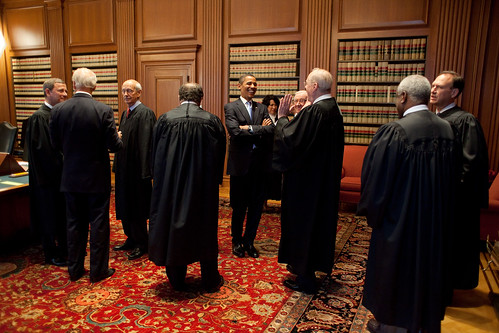
Let's analyze this picture of Obama and the Justices (and Biden).
Keep in mind that this is the shot the White House chose to put up on its Flickr page. (There's also this pic of Obama shaking hands with his appointee Sonia Sotamayor — with Scalia looking thoroughly delighted.)

(Enlarge.)
That's Biden, on the left, with his back to the camera, talking to Breyer and Roberts. The charming Roberts looks charmed by the gasbag VP, while Breyer — though more liberal than Roberts — looks like he's sleeping on his feet.
The short hulk by himself with his back to the camera is Scalia. Also alone, lurking in the background, is the newest Justice, Sonia Sotomayor. Or is Ruth Bader Ginsburg back there too (in the ladies section?) out of camera range?
Brooding over on the extreme right are Justice Thomas and Alito.
In the center, there's the President. As Stevens looks on, Obama laughs at Justice Kennedy's vain effort to enlist the Prez in a game of pattycake. Oh! Pattycake! Such fun!
IN THE COMMENTS: Freeman Hunt says:
(Enlarge.)
That's Biden, on the left, with his back to the camera, talking to Breyer and Roberts. The charming Roberts looks charmed by the gasbag VP, while Breyer — though more liberal than Roberts — looks like he's sleeping on his feet.
The short hulk by himself with his back to the camera is Scalia. Also alone, lurking in the background, is the newest Justice, Sonia Sotomayor. Or is Ruth Bader Ginsburg back there too (in the ladies section?) out of camera range?
Brooding over on the extreme right are Justice Thomas and Alito.
In the center, there's the President. As Stevens looks on, Obama laughs at Justice Kennedy's vain effort to enlist the Prez in a game of pattycake. Oh! Pattycake! Such fun!
IN THE COMMENTS: Freeman Hunt says:
Imagine holding a party. Your spouse takes pictures. When the guests leave, you say, "I'll email a group picture to you all."
The guests check their email accounts the next morning to find a picture wherein all of them have their backs to the camera or are by some other means obscured. Except you. You stand, fully visible, smiling broadly, center frame.
He he he.
Subscribe to:
Posts (Atom)