Showing posts with label breastfeeding. Show all posts

Tuesday, January 18, 2011

"I am working to make a delicious Wisconsin human cheddar."

"I purchased the milk from [a woman who] shipped it to me in ice, from Wisconsin... I found [her] on an online marketplace for breast milk – where women regularly arrange to sell and donate their milk. It’s pretty interesting, women set the price of their breast milk depending on if they provide blood work, and also the health of their diet."

Via Metafilter.

This remind me of Ricky Gervais and that rice pudding. From his Newsweek list of things that annoy him:
People who think they're "eccentric." What does that mean? You wear lots of different hats? You ride a funny-colored bike? That makes you eccentric? A friend of mine moved out to the country, and the woman next door came round; she was sort of hippie-ish, very long hair, back to nature, all that stuff. And she says, "I've made you a rice pudding, and I've made it with breast milk, because, you know, waste not, want not!" So my friend took it, threw it away, washed the dish and gave it back. He said to her, "Thanks, that was great!" I couldn't believe it. I told him that he should've said, "No, there is no way I'm eating that. Definitely not. Do not bring me any other bodily-function puddings."
That's the cleaned-up-for-Newsweek version. Get the podcast, Series 5 Episode 2. I don't have a complete transcript, but Wikipedia quotes:
Ricky: Surely you draw the line there, of a stranger’s breastmilk.

Steve: Oh yeah yeah, no absolutely… any kind of jizz flan....

Ricky: Here’s a cum sandwich. It doesn’t matter if it’s natural, it’s fucking disgusting.
ADDED: The A.V. Club says:
Of course, anyone looking to whip up some human cheese should definitely hit up the Dairy State for the breast milk, but that’s not the argument here. No, the real question is: Is cheese really the best place to start the “human milk” dairy product revolution?

Monday, August 10, 2009

Let's talk about that "breastfeeding doll."

Lisa Belkin writes about "Bebe Gloton," the doll that makes a sucky noise and mouth movement when placed next to plastic flower-shapes that are positioned at nipple level on a shirt to be worn by a little girl (or — I might add — boy):
Dr. Ronald Cohen, medical director for the Mother’s Milk Bank in San Jose as well as director of the intermediate intensive care nursery at Lucile Packard Children’s Hospital at Stanford University, told ABC News, “My take is that anything which reminds young girls that their bodies are something other, and more, than sex objects, is a very good thing.” In the next sentence he added: “On the other hand, encouraging young girls to want to have babies at a very young age may not be so great.”
Don't all baby dolls do that?!

Here's video showing the doll — and The Today Show's Hoda Kotb and Kathie Lee Gifford — in action:


I think it's pretty tame, actually. In any case, little girls (and boys!) who see their mothers breastfeeding younger siblings are likely to put their dolls up to their nipples and pretend to breastfeed. You don't need the additional technology to get that effect. My main objection to the doll is that it is annoying. I'd try not to buy kids toys that make irritating sounds. Leave more to the imagination.

And speaking of annoying sounds... Hoda Kotb and Kathie Lee Gifford... yeesh!

Friday, July 24, 2009

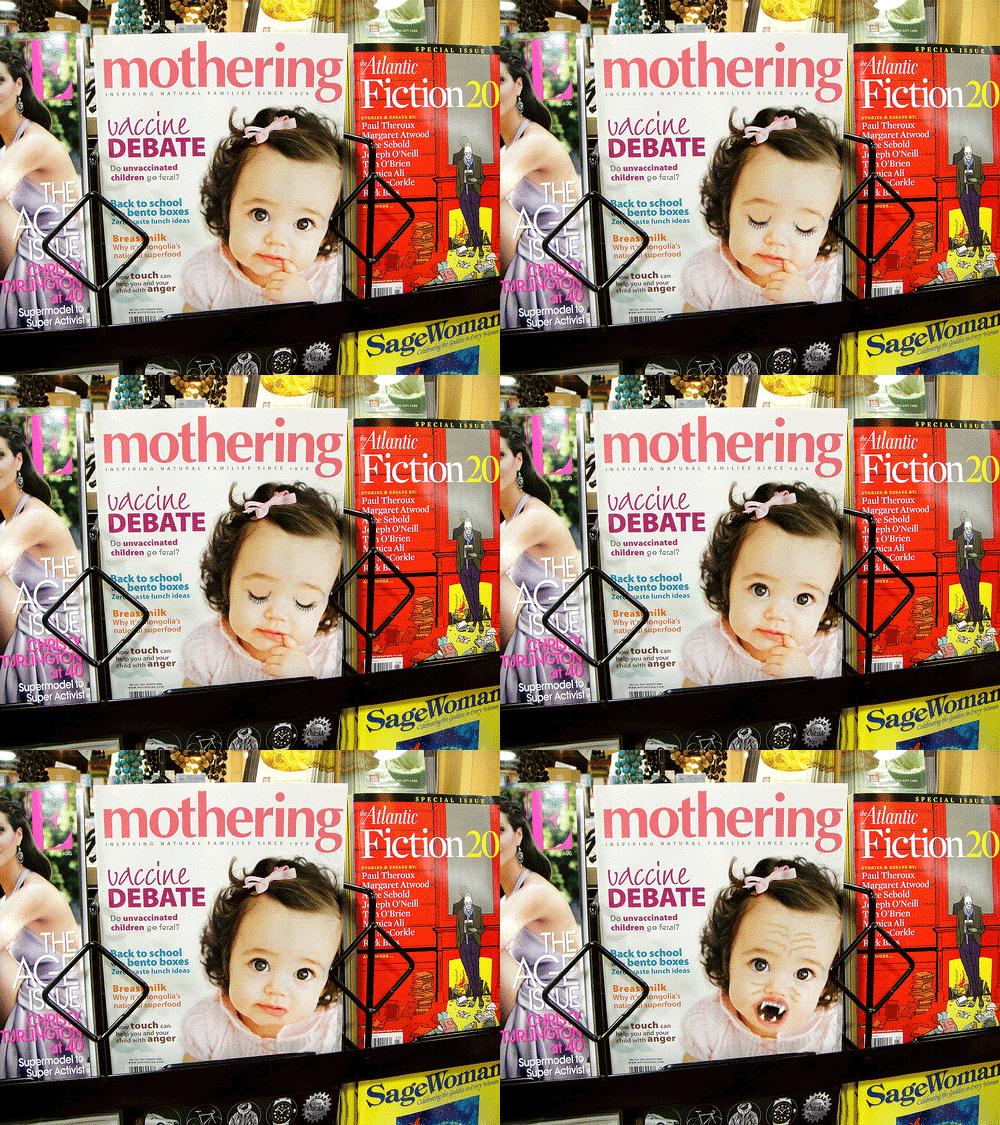
This magazine cover freaked me out.

DSC02424

Each element of it freaked me out more than the next. There's the big debate about whether it's okay for you not to get your child vaccinated because of the way other people's children are taking responsibility for keeping diseases out of the way of your precious bundle of purity. There are those bento box lunches. Breast milk and Mongolia. "How touch can help you and your child with anger."

And then there's that cover baby with the giant forehead. Photoshopped? But why? To convey braininess? Braininess in a baby who is looking to you for answers... questioning you... do you know enough about vaccination dangers, elite food packaging, breast milk in those distant places where people must be so wise and pure, and touch, come on, touch me — how?! — touch me or I might become enraged in ways that you — you with your tiny brain — cannot possibly imagine.

IN THE COMMENTS: rhhardin said:
Each element of it freaked me out more than the next.

That's a favorite, up there with "fills a much needed gap."

LOL. You got me there.

And Chip Ahoy says he's freaked out too:

Sunday, May 20, 2007

"The phrase Memory Almost Full came into mind, then I realised I'd seen it on a phone - you know, you must delete something."

The Guardian has a nice piece on Paul McCartney, who is about to release a record called "Memory Almost Full," with songs covering his life story and his anticipation of death:
At times, he appears to argue with himself about how autobiographical the songs are. Take Mr Bellamy, which is about a man in a desperate situation - refusing to come down from the roof of his house because he's happier up there with "nobody here to spoil the view, interfere with my plans ... I like it up here without you" - newspapers have suggested this is about his state of mind. But that's too easy, he says - for starters, he began writing this album when he and Mills were happily married, and anyway, this is a character-led vignette, a Beatles-esque short story.
Hmm... well, I think writers start writing things about a marriage going bad before it actually does, either because somewhere in their head they realize where things will go or because in the process of writing they are analyzing a situation and become persuaded that what looks good on the surface is not actually good. But quite apart from that, outsiders don't know whether people who now appear happily married are still or ever were happily married. Happily married is the sort of thing you pretend to be. Happy is the sort of thing you pretend to be. Now, when people look unhappy, you can believe it -- though not always. These songwriter types -- and other sorts of poets and artists -- have reason to play the forlorn, angsty role. But, surely, some of them are sincere.

Anyway, this Mr. Bellamy character sounds like the same guy as "The Fool on the Hill," which was a Paul song.
"The common denominator is me. Even if I try and write, 'Desmond and Molly had a barrow in the market place', inevitably I come through the song."
Yes, as a lightweight nitwit, Paul detractors would say. No, that's not me saying that. I'm imagining other people. I'd give a lot of credit to Paul for choosing "Ob-La-Di, Ob-La-Da" as his example, because he must know that it was conspicuously voted the Worst Song Ever. Personally, I think it's a cool song. For one thing, they repeatedly sing the word "bra" completely out of context just for fun (like "tit" in "Girl"). For another, the sex roles get reversed in the end. ("Desmond stays at home and does his pretty face.") But the main thing I like about it is that it is where it is in a sequence of songs on a great album that can't be thought of without all of its parts exactly how and where they are. (A feeling people won't have anymore in the future because of digitized music, and maybe you've already lost it.)

Speaking of The White Album:
Nowadays, when he tours, he feels at ease with his audience. "It's funny, a couple of American tours ago, I was singing Blackbird and I started to chat to the audience much more. I'm very confident like that now. I remembered stuff that I'd forgotten for 30 years in explaining it. I get a therapy session with the audience, and I go, 'Hold on, I remember what that came from, it was a Bach thing that George and I used to play'."

He gets up to fetch a guitar from beside the Wurlitzer and starts playing the Bach. "Is this in tune? Yes. So that's the Bach. See, that's the bastardisation of it, and then this is how it evolves into Blackbird." He plays beautifully to demonstrate the transition.
They really should identify the Bach piece! Hey, I got the answer in 2 seconds from Wikipedia:
McCartney revealed on PBS's Great Performances (Paul McCartney: Chaos and Creation at Abbey Road), aired in 2006, that the guitar accompaniment for Blackbird was inspired by Bach's Bouree, a well known classical guitar piece. As kids, he and George Harrison tried to learn Bouree as a "show off" piece. Bouree is distinguished by melody and bass notes played simultaneously on the upper and lower strings. McCartney adapted a segment of Bouree as the opening of "Blackbird," and carried the musical idea throughout the song.
Back to the Guardian:
[T]here are things he doesn't want to revisit. His divorce from Mills has not only been horribly public and extended, it has also involved a series of leaked allegations about McCartney's behaviour. The model family man has been portrayed by Mills as selfish, self-obsessed and violent - she has alleged that he refused to allow her to use a bedpan to save her crawling to the lavatory on her one leg, that he discouraged her from breastfeeding their daughter, Beatrice, because he wanted her breasts to himself, that he was a drunken pot addict who had hit her in an alcoholic rage.
Think about how everything you're doing now in your marriage could be restated in divorce allegations. Aren't you a monster?
You know what people want to do to you at the moment, I say. No, he replies. And I reach over and give him a big hug. McCartney smiles. "People actually do that. I get a lorra that off people. I get people I don't even know saying, 'Look, mate'," and he gives himself a sympathetic pat on the arm. "A lot of people come up to you and offer their support. A lot of people have been through similar circumstances and feel they have to communicate it to you."
"A lorra that"... if it means "a lot of," why did they write "a lot of" all those other times? The English!
"[T]here is a tunnel and there is a light and I will get there, and meantime I really enjoy my work and my family. I see people worse off than me, so I can put it in perspective. There's a thing we always used to quote in the 60s when things were rough: 'I walked down a street and I cried because I had no shoes, then I saw a man with no feet.' " It was an Indian parable, and that is one of the lines I live by."
See, I told you! People used to always say that in the 60s! It's just a way to say "It could be worse," but "It could be worse" lacks the gruesome imagery.

Wednesday, October 4, 2006

Breastfeeding doesn't make kids smarter.

It's just that smarter mothers tend to breastfeed their kids. Why has it taken three-quarters of a century to puncture this myth, when the methodology -- described at the link -- was so easy?

Friday, September 1, 2006

Breastmilk-pumping.

Did you know some women use a device that pumps out their breastmilk while they are driving? That seems so wrong. But what do you think of all these other efforts women make to keep up with breastfeeding when they are separated from their babies? From my own experience with breastfeeding, I can't imagine wanting to keep it up once I'd gone back to work. The idea of using a mechanical pump is so unpleasant, and the milk seems too intimate to leave in the office refrigerator. (The picture at the link shows bags of milk -- cutesily labelled "My Mommy's Milk" -- on a freezer rack next to a box of black bean enchiladas.) And there's a huge problem -- not mentioned in the article -- that I'll just sum up in one word: leakage.

But apparently, a lot of women are working and pumping these days. I guess if you don't now, you're supposed to feel bad. It's hard enough to be a working mother without having people upping the standard of what it takes to do it passably well.

But as for the women who want to do it... they'd like more active accommodation by their employers. In pursuit of this goal, the linked NYT article takes the equality tack: Professional women are nicely accommodated by employers who offer posh "lactation rooms" and lots of time but working class women are stuck using the bathroom during their regular breaks. Are you softened up for some legislation yet?
[F]ederal law offers no protection to mothers who express milk on the job — despite the efforts of Representative Carolyn B. Maloney, Democrat of New York, who has introduced such legislation. “I can’t understand why this doesn’t move,” she said. “This is pro-family, pro-health, pro-economy.”

Meanwhile, states are stepping in. Twelve states have passed laws protecting pumping mothers — Oklahoma’s law, the newest, will take effect in November. But like Oklahoma’s, which merely states that an employer “may provide reasonable break time” and “may make a reasonable effort” to provide privacy, most are merely symbolic.
One solution that's not mentioned is giving women longer maternity leaves so they can breastfeed the baby directly. But that, ironically, would violate the Equal Protection Clause! Maternity leaves in excess of the pregnancy disability period of eight weeks -- unless an equal period is given to new fathers -- is unconstitutional sex discrimination. That's the plain implication of the Supreme Court's opinion in Nevada v. Hibbs -- upholding the Family and Medical Leave Act as an exercise of Congress's Fourteenth Amendment power -- as I pointed out in a law review article (PDF):
There was no recognition in Hibbs that a state might, without engaging in mere sex stereotypes, genuinely think that more than eight weeks are needed to recover from pregnancy and childbirth or might, quite apart from stereotypes about who ought to take care of a baby, want to facilitate breast-feeding for a period longer than eight weeks.

[FOOTNOTE} See Liz Galst, Babies Aren’t the Only Beneficiaries of Breast-Feeding, N.Y. TIMES, June 22, 2003, § 15, at 4 (noting the developing scientific evidence indicating that breastfeeding offers greater health benefits to children as well as to mothers). It is puzzling that there is no mention in the briefs or in the opinions of the issue of breast-feeding, which entails a real physical difference that can justify treating new mothers differently from fathers. The importance of accommodating breast-feeding women in the workplace should not make it seem invidious to support a new mother who wants to take a longer leave to procure this health benefit for herself and the infant, instead of struggling with breast-pumping or bringing the infant into the workplace. That medical research is developing in this area suggests the value of leaving room for experimentation with maternal leave policies.
When I was writing that article, I asked a colleague why no one brought up breastfeeding. She didn't have any ideas about why the states wouldn't use breastfeeding to account for treating men and women differently when it comes to giving leave to new parents (a key issue in Hibbs). But, she said, women's groups have not worked for breastfeeding leaves because it runs counter to their goal of pushing for requiring employers to accommodate breastfeeding employees. And, I would add, it conflicts with a preference for keeping women in the workplace. If a state offered more new parent leave to women in order to breastfeed, women's groups might construe it as an attempt to promote traditional sex roles, with the woman staying home with the baby. Can you tell the difference between a benefit and discrimination there? [ADDED: I should clarify that only government action violates the Equal Protection Clause, so that if the state is not the employer and if the new statutory law did not require longer leave for women, it would be possible to redo the statutory law that limits private employers.]

I think we could support giving women more of a choice whether to stay home and breastfeed or go back to work and continue to breastfeed. There is so much pressure on women! It's hard to go through pregnancy and childbirth and to take care of an infant. Breastfeeding a pretty simple part of this if you have your baby close by. But you may need to go back to work or want to go back to work. I strongly support that. And I support the pumping approach if you can do it. And of course the employer should accommodate the physical needs you will have. But it's a much harder question whether there should be laws that allow you to sue if you think your employer hasn't helped you enough. But of all the things we ought to do to make life easier for mothers, we should quit making them feel like they have to go through the pumping routine. It's hard to work and have an infant at home. It's going to be harder if you have to pump breastmilk throughout the day while you're trying to pay attention to your work -- regardless of how accommodating the employer is. Frankly, quite aside from the pumping task, I would not want to have to try to concentrate on work with my breasts acting up continually.

Now, before you pile on in the comments, let me restate my point. I think it's fine and admirable for women to pump breastmilk in the workplace, and employers should voluntarily accommodate them, but legislation may not be needed, we shouldn't put pressure on women to keep up breastfeeding when they go back to work, and women who decide they don't want to do it should feel perfectly justified in their decision.

Tuesday, June 7, 2005

Lactivism.

Nursing mothers protest Barbara Walters. Walters dared to say she felt uncomfortable sitting next to a nursing mother on an airplane.

Lactivism has been rather successful:
[S]ix states have recently passed laws giving a woman the right to breast-feed wherever she "is otherwise authorized to be."
Got a problem with that? I don't.

I know what it's like to need to breastfeed and be in a situation where there's nowhere private to go. One time, back in the early 80s, I breastfed my baby at the Baseball Hall of Fame. I remember feeling I was doing something really wrong and that I was about to be discovered at any point and treated harshly. So I like these laws. What are you supposed to do on a plane? You can't occupy the bathroom that long, and anyway, that would be a disgusting environment for a baby.

Breastfeeding mothers, like anyone else who has a right to be in a public place, should attend to their and their babies' physical needs discreetly and try not to trouble people. That means minimizing how much you expose yourself and not going out of your way to sit right next to a stranger. It's not shameful to be breastfeeding, but that doesn't mean it's in good taste to flaunt it.

As a rough comparison, imagine if you needed to blow your nose and you were in the middle of a store or a restaurant. We'd think it was outrageous if the owner kicked you out for doing it and rude if the other customers gave you dirty looks -- assuming you did it discreetly. But it would be rude of you and you'd deserve those dirty looks if you blew your nose loudly and sloppily right next to someone.

UPDATE: If anyone had ever told me that one day they'll be talking on TV about about my breasts and the Baseball Hall of Fame, I would have been amazed. Amazed and perplexed. (Does he make it sound like I was looking for a place to breastfeed, so I went to the Baseball Hall of Fame? I was that desperate.)