Photographs ##1 and 14 in this slideshow.
AND: Bush has an intense 7-minute conversation with Hillary before the funeral begins. Meanwhile, Nancy sits silently on his other side, and Michelle sits silently on Hillary's other side. Bush, hanging with the First Ladies... and giving all his attention to Hillary.
Showing posts with label Nancy Reagan. Show all posts
Showing posts with label Nancy Reagan. Show all posts
Tuesday, July 12, 2011

Sunday, February 6, 2011
Wednesday, April 21, 2010
"It’s a big shitty world, and it gets shittier by the minute."
A nugget from the newly revealed letters of J.D. Salinger. Don't you hanker for more heaping mouthfuls of that?
He had 2 children,Peggy and Matthew. At restaurants, Peggy had "a double portion of shrimp cocktail, dessert, and milk, with a pickle on the side, if available," while Matthew ate "lamb chops, almost exclusively."
He didn't like us too much: "Murder in my heart, daily, hourly, incessantly, and you ask if I feel as nasty as ever about planetary affairs. … How ready this wretched planet is for the bomb or more Nancy Reagan."
Imagine having such a troubled relationship with other people that you fixated on the idea of a nuclear war that would end it all, not just for you, but for everyone.
IN THE COMMENTS: Seven Machos says:
He had 2 children,Peggy and Matthew. At restaurants, Peggy had "a double portion of shrimp cocktail, dessert, and milk, with a pickle on the side, if available," while Matthew ate "lamb chops, almost exclusively."
He didn't like us too much: "Murder in my heart, daily, hourly, incessantly, and you ask if I feel as nasty as ever about planetary affairs. … How ready this wretched planet is for the bomb or more Nancy Reagan."
Imagine having such a troubled relationship with other people that you fixated on the idea of a nuclear war that would end it all, not just for you, but for everyone.
IN THE COMMENTS: Seven Machos says:
If you really want to hear about it, the first thing you'll probably want to know is what my kids like to eat at restaurants and what my lousy view of the world is like, and how I am occupied with thoughts of murder, and all that John Wayne Gacy kind of crap, but I don't feel like going into it, if you want to know the truth.
Sunday, November 9, 2008
Obama "revealed that, despite having edited the Harvard Law Review, he doesn’t know what 'enormity' means."
Crabs Peter Hitchens. I picked the same nit as I live-blogged on election night. Scroll to "yikes." And I note that he misused the word again in his first press conference. Perhaps when he's done apologizing to Nancy Reagan and persons of mixed race, he can acknowledge us language sticklers.
Sir Archy, archy, and blogging cockroach.
In the early morning hours yesterday, this blog received a visit from our ghost commenter Sir Archy -- dead these 260 Years and more. As a ghost, he had something to say about Barack Obama's first press conference, in which the prez-elect claimed to have spoken to all the living Presidents and quipped "I didn’t want to get into a Nancy Reagan thing about doing any séances." (That quip -- for which Obama's had to apologize -- would surely have inspired warm chuckles in a law faculty room.)
In the comments, Amba said about Sir Archy: "I get him mixed up with the cockroach." By "the cockroach, she means our delightful insect commenter blogging cockroach. (Click the "blogging cockroach" tag below to see old posts with writings by the industrious arthropod.)
Amba adds: "I wonder if they aren't the same person, though, and 'Archy' is a clue." She's thinking -- I happen to know -- of archy of archy and mehitabel, the literary creations of Don Marquis:
Marquis' George Herriman's ink drawings are sublime. See, here is archy putting in the immense athletic effort needed to type a short column:
Now, blogging cockroach is surely a tribute to Marquis' archy, and we appreciate his explanation of the the mechanics of his literary output by computer even as we contemplate whether the stuff is literature or not. (Perhaps someone can make a drawing in the Marquis style of blogging cockroach at the computer or photoshop this drawing somehow.)
But Amba's question is whether Sir Archy is named to connect him to the cockroach. (Bonus points if you you do that drawing/photoshop and replace mehitabel with Sir Archy.) Are these writers one and the same (and, if so, are they also anybody else that we see around here)?
Well, the cockroach saw Amba's musings and dropped by the comments thread. Here is what he wrote:
So here's another clue for you all:

Plus, cambridge mass... Harvard/MIT? Some bald professor with a penchant for nudism?
ADDED: And at last night's Crossroads Café, Chip Ahoy said:

That brought the cockroach over:
ADDED: Thanks to Jeff with one "f" for correcting me about the ink drawings. I love George Herriman -- and even blogged about him back here. Mehitabel's resemblance to Krazy Kat is clear... clearer than Sir Archy's resemblance to blogging cockroach.
AND: Dear, sweet Palladian has sent me the illustration I wanted!

In the comments, Amba said about Sir Archy: "I get him mixed up with the cockroach." By "the cockroach, she means our delightful insect commenter blogging cockroach. (Click the "blogging cockroach" tag below to see old posts with writings by the industrious arthropod.)
Amba adds: "I wonder if they aren't the same person, though, and 'Archy' is a clue." She's thinking -- I happen to know -- of archy of archy and mehitabel, the literary creations of Don Marquis:
Archy is a cockroach with the soul of a poet, and Mehitabel is an alley cat with a celebrated past -- she claims she was Cleopatra in a previous life....
"expression is the need of my soul," declares Archy, who labored as a free-verse poet in an earlier incarnation. At night, alone, he dives furiously on the keys of Don Marquis' typewriter to describe a cockroach's view of the world, rich with cynicism and humor. It's difficult enough to operate the typewriter's return bar to get a fresh line of paper; all of Archy's dispatches are written lowercase, and without punctuation, because he is unable to hit both shift and letter keys to produce a capital letter.
"boss i am disappointed in some of your readers," he writes, weary of having to explain the mechanics of his literary output. " ... they are always interested in technical details when the main question is whether the stuff is literature or not."
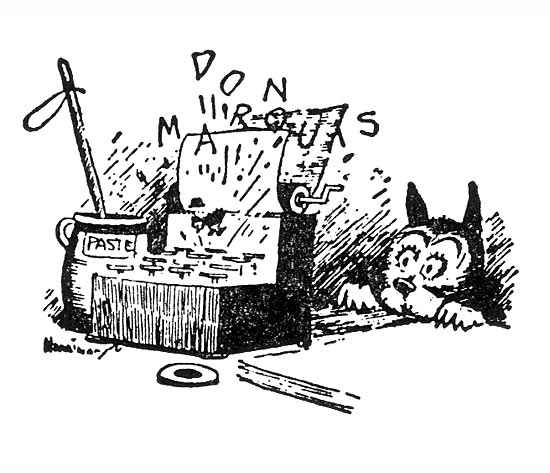
Now, blogging cockroach is surely a tribute to Marquis' archy, and we appreciate his explanation of the the mechanics of his literary output by computer even as we contemplate whether the stuff is literature or not. (Perhaps someone can make a drawing in the Marquis style of blogging cockroach at the computer or photoshop this drawing somehow.)
But Amba's question is whether Sir Archy is named to connect him to the cockroach. (Bonus points if you you do that drawing/photoshop and replace mehitabel with Sir Archy.) Are these writers one and the same (and, if so, are they also anybody else that we see around here)?
Well, the cockroach saw Amba's musings and dropped by the comments thread. Here is what he wrote:
well all i can say is that there are some
advantages to being a cockroach
one of them is i don t have to worry
about my hair or clothes anymore
having the transmigrated soul of a composer
i can look back at all the troubles i had
when i was a music professor
to buy the right suits and keep my shirts ironed etc
in those days they paid us a pittance
and so i drove a 56 studebaker
but had to wear a suit on campus every day
which cost me as much as the damn studebaker
i hated clothes
not to mention haircuts
i was actually kinda glad to go bald
except maybe for the combover
which frightened away my female students
damn
but now i don t worry about any of that
and other than molting now and then
life is simple
and i sure don t want to mess it up
with a powdered wig
but having spent a little time
on the astral plane myself
i can tell you archy s right about seances etc
you just settle in and some idiot
comes and bothers you
about something really stupid
reminded me of office hours
anyway one day my ex wife showed up
wondering where the key to the
safe deposit box was
now some exes hire private detectives
but mine hired a medium
tells you a lot
anyway i screamed let me out of here
let me slouch somewhere to be born
and presto the next ticket said
cockroach
cambridge mass
so here i am
maybe i ll tell you about the safe
deposit box next time
So here's another clue for you all:

Plus, cambridge mass... Harvard/MIT? Some bald professor with a penchant for nudism?
ADDED: And at last night's Crossroads Café, Chip Ahoy said:
What I know about the Kennedy administration was learned by reading.Go to Chip's lunch link for all the steps, but here's his last pic:
Smithsonian used to be so interesting. My favorite part was letters from the readers remarking on articles. What an erudite bunch. It ran a couple of pages. Then they got another new editor who cut that section back to just a few letters and to about half a page. That told me all I needed to know about the new editors attitude toward his readers.
Then they ran an article in relation to the John Kennedy assassination anniversary. Readers were asked where they were when the event occurred. That series of letters then ran for several pages. All the remarks were about how glorious the age of Camelot was, how idealistic, youthful, energetic, positive, and optimistic everyone was. How amazing incredibly beautiful the time was. Every single one glowed with praise and rued a lost past.
Except for one. A response from Tom Clancy. He had a wee on their little party. He remarked the administration wasn't all that remarkable. He reminded readers of several notable failures and obvious shortcomings. He suggested had the administration lasted, it would not be remembered so fondly. This caused me adore Tom Clancy, even though he's a schmuck.
I was so put off by the whole thing, the rebuff to the readers, the hard leftist turn, the ceaseless pontificating, the whole desktop publishing look, I ended the subscription I held since junior high school.
It occurred to me though, reading through all those responses, those writers, were recalling an idealized, sanitized youthful optimism -- their own youths. Their optimism was entirely of their own making and had little to do with facts on the ground. As is their present pessimism.
And now, I'm seeing that phenomenon occurring again right before my eyes. I'm going to enjoy this. As an observer. But this will not affect my own naturally occurring cheerful optimism nor my own self-indulgent satanic pessimism. I'm just going to watch my wonderful country, the less wonderful world, willfully create their own optimism. Myth making. That's what is happening. Observe a new myth. This is how it's created. Begin by overlooking faults, dismissing them, excusing them. Next exaggerate any gain, whatever actual good there is, suddenly is really REALLY, REALLY everlastingly good. Yay! Dance! Glee! Canonize! Deify. Mythologize. Expect comparisons to Camelot, and know then you're in the arena of myth. But know also, this is all occurring within the minds of the mythologists.
But know also, optimism is very real. Just as real an uplifter as pessimism interprets into very real and actual drag. Therefore, I choose to enjoy the optimism in my fellow Americans, no matter how ridiculous it is. I could go for another Camelot myself, even though I know it's all occurring entirely within the minds of all you silly dumkopfs, present company excepted, of course. I vastly prefer my fellow citizens as silly little shits, than as obnoxious unbearable cnuts. <--- See what I did there? Letter transposition. Disguises a word unacceptable in polite mixed company, one worse even than the s word before it. This completes my remarks about ridiculously delusional self-constructed optimistic mythos. And now for something entirely different. Here's what I made for lunch.
Sorry you couldn't be here, I'm sure you'd have been wonderful lunch dates.

That brought the cockroach over:
yes chip ahoy that was a beautiful lunchAnd here's what Tom Clancy wrote:
i adore hummus
if you don t eat those lettuce leaves completely
and leave the remains on the plate
or better yet drop one on the floor
well i ll have a beautiful lunch too
now about the beautiful
kennedy administration
i was a young grad student
when camelot happened
the main thing i remember
is seeing kennedy getting off
an airplane looking really snappy
or hot as they say today
and thinking man that guy
must get some action
then i thought naw
he s the president of the u s
that s really sick to think those thoughts
hoo boy was i wrong
I never voted for the guy. I was only 13 when he got elected. I was a junior in high school when Kennedy got whacked. I was in the Waverly Theater on Green Mount Avenue in Baltimore watching Shirley MacLame and Jack Lemmon. I had a half-day of school. It was a Friday. I heard it on the way coming out of the movie. The ticket-taker said the president got shot. Then followed four days of nothing but a dead president. They didn't even show the Colts play. He was the president of the United States, so I didn't want him murdered. I wanted him to lose the next election. I mean, what did he accomplish? He has been canonized by the media, which I think is a bit unseemly. He was a handsome guy. He had great style. He meant well. It was Lyndon Johnson who got the civil rights movement rolling. He was a patriot and he put his life at risk in World War II, and that's something to be admired, but I don't see anything historically significant that he did other than the space program. For the space program, I'd buy him a beer.
ADDED: Thanks to Jeff with one "f" for correcting me about the ink drawings. I love George Herriman -- and even blogged about him back here. Mehitabel's resemblance to Krazy Kat is clear... clearer than Sir Archy's resemblance to blogging cockroach.
AND: Dear, sweet Palladian has sent me the illustration I wanted!

Friday, November 7, 2008
"The United States has only one government and only one President at a time."
Said Barack Obama, at his press conference today, emphasizing the economy and pointing out a number of things that need to be done immediately. Presumably, President Bush is paying attention.
ADDED: There are 2 quotes that belong in the famous quote books:
1. "I've spoken to all the Presidents. Living, obviously. I don't want to get into a Nancy Reagan thing."
2. "A lot of shelter dogs are mutts like me."
UPDATE: Obama apologizes to Nancy Reagan:
ADDED: There are 2 quotes that belong in the famous quote books:
1. "I've spoken to all the Presidents. Living, obviously. I don't want to get into a Nancy Reagan thing."
2. "A lot of shelter dogs are mutts like me."
UPDATE: Obama apologizes to Nancy Reagan:
"President-elect Barack Obama called Nancy Reagan today to apologize for the careless and off handed remark he made during today’s press conference," said transition spokeswoman Stephanie Cutter. "The President-elect expressed his admiration and affection for Mrs. Reagan that so many Americans share and they had a warm conversation."Yes, exactly. It was Hillary who talked with the dead! Here's the NYT report from June 25, 1996:
Obama was asked at his press conference today if he'd spoken to all the "living" presidents.
"I have spoken to all of them who are living," he responded. "I didn’t want to get into a Nancy Reagan thing about doing any séances."
He was apparently confusing stories about Reagan's consulting with an astrologer with those about other First Ladies -- from Mary Todd Lincoln to Hillary Clinton -- who tried to make contact with figures from the past.
Although her views on altered states of consciousness and reincarnation would strike many Americans as outlandish, Jean Houston has instructed executives from such buttoned-down companies as Xerox, lectured at such sober universities as Harvard and worked with such mainstream figures as Margaret Mead.
Dr. Houston, a 57-year-old author of 15 books who is admired by many adherents of the human potential movement and of New Age mysticism, made headlines over the weekend because of her work with another mainstream figure, Hillary Rodham Clinton. "Seances" were among the interpretations of sessions in which Dr. Houston and Mrs. Clinton supposedly conversed with Eleanor Roosevelt and Gandhi.
But in an interview here at her Rockland County home today, Dr. Houston said Mrs. Clinton never made any seance-like effort to contact the spirits of Mrs. Roosevelt or Gandhi but simply engaged in an intellectual role-playing exercise to tackle a problem the First Lady was having with her book about children, "It Takes a Village."
"We were using an imaginative exercise to force her ideas, to think about how Eleanor would have responded to a particular problem," Dr. Houston said. "I have never been to a seance."...
Dr. Houston said that Mrs. Clinton would never engage in spiritualism because she is "a very committed Christian" and a "serious, reflective and prayerful" woman.
Wednesday, January 30, 2008
The Republican debate.
This time, no Fred and no Rudy, but Paul is still there, along with the 3 guys who've won primaries/a caucus. They're greeted — at the Reagan Library — by Nancy Reagan (who, unfortunately, looks terrible), and they take seats in front of Air Force One.
The first question is Reagan's question: Are you better off than you were 4 (or 8) years ago? Mitt reframes the question, because he's not running on Bush's record, as a boast about his stint as governor of Massachusetts. Anderson Cooper interrupts to inform him that he's not answering the question asked, and Mitt tells him to shut up — in so many words — and keeps talking about Massachusetts.
On the second question, John McCain taunts Romney about how the Boston newspapers endorsed McCain. He calls Mitt "my friend" and laughs and says he guarantees that the Arizona newspapers are going to endorse him. He's relaxed and happy and keeps inserting wisecracks.
ADDED: Asked about Reagan's choice of Sandra Day O'Connor for the Supreme Court, they all acted like they were respecting her (and Reagan), but proceeded to disrespect her. Only Paul admits he wouldn't have picked her. Huckabee says he's not stupid enough to sit in the Reagan Library and say he disagrees with Reagan and launches into a pro-life soliloquy. Ron Paul says he'd have picked a "much stronger constitutionalist." McCain says he's "proud" of O'Connor as a "fellow Arizonan," but he wants judges like Roberts and Alito who have a "proven record of strict interpretation." Romney says he wants judges like Roberts and Alito and Scalia and Thomas that "follow the Constitution and do not make law from the bench."
MORE: McCain and Romney really went at it over the Iraq "timetables" issue, and McCain garbled his words many times — such as calling April a "year" — and I think this evidenced great tension. Romney's self-defence got cheers. McCain kept asserting that the quote meant what it clearly didn't mean. Saying that we don't want al Qaeda waiting "in the weeds" until we leave means that we should never announce a timetable. McCain claimed to read it as a plan to leave on a timetable.
It's possible that Romney is such a fence-straddler that he threw the word "timetables" out so people would pick up the signal that he wants to leave, but he embedded it in a sentence so slippery that he'd never have to own up to any meaning he didn't like. McCain acts sure that he knows the "buzzwords" and he sees how politicians use them, and someone truly devoted to sticking it out in Iraq would never have uttered the buzzword "timetables."
Anderson Cooper presses Romney: Why did you refuse to take a position on the surge on the ground that you're a governor, when 2 months later, you declared your candidacy? The impression one gets is that he was carefully crafting his position to run for President. So he preserved his ability to go either way on the war. He accuses McCain of throwing mud. And McCain just smiles and assures us he knows what politicians are doing with language.
The first question is Reagan's question: Are you better off than you were 4 (or 8) years ago? Mitt reframes the question, because he's not running on Bush's record, as a boast about his stint as governor of Massachusetts. Anderson Cooper interrupts to inform him that he's not answering the question asked, and Mitt tells him to shut up — in so many words — and keeps talking about Massachusetts.
On the second question, John McCain taunts Romney about how the Boston newspapers endorsed McCain. He calls Mitt "my friend" and laughs and says he guarantees that the Arizona newspapers are going to endorse him. He's relaxed and happy and keeps inserting wisecracks.
ADDED: Asked about Reagan's choice of Sandra Day O'Connor for the Supreme Court, they all acted like they were respecting her (and Reagan), but proceeded to disrespect her. Only Paul admits he wouldn't have picked her. Huckabee says he's not stupid enough to sit in the Reagan Library and say he disagrees with Reagan and launches into a pro-life soliloquy. Ron Paul says he'd have picked a "much stronger constitutionalist." McCain says he's "proud" of O'Connor as a "fellow Arizonan," but he wants judges like Roberts and Alito who have a "proven record of strict interpretation." Romney says he wants judges like Roberts and Alito and Scalia and Thomas that "follow the Constitution and do not make law from the bench."
MORE: McCain and Romney really went at it over the Iraq "timetables" issue, and McCain garbled his words many times — such as calling April a "year" — and I think this evidenced great tension. Romney's self-defence got cheers. McCain kept asserting that the quote meant what it clearly didn't mean. Saying that we don't want al Qaeda waiting "in the weeds" until we leave means that we should never announce a timetable. McCain claimed to read it as a plan to leave on a timetable.
It's possible that Romney is such a fence-straddler that he threw the word "timetables" out so people would pick up the signal that he wants to leave, but he embedded it in a sentence so slippery that he'd never have to own up to any meaning he didn't like. McCain acts sure that he knows the "buzzwords" and he sees how politicians use them, and someone truly devoted to sticking it out in Iraq would never have uttered the buzzword "timetables."
Anderson Cooper presses Romney: Why did you refuse to take a position on the surge on the ground that you're a governor, when 2 months later, you declared your candidacy? The impression one gets is that he was carefully crafting his position to run for President. So he preserved his ability to go either way on the war. He accuses McCain of throwing mud. And McCain just smiles and assures us he knows what politicians are doing with language.
FINALLY: I think Huckabee was very appealing and modest. I liked in the end when, unlike the others, he declined to say that Ronald Reagan would endorse him. It would be "arrogant" to say that, so he just wants to say that he endorses Ronald Reagan. (But wait a minute. Isn't it actually arrogant to say it would be arrogant to say what the others just said? He's a crafty one too, that Huckabee.) Ron Paul is whatever he already is to you. McCain and Romney each helped and hurt themselves. There is so much at stake for them. They had to fight, and some of it looked pretty ugly. Yet they made their points. I think Romney established that McCain had been too hard on him about the "timetables" remark and that he's creative and capable on economic issues. But McCain is clearly the one with the rock-solid record on the war. He staked his reputation on it when Romney was being cagey.
Sunday, November 25, 2007
"Being first lady is sort of half job and half life but good experience in either case."
Writes Michael Kinsley, analyzing Hillary Clinton and her recent jab "We can't afford on-the-job training for our next president."
Count me as one of those people!
And does anyone think of her as qualified for the presidency? How about Nancy Reagan?
Oh, let's direct these questions at Hillary Clinton, can we? Do you mean to say that pillow talk is good experience?
I'm interested in seeing if her mockery silences him. Will he shut up about this idea that he is what Kinsley calls "a world man." Or will he figure out how to say it better and not her allow her to squelch him. If he can't do that, his vaunted oratorical skills mean little.
Kinsley owns up to supporting Obama. Here's how he explains his reason:
Oh, good lord. You can say that about people you meet every day in academia, and there's no reason at all to trust those characters as President. I'm sorry, but I hear patronizing in Kinsley's words.
... Clinton was clearly referring to work experience. But there is also life experience. Being first lady is sort of half job and half life but good experience in either case.
She has to be careful about making a lot of this. Many people resent her using her position as first lady to take what they see as a shortcut to elective office. More profoundly, some people see her as having used her marriage as a shortcut to feminism.
Count me as one of those people!
But being the president's spouse has to be very helpful for a future president. It's like an eight-year "Take Your Daughter to Work Day." Laura Bush, as far as we know, has made no important policy decisions during her husband's presidency, but she has witnessed many and must have a better understanding of how the presidency works than all but half a dozen people in the world.
And does anyone think of her as qualified for the presidency? How about Nancy Reagan?
One of those half a dozen is Hillary Clinton, who saw it all -- well, she apparently missed one key moment -- and shared in all the big decisions. Every first lady is promoted as her husband's key adviser, closest confidant, blah, blah, blah, but in the case of the Clintons, it seems to be true. Pillow talk is good experience.
Oh, let's direct these questions at Hillary Clinton, can we? Do you mean to say that pillow talk is good experience?
Clinton mocks Obama's claims that four years growing up in Indonesia constitute useful world-affairs experience. But they do.
I'm interested in seeing if her mockery silences him. Will he shut up about this idea that he is what Kinsley calls "a world man." Or will he figure out how to say it better and not her allow her to squelch him. If he can't do that, his vaunted oratorical skills mean little.
Kinsley owns up to supporting Obama. Here's how he explains his reason:
When I hear him discussing issues, I hear intelligence and reflection and almost a joy in thinking it through.
Oh, good lord. You can say that about people you meet every day in academia, and there's no reason at all to trust those characters as President. I'm sorry, but I hear patronizing in Kinsley's words.
Sunday, November 11, 2007
It's Kurt Vonnegut's birthday, the first since his death.
So let's read this 1992 Playboy Interview with him and Joseph Heller, who is also dead. There's some talk of Norman Mailer, and he's dead now too.
PLAYBOY: What are you working on, Kurt?
VONNEGUT: On a divorce. Which is a full-time job. Didn't you find it a full-time job?...
VONNEGUT: It seems to me divorce is so common now. It ought to be more institutionalized. It's like a head-on collision every time. It's supposed to be a surprise but it's commonplace. Deliver your line about never having dreamed of being married.
HELLER: It's in Something Happened: ''I want a divorce; I dream of a divorce. I was never sure I wanted to get married. But I always knew I wanted a divorce.''
VONNEGUT: Norman Mailer has what--five divorces now?...
PLAYBOY: Do either of you read any contemporary writers?
VONNEGUT: Well, it's not like the medical profession where you have to find out the latest treatments. I've been reading Nietzsche.
HELLER: And I've been reading Thomas Mann....
PLAYBOY: What about Norman Mailer's?
VONNEGUT: That's none of your business. Norman's a friend of mine.
HELLER: I intend to read it at one sitting....
PLAYBOY: Why don't you guys write more explicitly about sex and its emotional trappings?
HELLER: More explicitly than what? You keep projecting. You keep attaching emotional reactions to sexual reactions. Earlier you used the words ''love'' and ''sex'' and now you're suggesting emotional reactions to sex. By emotional I'm sure you mean something different from the sensory responses.
PLAYBOY: Well, emotions are different from senses.
HELLER: I don't think there is a necessary correlation between emotional responses and sex.
PLAYBOY: Didn't D. H. Lawrence write about emotions?
HELLER: That was the content of his artistic or literary consciousness. I don't think writers have a choice, by the way. I think we discover a field in which we can be proficient and that's our imagination. My imagination cannot work like Kurt's and I don't think his can work like mine. Neither of us could write like Philip Roth or Norman Mailer. I know John Updike has a lot of tales of the sexual encounter. And I suppose there are writers who can do it and will do it and want to do it.
PLAYBOY: Henry Miller?
HELLER: What you get there is the raw activity.... I must say, for me, it doesn't normally make good literature. Fiction having extensive detail about the gymnastics of copulation or sexual congress--or even the alleged responses to it--does not make interesting reading to me. It's like trying to describe the noise of a subway train. There are people who can do it. Young writers go in for that type of description. But when they're finished, all they've done is described the noise of a subway train coming into a station or pulling out of a station. Is that the noblest objective of a work of fiction? To convince the reader that what you're writing about is really happening? I don't think so....
VONNEGUT: Nietzsche had a little one-liner on how to choose a wife. He said, ''Are you willing to have a conversation with this woman for the next forty years?'' That's how to pick a wife.
HELLER: If people were more widely read, there'd be fewer marriages.
VONNEGUT: I will give you all the money that's left after the divorce if you can get me a film clip of Frank Sinatra making it with Nancy Reagan. I think that is the funniest damn thing.
PLAYBOY: In the White House?
VONNEGUT: I don't care where. Those two scrawny people....
Thursday, May 3, 2007
Simulblogging the Republican Debate.
1. Yes, I'll do it. And I'll do it without TiVo assistance. Going TiVo-less is not just to make me completely spontaneous. I don't want to get bogged down in it. Once I start pausing, I start feeling responsible for everything. But there will be a transcript later for that. And, dammit, I want the TiVo for "Survivor"!
2. I didn't realize there was a debate today until someone asked me this morning if I was going to watch it. Oh, no. I guess I am. But how many candidates? 8 for the Democrats was pretty annoying, though the 8th guy -- Gravel -- did provide some comic relief. I have to listen to 10 Republicans? 10! Who the hell are they? 10? Let's see there's Giuliani and McCain... uh.... and Tommy Thompson but not Fred Thompson... conversation about whether Tommy gets any boost in popularity by having the same name as the strangely longed-for non-candidate Fred... so, come on, you only got 3. There's 10! Where's my coffee? I can't believe you don't even remember Romney. Oh, yeah, Romney. How could I forget? Who else? A Senator from Kansas? A Senator from Kansas, really? Not Dole... Brownback! Oh, he's from Kansas. How perfectly boring. Huckabee. Oh, yeah, Huckabee. He used to be fat. Yikes, that's still only 6! Who are the other 4? And I'm committing to listening to them? Ron Paul. He might be amusing. Who else? I look it up: Jim Gilmore, Duncan Hunter, Tom Tancredo. Oh, the pain.
3. The Reagan Library set is glossy, what with the reflection on the underside of Air Force One, suspended over the heads of the audience. So are you pouring a big glass of wine and planning to take a sip whenever anyone says "Reagan" and drain the glass if anyone says "I knew Ronald Reagan, and you're no blah blah blah"? Nancy Reagan is there, sitting with Arnold Schwarzenegger. The voiceover guys are gushing about how "regal" the setting is. Chris Matthews gives a snazzy introduction, brimming with enthusiasm for Reagan. Reagan Reagan Reagan. Agghh. Where's my wine glass?
4. Ooh, it's closed book. No notes allowed. The first question is about optimism (like Reagan's) and pessimism (shown in the current polls). Giuliani has one minute, and he leverages in statements about immigration, health care, and the war on terror. McCain is next. He stammers a bit but sounds very strong -- and angry at the congressional Democrats for cheering surrender in Iraq. Tommy Thompson looks awful, but he lays out a point-by-point political solution for Iraq. Mitt Romney looks great.
5. They're all asked if they'd amend the Constitution to let Arnold Schwarzenegger run for President. Nearly all of them say no. Right to his face. Take that. Now, we're getting some questions submitted and voted on through Politico.com. That's a nice touch. What does Romney dislike most about America? He just acts like the question is: What do you love about America?
6. Values! In other words: abortion. Okay to "repeal" Roe v. Wade? All must answer. All say yes, with different levels of passion. Giuliani says it's okay to "repeal" it, but it would also be okay for a "strict constructionist" judge to uphold it based on stare decisis. Romney is confronted about his change of mind on abortion rights, and he clearly says he changed his mind. Wasn't that purely political? He denies it and ties his change of mind to thinking about cloning. I don't believe that.
7. McCain: "I know there's good and evil in the world. I've seen it."
8. Can a business fire an employee because he's gay? Tommy: yes.
9. Romney is asked about religion, and he is speaking very well about it. Matthews keeps asking the question about whether religious faith has any relevance to the presidential race. The right answer here is rather obvious, and I think everyone on the stage knows what it is. A person's religious faith gives rise to values that matter in public life, but which religion it is doesn't matter and we shouldn't argue about that. It's really just a matter of saying that in a clear and inspiring way: America is great because of our religious tolerance, etc.
10. Halfway into this, I'd say the person making the most headway is Romney.
11. Romney takes a shot at the McCain-Feingold Act in the middle of an answer about abortion. He's referring to the effect of the Act on issues ads close to the election (something that is before the Court in the Wisconsin Right to Life case argued last week).
12. Stem cells. Tommy Thompson talks about the research going on at the University of Wisconsin in Madison, Wisconsin. That appealed to me.
13. Wow! Romney on health care! I have no idea if his policy is good. I'll have to read about it. But his form of expression was great here.
14. Tax. It's very hard to compare tax policies on the fly. Thompson struck me with his idea of dealing with the AMT by giving people the option of a flat tax: you get whichever is lower. He brags about all the vetoing he did as governor of Wisconsin and acts like he could bring that vetoing style to the White House. But Wisconsin has an extremely strong veto power. You can't do that in the White House.
15. A yes-or-no question: Do you believe in evolution? It looks like 3 of them raised their hands on no, but I didn't quite catch who.
16. Gilmore is asked a question and I realize he's made no impression on me so far.
17. Brownback is too conservative for me, but I give him credit for speaking well. He's a good voice for his position, not that I want it to succeed. "This is a set of quality candidates" he says, when asked what he doesn't like about Giuliani. I like that he doesn't take a shot at Rudy. Clearly, the two men have very different positions. People can see that, and it's cool of Brownback to be magnanimous about it.
18. Giuliani seems natural and good-humored. I think he's showing what he is in an attractive way. A moment ago he was asked the sort of pop-quiz question that isn't at all about trying to find out what his policies are: explain the difference between Shiites and Sunnis. He does it exactly right. Later, Thompson gets a question like that: How many Americans have died in the Iraq war? I don't like this sort of smart-ass question, especially when only some of them get hit with one. The idea is to see if they'll screw up. There's nothing to be learned in a positive way. Let's just see if this guy is clueless.
19. Guy! They're all guys! It just hit me. They're all white too. Should be a question on that.
20. National ID card. McCain's all for it. Ron Paul lights on fire: ID cards are eeevvviiilllll.
21. Romney lights into Patrick Fitzgerald and the way he went after Scooter Libby. I like the way Romney is cool and controlled but gets passionate -- in a controlled way -- when it goes with his issue. Or do you think he's too slick? I think he's doing well. He's seems ready to play the role of candidate. Republicans ought to want to take advantage of that.
22. I confess to being moved to tears by Brownback talking about the sacredness of Terri Schiavo's life (even though I disagreed with what the Congress did). I'm impressed by the way this man believes what he believes and expresses this. But, of course, it would be a terrible mistake to make him the candidate.
23. Hey, Chris Matthews is doing a great job. He's keeping it lively, without seeming like he's lording his power over them. He's making it seem like fun, when it can't be fun. Nice going.
24. Closing statements. Jabbery details. Moving too fast. Okay. Time up. Stop already.
25. Giuliani uses his time to compliment the President, giving him credit for the lack of additional terrorist attacks after 9/11. He distinguishes himself in the group by going positive here.
26. In the after show hubbub, we see Romney getting into a photogenic encounter with Nancy Reagan.
27. The commentators. They're going to go on for another 90 minutes. Wow. Who will listen?
28. Glenn Reynolds has a good collection of links to other "live-blogging." I can't bring myself to use that term when I'm not there in the room. He includes a link to me, which is nice, and characterizes me as blogging "from her very own perspective." Well, yeah. What are other people doing?
2. I didn't realize there was a debate today until someone asked me this morning if I was going to watch it. Oh, no. I guess I am. But how many candidates? 8 for the Democrats was pretty annoying, though the 8th guy -- Gravel -- did provide some comic relief. I have to listen to 10 Republicans? 10! Who the hell are they? 10? Let's see there's Giuliani and McCain... uh.... and Tommy Thompson but not Fred Thompson... conversation about whether Tommy gets any boost in popularity by having the same name as the strangely longed-for non-candidate Fred... so, come on, you only got 3. There's 10! Where's my coffee? I can't believe you don't even remember Romney. Oh, yeah, Romney. How could I forget? Who else? A Senator from Kansas? A Senator from Kansas, really? Not Dole... Brownback! Oh, he's from Kansas. How perfectly boring. Huckabee. Oh, yeah, Huckabee. He used to be fat. Yikes, that's still only 6! Who are the other 4? And I'm committing to listening to them? Ron Paul. He might be amusing. Who else? I look it up: Jim Gilmore, Duncan Hunter, Tom Tancredo. Oh, the pain.
3. The Reagan Library set is glossy, what with the reflection on the underside of Air Force One, suspended over the heads of the audience. So are you pouring a big glass of wine and planning to take a sip whenever anyone says "Reagan" and drain the glass if anyone says "I knew Ronald Reagan, and you're no blah blah blah"? Nancy Reagan is there, sitting with Arnold Schwarzenegger. The voiceover guys are gushing about how "regal" the setting is. Chris Matthews gives a snazzy introduction, brimming with enthusiasm for Reagan. Reagan Reagan Reagan. Agghh. Where's my wine glass?
4. Ooh, it's closed book. No notes allowed. The first question is about optimism (like Reagan's) and pessimism (shown in the current polls). Giuliani has one minute, and he leverages in statements about immigration, health care, and the war on terror. McCain is next. He stammers a bit but sounds very strong -- and angry at the congressional Democrats for cheering surrender in Iraq. Tommy Thompson looks awful, but he lays out a point-by-point political solution for Iraq. Mitt Romney looks great.
5. They're all asked if they'd amend the Constitution to let Arnold Schwarzenegger run for President. Nearly all of them say no. Right to his face. Take that. Now, we're getting some questions submitted and voted on through Politico.com. That's a nice touch. What does Romney dislike most about America? He just acts like the question is: What do you love about America?
6. Values! In other words: abortion. Okay to "repeal" Roe v. Wade? All must answer. All say yes, with different levels of passion. Giuliani says it's okay to "repeal" it, but it would also be okay for a "strict constructionist" judge to uphold it based on stare decisis. Romney is confronted about his change of mind on abortion rights, and he clearly says he changed his mind. Wasn't that purely political? He denies it and ties his change of mind to thinking about cloning. I don't believe that.
7. McCain: "I know there's good and evil in the world. I've seen it."
8. Can a business fire an employee because he's gay? Tommy: yes.
9. Romney is asked about religion, and he is speaking very well about it. Matthews keeps asking the question about whether religious faith has any relevance to the presidential race. The right answer here is rather obvious, and I think everyone on the stage knows what it is. A person's religious faith gives rise to values that matter in public life, but which religion it is doesn't matter and we shouldn't argue about that. It's really just a matter of saying that in a clear and inspiring way: America is great because of our religious tolerance, etc.
10. Halfway into this, I'd say the person making the most headway is Romney.
11. Romney takes a shot at the McCain-Feingold Act in the middle of an answer about abortion. He's referring to the effect of the Act on issues ads close to the election (something that is before the Court in the Wisconsin Right to Life case argued last week).
12. Stem cells. Tommy Thompson talks about the research going on at the University of Wisconsin in Madison, Wisconsin. That appealed to me.
13. Wow! Romney on health care! I have no idea if his policy is good. I'll have to read about it. But his form of expression was great here.
14. Tax. It's very hard to compare tax policies on the fly. Thompson struck me with his idea of dealing with the AMT by giving people the option of a flat tax: you get whichever is lower. He brags about all the vetoing he did as governor of Wisconsin and acts like he could bring that vetoing style to the White House. But Wisconsin has an extremely strong veto power. You can't do that in the White House.
15. A yes-or-no question: Do you believe in evolution? It looks like 3 of them raised their hands on no, but I didn't quite catch who.
16. Gilmore is asked a question and I realize he's made no impression on me so far.
17. Brownback is too conservative for me, but I give him credit for speaking well. He's a good voice for his position, not that I want it to succeed. "This is a set of quality candidates" he says, when asked what he doesn't like about Giuliani. I like that he doesn't take a shot at Rudy. Clearly, the two men have very different positions. People can see that, and it's cool of Brownback to be magnanimous about it.
18. Giuliani seems natural and good-humored. I think he's showing what he is in an attractive way. A moment ago he was asked the sort of pop-quiz question that isn't at all about trying to find out what his policies are: explain the difference between Shiites and Sunnis. He does it exactly right. Later, Thompson gets a question like that: How many Americans have died in the Iraq war? I don't like this sort of smart-ass question, especially when only some of them get hit with one. The idea is to see if they'll screw up. There's nothing to be learned in a positive way. Let's just see if this guy is clueless.
19. Guy! They're all guys! It just hit me. They're all white too. Should be a question on that.
20. National ID card. McCain's all for it. Ron Paul lights on fire: ID cards are eeevvviiilllll.
21. Romney lights into Patrick Fitzgerald and the way he went after Scooter Libby. I like the way Romney is cool and controlled but gets passionate -- in a controlled way -- when it goes with his issue. Or do you think he's too slick? I think he's doing well. He's seems ready to play the role of candidate. Republicans ought to want to take advantage of that.
22. I confess to being moved to tears by Brownback talking about the sacredness of Terri Schiavo's life (even though I disagreed with what the Congress did). I'm impressed by the way this man believes what he believes and expresses this. But, of course, it would be a terrible mistake to make him the candidate.
23. Hey, Chris Matthews is doing a great job. He's keeping it lively, without seeming like he's lording his power over them. He's making it seem like fun, when it can't be fun. Nice going.
24. Closing statements. Jabbery details. Moving too fast. Okay. Time up. Stop already.
25. Giuliani uses his time to compliment the President, giving him credit for the lack of additional terrorist attacks after 9/11. He distinguishes himself in the group by going positive here.
26. In the after show hubbub, we see Romney getting into a photogenic encounter with Nancy Reagan.
27. The commentators. They're going to go on for another 90 minutes. Wow. Who will listen?
28. Glenn Reynolds has a good collection of links to other "live-blogging." I can't bring myself to use that term when I'm not there in the room. He includes a link to me, which is nice, and characterizes me as blogging "from her very own perspective." Well, yeah. What are other people doing?
Sunday, July 23, 2006
Stanley Fish takes on the Kevin Barrett controversy.
Stanley Fish takes on the Kevin Barrett controversy in an op-ed in the NYT today:
Hey! Fact check, people! Can't you tell the difference between the blogger and the commenters? I've written a lot about the Barrett controversy, but I didn't write that. A commenter called "kpom" did. (Note to the NYT: I want a correction printed!) [CORRECTION! I misread that myself. Sorry! He does say a commenter.]
I have said this:
And I've said this, as a comment in the thread with the quote that isn't mine:
More Fish:
Both Fish and Farrell stress process over substance. It's not a question of what subjects come into the classroom. (They ignore the process point I've made, which is that I doubt that administrators could stick to substance neutrality. Again: picture a teacher of white supremacy.) Farrell emphasizes the process of multiple viewpoints and debate. Fish emphasizes the process of academic inquiry and avoiding proselytizing. He would ask the teacher whether he could set aside "your partisan identity" and not "urge political action."
I wonder how far Fish means to take that. I've heard many law professors over the years say that since everyone is really partisan in some way, it's more honest to come right out and say what your positions are. They would portray Fish's ideal professor as a big sneak, posturing as neutral, but really slipping opinion in everywhere. Is Fish saying that professors who take the open approach are wrongly allowing their "partisan identity" to appear in the classroom? It would be terribly repressive for administrators to forbid that. Maybe Fish only means for the professor to refrain from "urg[ing] political action." If so, he's not saying very much. But Fish thinks he's identified a clear line:
UPDATE: From ACTA:
ANOTHER UPDATE: Let me first say that by writing "If so and if Fish is right, we have a huge problem here," I mean to suggest the likelihood that Fish is wrong.
Southern Appeal writes:
This goes along with something Ben Wallace and I have been writing in the comments here. Ben says:
YET ANOTHER UPDATE: Jim Lindgren has a post titled "Astrology, Fish, Althouse, and 9/11 Conspiracy Theories." He's into the astrology subject:
Mr. Barrett’s critics argue that academic freedom has limits and should not be invoked to justify the dissemination of lies and fantasies. Mr. Barrett’s supporters (most of whom are not partisans of his conspiracy theory) insist that it is the very point of an academic institution to entertain all points of view, however unpopular.....
Both sides get it wrong. The problem is that each assumes that academic freedom is about protecting the content of a professor’s speech; one side thinks that no content should be ruled out in advance; while the other would draw the line at propositions (like the denial of the Holocaust or the flatness of the world) considered by almost everyone to be crazy or dangerous.
But in fact, academic freedom has nothing to do with content. It is not a subset of the general freedom of Americans to say anything they like (so long as it is not an incitement to violence or is treasonous or libelous). Rather, academic freedom is the freedom of academics to study anything they like; the freedom, that is, to subject any body of material, however unpromising it might seem, to academic interrogation and analysis....
In short, whether something is an appropriate object of academic study is a matter not of its content — a crackpot theory may have had a history of influence that well rewards scholarly scrutiny — but of its availability to serious analysis. This point was missed by the author of a comment posted to the blog of a University of Wisconsin law professor, Ann Althouse: “When is the University of Wisconsin hiring a professor of astrology?” The question is obviously sarcastic; its intention is to equate the 9/11-inside-job theory with believing in the predictive power of astrology, and to imply that since the university wouldn’t think of hiring someone to teach the one, it should have known better than to hire someone to teach the other.
I have said this:
It's conceivable that [Barrett] could still, as a teacher, present [the 9/11 conspiracy theory] neutrally, just as a university teacher on religion could teach the religion he believes in. My problem is that the teacher believes a crackpot, ridiculous theory and he's using a class on Islam to teach his theory. It's like being hired to teach astronomy and covering astrology and actually being someone who believes in astrology. I feel sorry for the students who think it's worth their time to engage with this material and to subject themselves to the power of someone who would believe something so nutty.So my problem is that belief in this conspiracy theory reveals such a defective mind that the teacher cannot be trusted, and that the factual truth of the conspiracy theory isn't properly taught in a course about Islam. That many Muslims believe the theory could be part of the course, but the inquiry should be into why they would be drawn into such beliefs, and a teacher who thinks the beliefs are true would not seem to have much grasp of the topic.
And I've said this, as a comment in the thread with the quote that isn't mine:
[A] test for the university will come when we see how it treats others in similar positions. What if we found someone hired to teach here was a white supremacist, planning to devote a week of his course to his theory? Would he be treated with as much respect as Barrett? What if we found someone hired to teach evolution was a young earth creationist planning to devote a week of his course to his theory? These people now must be treated the same. Pretty horrible. I hate to even type that out. But this underscores why the hiring phase matters so much.Back to Fish:
[T]he truth is that it would not be at all outlandish for a university to hire someone to teach astrology — not to profess astrology and recommend it as the basis of decision-making (shades of Nancy Reagan), but to teach the history of its very long career. There is, after all, a good argument for saying that Shakespeare, Chaucer and Dante, among others, cannot be fully understood unless one understands astrology.
The distinction I am making — between studying astrology and proselytizing for it — is crucial and can be generalized; it shows us where the line between the responsible and irresponsible practice of academic freedom should always be drawn. Any idea can be brought into the classroom if the point is to inquire into its structure, history, influence and so forth. But no idea belongs in the classroom if the point of introducing it is to recruit your students for the political agenda it may be thought to imply.I agree heartily right up to the last sentence. It is the responsibility of the teacher not to cross this line. But how is the administration to police it? Students may think a teacher is really pushing a viewpoint when he isn't, and a good teacher can sell his viewpoint without it showing. I could use the Socratic method in the law school classroom and only ask questions but have a position I'm hoping to ingrain. I could run a discussion in which I constantly take the opposite side from the one I want the students to adopt and do it in a way that I think will cause students to internalize the side I'm forcing them to defend. How could the administration find out? What would you want them to do about it? And what percentage of university professors do you think cross this line? You'd need a witch hunt if administrators got serious about Fish's line: "that is a moment no college administration should allow to occur."
And this is where we come back to Mr. Barrett, who, in addition to being a college lecturer, is a member of a group calling itself Scholars for 9/11 Truth, an organization with the decidedly political agenda of persuading Americans that the Bush administration “not only permitted 9/11 to happen but may even have orchestrated these events.”
Is the fact of this group’s growing presence on the Internet a reason for studying it in a course on 9/11? Sure. Is the instructor who discusses the group’s arguments thereby endorsing them? Not at all. It is perfectly possible to teach a viewpoint without embracing it and urging it. But the moment a professor does embrace and urge it, academic study has ceased and been replaced by partisan advocacy. And that is a moment no college administration should allow to occur.
More Fish:
Provost Farrell ... is too hung up on questions of content and balance. He thinks that the important thing is to assure a diversity of views in the classroom, and so he is reassured when Mr. Barrett promises to surround his “unconventional” ideas and “personal opinions” with readings “representing a variety of viewpoints."...
Rather, the question should be: “Do you separate yourself from your partisan identity when you are in the employ of the citizens of Wisconsin and teach subject matter — whatever it is — rather than urge political action?” If the answer is yes, allowing Mr. Barrett to remain in the classroom is warranted. If the answer is no, (or if a yes answer is followed by classroom behavior that contradicts it) he should be shown the door. Not because he would be teaching the “wrong” things, but because he would have abandoned teaching for indoctrination.
[A]cademic freedom is just that: the freedom to do an academic job without external interference. It is not the freedom to do other jobs, jobs you are neither trained for nor paid to perform. While there should be no restrictions on what can be taught — no list of interdicted ideas or topics — there should be an absolute restriction on appropriating the scene of teaching for partisan political ideals. Teachers who use the classroom to indoctrinate make the enterprise of higher education vulnerable to its critics and shortchange students in the guise of showing them the true way.What Farrell did was to rely on the fact that Barrett "assured me that students will be free -- and encouraged -- to challenge his viewpoint," that "Barrett appreciates his responsibility as an instructor," and that "he will attempt to provide students with a classroom experience that respects and welcomes open dialogue on all topics." That is, Farrell accepts Barrett as a strong advocate for one side as long as he maintains an open debate in which the students can speak and argue with him.
Both Fish and Farrell stress process over substance. It's not a question of what subjects come into the classroom. (They ignore the process point I've made, which is that I doubt that administrators could stick to substance neutrality. Again: picture a teacher of white supremacy.) Farrell emphasizes the process of multiple viewpoints and debate. Fish emphasizes the process of academic inquiry and avoiding proselytizing. He would ask the teacher whether he could set aside "your partisan identity" and not "urge political action."
I wonder how far Fish means to take that. I've heard many law professors over the years say that since everyone is really partisan in some way, it's more honest to come right out and say what your positions are. They would portray Fish's ideal professor as a big sneak, posturing as neutral, but really slipping opinion in everywhere. Is Fish saying that professors who take the open approach are wrongly allowing their "partisan identity" to appear in the classroom? It would be terribly repressive for administrators to forbid that. Maybe Fish only means for the professor to refrain from "urg[ing] political action." If so, he's not saying very much. But Fish thinks he's identified a clear line:
The distinction I am making — between studying astrology and proselytizing for it — is crucial and can be generalized; it shows us where the line between the responsible and irresponsible practice of academic freedom should always be drawn. Any idea can be brought into the classroom if the point is to inquire into its structure, history, influence and so forth. But no idea belongs in the classroom if the point of introducing it is to recruit your students for the political agenda it may be thought to imply.Is that a clear line? The more I look at it, the less clear it seems. It's quite subjective. Each of the last two sentences of his essay contains the phrase if the point is. How are we to tell what the teacher's point really is? A smart person with an agenda knows how to hide it.
UPDATE: From ACTA:
The Times' publication of this piece, written by one of the great old lions of the academic culture wars (recall that Fish chaired the English department at Duke during the years when it was making a serious bid to become the most politically and theoretically avant-garde department in the country), is highly significant. Perhaps the time has finally come for a national discussion about what academic freedom is, why it matters, what it protects, and, crucially, where its privileges end.Polonius writes:
[W]hat on earth is wrong with professors urging activism? Professors are the canaries in the coal mine; they're often the first ones to see what's gone wrong. If they don't urge activism, there's often no one who will.Similarly, in the comments here, Ben Wallace writes (and I've added links):
Fish argues that advocacy of ideas is the dividing line between legitimate and illegitimate speech in a university. This is an acceptable normative position but the position is inconsistent with academic freedom as practiced at the UW since the 1890s. Under Fish's standard, Richard T. Ely would have been fired, not defended, for advocating socialism and encouraging activism. Fish's position, if implemented, would undermine a long-settled standard of academic freedom by attempting to eliminate partisan advocacy of ideas.Is Fish's idea at odds with "The Wisconsin Idea"? If so and if Fish is right, we have a huge problem here.
ANOTHER UPDATE: Let me first say that by writing "If so and if Fish is right, we have a huge problem here," I mean to suggest the likelihood that Fish is wrong.
Southern Appeal writes:
[T]his is a bit of a strange argument for Fish, who has made his name (outside literature circles) by pressing the view that we can’t separate ourselves from our basic beliefs and that there is no neutral ground....
[T]here’s something to Fish’s distinction between “teaching” and “indoctrination” and in the idea that the classroom isn’t supposed to be a recruiting session for one’s pet projects, however noble they might be. But that doesn’t mean, I think, that teachers need to separate themselves from their views. ...
[T]he detachment model is deficient [because] it subtly teaches students that what smart people do when faced with controversial subjects is to take an air of detached neutrality, cooly surveying the various options, and declining to embrace any of them. My experience as a teacher has been that students don’t really like to get engaged in arguments over controversial subjects -- the detachment model merely reinforces that tendency.
This goes along with something Ben Wallace and I have been writing in the comments here. Ben says:
Under Fish's rule, a faculty member in the South in the 1950s could not embrace and urge the idea that segregation is wrong and that students should act to remedy the situation. The only thing that would be available to a faculty member in that situation [w]ould be dispassionate analysis of the benefits and costs of segregation and a discussion of the different arguments behind segregation. Allowing advocacy and urging students to engage all ideas has demonstrated more effective than efforts to create speech codes, which is essentially what Fish has come up with.I add:
[I]f the university required teachers to take this dispassionate, neutral stance, it would exclude a certain type of emotive, engaged person who actually is an excellent teacher. The drier, abstract folks would get more jobs in Fish's ideal university... and the students would get more... bored.
YET ANOTHER UPDATE: Jim Lindgren has a post titled "Astrology, Fish, Althouse, and 9/11 Conspiracy Theories." He's into the astrology subject:
I have actually been studying who believes in astrology. Some indices of conservatism use a belief in astrology as a measure of how conservative a respondent is. Yet Democrats are more likely to believe in astrology than Republicans, with the most conservative subgroup -- conservative Republicans -- being among the least likely to believe in astrology.That makes me want to remind you of this old post of mine from back when were were all talking about Jerome Armstrong (which may well be what prompted Lindgren's study). I have no idea what the politics of believing in astrology are. I don't see it as having anything to do with politics, but it has something to do with being unscientific. I think there are lots of unscientific folks out there, and neither party is completely anti-science or bound to science.
Subscribe to:
Posts (Atom)